
YACC in Compiler Design

YACC 

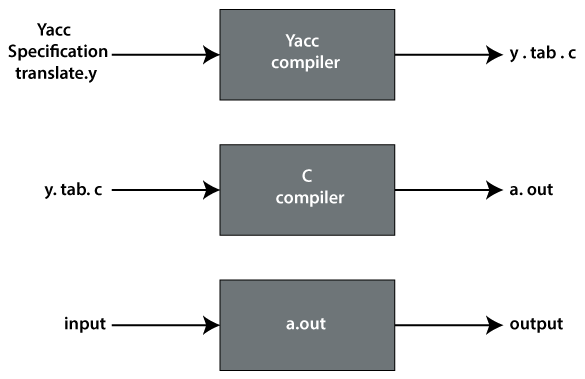
YACC is known as Yet Another Compiler Compiler. It is used to produce the source code of the syntactic analyzer of the language produced by LALR (1) grammar. The input of YACC is the rule or grammar, and the output is a C program. Stephen C. Johnson creates the first kind of YACC. If we have a file translate.y that consists of YACC specification, then the UNIX system command is:

YACC translate.y

This command converts the file translate.y into a C file y.tab.c. It represents an LALR parser prepared in C with some other user’s prepared C routines. By compiling y.tab.c along with the ly library, we will get the desired object program a.out that performs the operation defined by the original YACC program.

The construction of translation using YACC is illustrated in the figure below:
A YACC source program contains three parts:

  • Declarations

%%

  • Translation rules

%%

  • Supporting C rules

Declarations Part

This part of YACC has two sections; both are optional. The first section has ordinary C declarations, which is delimited by %{ and %}. Any temporary variable used by the second and third sections will be kept in this part. See the below code:

%{

#include <ctype.h>

%}

%token DIGIT

%%

line               :  expr  ‘\n’                { printf("%d\n", $1); }

                     ;

expr              :  expr   '+' term          { $$ = $1 + $3; }

                     |   term

                     ;

term              :  term '*' factor           { $$ = $1 * $3; }

                     |  factor

                     ;

factor            :  ‘(‘ expr ’)’                  { $$ = $2; }

                     |    DIGIT

                     ;

%%

yylex() {

int c;

c = getchar();

if (isdigit(c)) {

yylval = c-'0';

return DIGIT;

}

return c;

}

In the above code, the declaration part only contains the include statement.

#include <ctype.h>

Declaration of grammar tokens also comes in the declaration part.

%token DIGIT

This part defined the tokens that can be used in the later parts of a YACC specification. 

Translation Rule Part

After the first %% pair in the YACC specification part, we place the translation rules. Every rule has a grammar production and the associated semantic action.

A set of productions:

                         <head> => <body>1 | <body>2 | ..... | <body>n

would be written in YACC as

                            <head>    :      <body>1          {<semantic action>1}

                                            |      <body>2          {<semantic action>2}

                                                     .....

                                             |       <body>n         {<semantic action>n}

                                             ;

In a YACC production, an unquoted string of letters and digits that are not considered tokens is treated as non-terminals.

The semantic action of YACC is a set of C statements. In a semantic action, the symbol $$ considered to be an attribute value associated with the head's non-terminal. While $i considered as the value associated with the ith grammar production of the body.

If we have left only with associated production, the semantic action will be performed. The value of $$ is computed in terms of $i's by semantic action.

Supporting C–Rules

It is the last part of the YACC specification and should provide a lexical analyzer named yylex(). These produced tokens have the token's name and are associated with its attribute value. Whenever any token like DIGIT is returned, the returned token name should have been declared in the first part of the YACC specification.

The attribute value which is associated with a token will communicate to the parser through a variable called yylval. This variable is defined by a YACC.

Whenever YACC reports that there is a conflict in parsing-action, we should have to create and consult the file y.output to see why this conflict in the parsing-action has arisen and to see whether the conflict has been resolved smoothly or not.

Instructed YACC can reduce all parsing action conflict with the help of two rules that are mentioned below:

  • A reduce/reduce conflict can be removed by choosing the production which has conflict mentioned earlier in the YACC specification.
  • A shift/reduce conflict is reduced in favor of shift. A shift/reduce conflict that arises from the dangling-else ambiguity can be solved correctly using this rule.

Related Topics

Three-Address Code

Three-Address Code If there is at most one operator on the right side of the instruction, then the instruction will be the three-address code so that no arithmetic expressions are permitted....

2 minutes read.

CLR Parsing Compiler Design

CLR Parsing CLR parsing refers to the canonical lookahead. We will use the canonical collection of LR(1) items for the construction of the CLR(1) parsing table. Generally, CLR(1) parsing has more...

6 minutes read.

LR Parser Compiler Design

LR Parser LR parsing is a type of bottom-up parsing that is used to parse the large class of grammars. Here "L" stands for left-to-right scanning of the input "R" stands...

6 minutes read.

Symbol Table Compiler Design

Symbol Table It is an important data structure used by the compiler. It stores information about various entities such as object, class, variable names, functions name, interfaces, procedure, literals, string etc.  The...

3 minutes read.

Errors in Compiler Design

Introduction Errors in compiler design refer to mistakes or issues that arise during the process of execution of the program. A compiler is a program that translates source code written in...

4 minutes read.

Evolution of Programming Languages in Compiler Design

The Evolution of Programming Languages The first computer came in the 1940s and was programmed in a binary language that told the computer what operations are to be performed and in...

4 minutes read.

Boolean Expression in Compiler Design

Boolean Expression The translation of conditional statements such as if-else statements and while-do statements is associated with Boolean expression's translation. The main use of the Boolean expression is the following: Boolean expressions...

3 minutes read.

Syntax Analysis Compiler Design

Syntax Analysis This article will describe the parsing method used in the compiler. The grammatical rule of programming language can be constructed with the help of context-free grammars or BNF (Backus–Naur...

3 minutes read.

Phases of Compiler

Phases of Compiler The compilation process of a compiler goes through various phases. Each phase of the compiler takes the output from the previous as an input. Here we will see all...

2 minutes read.

Ambiguity Elimination Compiler Design

Ambiguity Elimination Ambiguity elimination makes the sentence clear and readable. A sentence is grammatically ambiguous if it can produce more than one parse tree for a particular grammar. In this article,...

3 minutes read.

LEX

LEX Lex is a tool/computer program that generates a Lexical analyzer. Lex is developed by Vern Paxson in C around 1987. Lex works together with the YACC parser generator. It allows...

3 minutes read.

Translation of Array References in Compiler Design

Translation of Array References We can access the elements of an array stored in consecutive blocks very easily and quickly. In a programming language like C and Java, the size of...

2 minutes read.

Basic Blocks and Flow Graphs in Compiler Design

Basic Blocks and Flow Graphs In this section, we are going to learn how to work with basic block and flow graphs in compiler design. Basic Block The basic block is a set...

3 minutes read.

Syntax-Directed Translation

Syntax-Directed Translation A context-free-grammar with some additional rules is known as a syntax-directed definition. In SDT, attributes are associated with grammar symbols and rules are associated with productions. The attributes can...

3 minutes read.

LR Parser in Compiler Design

LR Parser The most popular type of bottom-up parsing is LR(K) parsing. The LR() parser scans the input from left – to – right, which is the actual abbreviation of L...

2 minutes read.

Stack Allocation of Space

Stack Allocation of Space Almost all compilers for languages that use procedure, functions, or methods manage their run-time memory as a stack. Whenever a procedure is called, the local variable's space...

2 minutes read.

Compiler Design Tutorial

Our compiler design tutorial will provide all the information about compiler from basic to advanced level. This compiler tutorial will help the student for their semester as well as for...

3 minutes read.

LALR 1 Parsing | Compiler Design

LALR (1) Parsing The LALR parsing refers to the "lookahead LR" that has many lesser steps than typical parsers based on LR(1) items. For constructing the LALR(1) parsing table, the canonical...

6 minutes read.

Code Generation

Code Generation The last phase of the compiler is code generation. It is the compiler's back-end that makes multiple passes over the IR before generating the target program. The code generator's...

4 minutes read.

Data Flow Analysis in Compiler Design

Data Flow Analysis All the optimization techniques we have learned earlier depend on data flow analysis. DFA is a technique used to know about how the data is flowing in any...

3 minutes read.