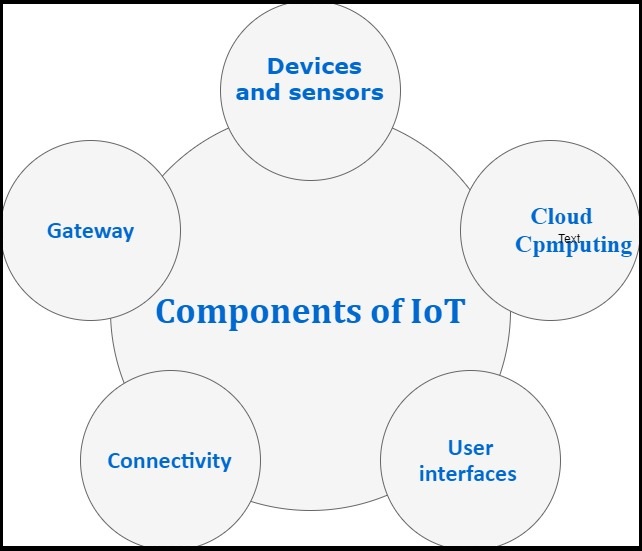
Components of IoT

There are the following components used in IoT:

  • Devices and sensors
  • Cloud Computing
  • User interface
  • Networking connection
  • Gateway
Components of IoT

Devices and sensors

Devices and sensors are the components of the connectivity layer. These smart sensors continuously collect data from the environment and transmit it to the next layer. For example, our phone is a device with multiple sensors such as GPS, camera, motion, etc.

The latest techniques in semiconductor technology enable intelligent micro-sensors to be produced for various applications.

There are some common sensors are as follows:

  • Temperature and thermostats sensors
  • Pressure sensors
  • Humidity / Moisture level
  • Light intensity detectors
  • Moisture sensors
  • Proximity detection
  • RFID tags

Cloud Computing

IoT systems send huge data from devices, and these data must be managed efficiently to generate meaningful results. IoT technology uses the cloud to store a large amount of data. It provides tools for collecting, processing, and storing data. The data is easily available and accessible remotely through the internet. It also provides a platform for analysis. The IoT cloud is an advanced network of high-performance servers for high-speed processing of large amounts of data.

User interface

User interfaces are the physical and visible part of the IoT system accessible to users. User interface design is more important in today's competitive market, as it often allows the user to choose a particular device or appliance. Users will be interested in buying new smart devices if it is effortless to use and compatible with current wireless standards.

Modern technology offers a lot of interactive design to facilitate complex tasks in simple touch screen controls. Multi-colored touch screens have replaced the hardware switches on our devices, and the trend is on the rise for almost all smart home devices.

Networking connection

Internet connectivity is required for communication. Internet connectivity provides an IP address to each device. Although fewer addresses are depending on the IP address.

But this IP address is no longer sufficient due to a large number of uses in devices. As a result, researchers find an alternative to the IP address system to represent each physical device.

Gateway

IoT Gateway manages bi-directional data traffic between different networks and protocols. Another function of the gateway is to translate different network protocols and to ensure the interoperability of connected devices and sensors.

The IoT gateway provides a certain level of security for the network and data transmitted with higher-order encryption techniques. It acts as a middle layer between the devices and the cloud that protects the system from malicious attacks and unauthorized access.

Gateways can be configured to pre-process collected data locally from thousands of sensors before forwarding them to the next step. In some cases, it would be necessary due to the compatibility of the TCP / IP protocol.


Related Topics

IoT Tutorial

IoT stands for the Internet of Things. The term "Things" refers to objects (home appliances and devices) that we use in our daily life. These objects are accessible or connected...

4 minutes read.

IoT Ecosystem

The following figure shows the seven-layer model of the IoT Ecosystem. The first layer represents the market or application domain that includes smart grid, connected home, smart health, or smart cities, etc.The second layer consists...

1 minute read.

Download and Install Arduino in Windows

Download and Install Arduino in Windows Step 1. Download  IDE from https://www.arduino.cc/en/Main/Software. Step 2. Scroll down the page and click on Windows app link, as shown in the following figure. Step 3. Click on the...

1 minute read.

IoT Protocols

IoT Protocols A protocol is a set of basic rules that allow electronic devices to communicate with each other. These instructions include the types of data that can be sent, the...

1 minute read.

Salesforce IoT Cloud

Salesforce IoT Cloud IoT Cloud is a platform from Salesforce. Salesforce is designed to store and process IoT data. It is powered by Thunder. Thunder is an event processing engine designed to capture, filter, and...

2 minutes read.

Detect darkness Using Arduino and LDR Sensor

Detect the darkness with the help of Arduino board and LDR Sensor In this project, Arduino and LDR Sensor turns on lights automatically, when an LDR sensor detects darkness. Requirements of hardware...

2 minutes read.

Arduino UNO Home Automation

Build a Bluetooth controlled Home Automation Setup Using Arduino UNO board and Relay module Do you want to automate your home? Have you ever wanted to control your home appliances by swipe the screen...

4 minutes read.

Internet of Things

The Internet of Things is a network of objects embedded with sensors, software, and other technologies for connecting and exchanging data with other devices and systems over the internet. These devices...

5 minutes read.

Arduino UNO Distance Project

Ultrasonic Sensor HC-SR04 and Arduino to distance calculation using Processing App: Let's build an IoT project using Ultrasonic HC-SR04 Sensor and Arduino UNO to calculate the distance between the Ultra Sonic HC-SR04 device and...

2 minutes read.

Skills required for an IoT Developer

"Internet of Things" is about communication between software and devices. An IoT development team should be essentially large, and developers are divided into different areas according to their respective work. Some of these...

1 minute read.

3D Printing

3D printing is making 3D solid objects from a digital file, achieved using additive processes. In this process, an object is created by laying down successive layers of the material...

4 minutes read.

Major Boards of IoT

Major Boards of IoT Arduino:  Arduino UNO is the popular open-source electronics platform based on easy-to-use software and hardware. It is intended for artists, hobbyists, designers, and anyone interested in building interactive objects. It...

2 minutes read.

Challenges of IoT

Challenges of IoT There are two categories of challenges to overcome for the IoT organization to grow. It is accepted by all the technologies not only for IoT. Two significant challenges in IoT: Technological...

3 minutes read.

5G

The next generation of mobile networks is a new global wireless standard after 1G, 2G, 3G, and 4G networks. It enables a new network to connect virtually everyone, including machines,...

5 minutes read.

IoT Technologies

The IoT is based on three main technologies: Hardware (includes chips and sensors)Communication (includes wireless network)  Software (includes data storage, analytics, front-end applications) The reason the Internet of Things is emerging so rapidly today...

1 minute read.

IoT-ThingWorx

IoT-ThingWorx The ThingWorx is an IoT platform that helps commercial corporations assess and release the value of IoT. It promises the tools and technology necessary to developed. It implements a robust...

2 minutes read.

Components of IoT

There are the following components used in IoT: Devices and sensorsCloud ComputingUser interfaceNetworking connectionGateway Devices and sensors Devices and sensors are the components of the connectivity layer. These smart sensors continuously collect data from the...

2 minutes read.

Advantages and Disadvantages of IoT

Advantages of IoT Applications Security: You can control your home through the mobile phones. It provides personal protection. Stay connected: You can connect virtually to your family. Efficient usage of electricity:  You can use...

2 minutes read.

IoT Software

The IoT software addresses significant areas of networking and action through platforms, integrated systems, associated systems, and middleware. These applications are responsible for data collection, device integration, real-time analysis, and process extension in the...

1 minute read.

Network layer Protocols

Network layer Encapsulation ProtocolsNetwork Layer Routing Protocols 1. Network layer Encapsulation Protocols a) 6LoWPAN 6LoWPAN stands for IPv6 Over Low-Power Wireless Personal Area Network. It is mostly used standard in this category. It...

2 minutes read.