
IoT Architecture

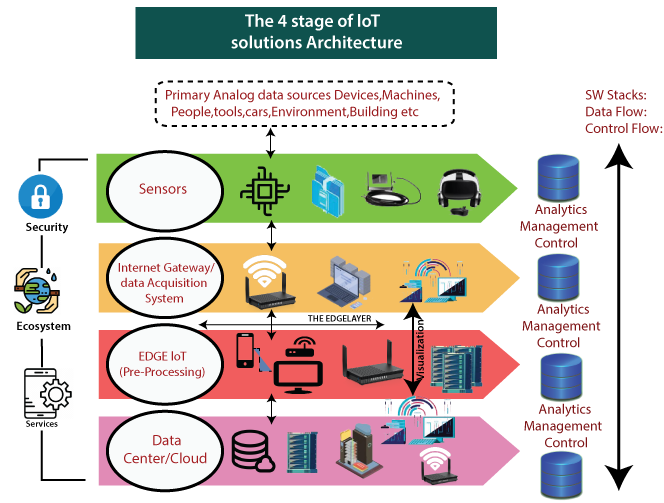
Our approach to the IoT architecture is reflected in the IoT architecture diagram that presents the diagram of an IoT system and explains how it is connected to store, collect, and process data.
IoT Architecture
IoT Architecture

Sensing/ActuatingA "thing" is an object equipped with sensors that collect data. The data transferred through the network and the actuators allow things to perform. For example, turn the light on or off, open or close the door, increase or decrease the speed of motor rotation, etc. 

Data Acquisition Systems: Although this stage in the IoT architecture still means working near sensors and actuators, Internet getaways and data acquisition systems also appear here. Specifically, the latest sensor network connections and general output, while Internet getaways run through Wi-Fi, wired LANs and perform additional processing.                          

The importance of this stage is to process a large amount of information collected in the previous stage and reduce it to the optimum size for further analysis. Also, the necessary conversion in terms of time and structure occurs here.

Edge Analytics: During this phase, between the stages of the IoT architecture, the prepared data is transferred to the world of IT. In particular, Edge IT systems perform improved analysis and preprocessing here. For example, it relates to machine learning and visualization technologies. At the same time, additional processing can take place here before the data center entry phase.

Data Center/ Cloud (Analysis, management, and storage of data): The main processes of the last stage of the IoT architecture take place in the data center or in the cloud. Precisely, it allows in-depth processing, as well as a follow-up review for comments. Here, the skills of IT professionals and occupational technology are needed. In other words, the phase already includes the highest-level analytical skills, both in the digital and human world. As a result, data from other sources can be included here to ensure an in-depth analysis.


Related Topics

Detect darkness Using Arduino and LDR Sensor

Detect the darkness with the help of Arduino board and LDR Sensor In this project, Arduino and LDR Sensor turns on lights automatically, when an LDR sensor detects darkness. Requirements of hardware...

2 minutes read.

5G

The next generation of mobile networks is a new global wireless standard after 1G, 2G, 3G, and 4G networks. It enables a new network to connect virtually everyone, including machines,...

5 minutes read.

IoT GE Predix

The GE Predix stands for the General Electric Predix. GE Predix is a software platform that collects data from industrial instruments. It provides a cloud-based PaaS (platform as a service)...

1 minute read.

Download and Install Arduino in Windows

Download and Install Arduino in Windows Step 1. Download  IDE from https://www.arduino.cc/en/Main/Software. Step 2. Scroll down the page and click on Windows app link, as shown in the following figure. Step 3. Click on the...

1 minute read.

Components of IoT

There are the following components used in IoT: Devices and sensorsCloud ComputingUser interfaceNetworking connectionGateway Devices and sensors Devices and sensors are the components of the connectivity layer. These smart sensors continuously collect data from the...

2 minutes read.

IoT Architecture

Our approach to the IoT architecture is reflected in the IoT architecture diagram that presents the diagram of an IoT system and explains how it is connected to store, collect,...

2 minutes read.

Internet of Things

The Internet of Things is a network of objects embedded with sensors, software, and other technologies for connecting and exchanging data with other devices and systems over the internet. These devices...

5 minutes read.

Salesforce IoT Cloud

Salesforce IoT Cloud IoT Cloud is a platform from Salesforce. Salesforce is designed to store and process IoT data. It is powered by Thunder. Thunder is an event processing engine designed to capture, filter, and...

2 minutes read.

Session Layer Protocols

1) MQTT MQTT stands for Message Queue Telemetry Transport. It was introduced by IBM in 1999 and standardized by OASIS in 2013. It is used for remote monitoring in IoT. Its...

2 minutes read.

Eclipse IoT

Eclipse IoT The two technologies IoT and M2M (Machine to Machine) are becoming trendy in the IT industry. The ability to connect sensors, actuators, and a wide range of devices open up a...

2 minutes read.

IoT - Platform

IoT Platform: As in IoT, all IoT devices are connected to other IoT devices and applications to transmit and receive information through protocols. There is a difference between the IoT...

2 minutes read.

IoT Tutorial

IoT stands for the Internet of Things. The term "Things" refers to objects (home appliances and devices) that we use in our daily life. These objects are accessible or connected...

4 minutes read.

Arduino UNO Radar Project

Arduino Radar Project In this project, we will explain how to create a simple radar system using Arduino and Processing IDE. The Arduino radar project is implemented using Processing Applications. Radar is a long-range object detection...

9 minutes read.

Advantages and Disadvantages of IoT

Advantages of IoT Applications Security: You can control your home through the mobile phones. It provides personal protection. Stay connected: You can connect virtually to your family. Efficient usage of electricity:  You can use...

2 minutes read.

IoT Ecosystem

The following figure shows the seven-layer model of the IoT Ecosystem. The first layer represents the market or application domain that includes smart grid, connected home, smart health, or smart cities, etc.The second layer consists...

1 minute read.

IoT Technologies

The IoT is based on three main technologies: Hardware (includes chips and sensors)Communication (includes wireless network)  Software (includes data storage, analytics, front-end applications) The reason the Internet of Things is emerging so rapidly today...

1 minute read.

IoT Software

The IoT software addresses significant areas of networking and action through platforms, integrated systems, associated systems, and middleware. These applications are responsible for data collection, device integration, real-time analysis, and process extension in the...

1 minute read.

Arduino UNO Bluetooth LED Controls

How to Build a Bluetooth controlled LED light Setup Using Arduino UNO board: Let's build an IoT project using Arduino UNO and the Bluetooth module HC-05 to control an LED. In this project,...

2 minutes read.

Arduino UNO Distance Project

Ultrasonic Sensor HC-SR04 and Arduino to distance calculation using Processing App: Let's build an IoT project using Ultrasonic HC-SR04 Sensor and Arduino UNO to calculate the distance between the Ultra Sonic HC-SR04 device and...

2 minutes read.

Contiki OS

Contiki OS Contiki is an open-source operating system (OS) that works on small, low-power microcontrollers. It allows the development of applications. The application allows efficient use of hardware while providing standardized low-power wireless communication...

2 minutes read.