×

React Map

React Map

The map() is the standard function of JavaScript, which can be called at any array. The map() method is used for traversing and displaying a list of the similar objects of a component. The map() method mainly creates a new array simply by calling the provided function on every element within the calling array.

The map() function is the data collection type in which data stores in the form of pairs. The map() function contains a unique key. The value which gets stored in the map() function must be mapped with the key. You cannot store the duplicate pair in the map() function. It happens because every stored key is unique. We mainly used it for the fast searching of data.

Example:

In the following example, there is a map() function, which is taking an array of numbers and half their values. We assign the new array, which is returned by map() function to the variable value and log it.

var numbers = [1, 2, 3, 4, 5]; 
const value = numbers.map((number)=>{ 
return (number / 2); 
}); 
console.log(value);  

In React, the map() function is used for:

Traversing the List element

import React from 'react'; 
class App extends React.Component{
constructor(props){
super(props);
this.state={
users:['Arun','Shivam','Raman','Sagar','Anuj','Akash','Tanuj']
}
}
render(){ 
return(
    {this.state.users.map((user,index)=>(
  • {user}
  • ))}
) } } export default App;

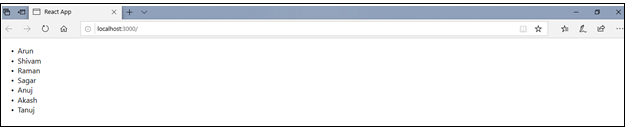
Output:

Traversing the List element

As we can see above code is working fine, but when you inspect (ctrl + shift + I) this output in your browser and open the console section then you will see a warning as shown in the following image:
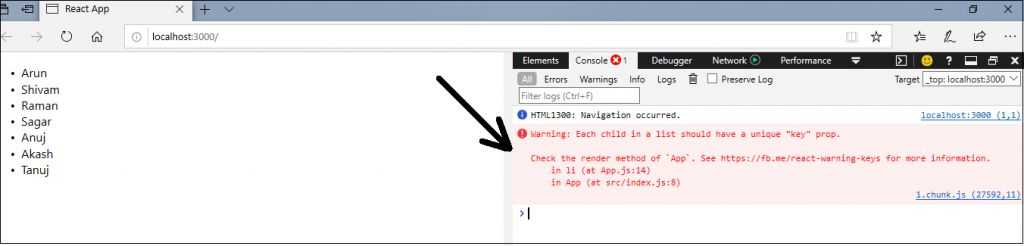
As we can see above code is working fine

This warning occurs because, in the previous example, we have not defined any key attribute and react asks for a key attribute by which the item gets uniquely identified.

So, if we re-write the above code and assign a key by using the index value, then the warning will be resolved. Now, we are adding the key attribute in the above code.

App.js

import React from 'react'; 
class App extends React.Component{
constructor(props){
super(props);
this.state={
users:['Arun','Shivam','Raman','Sagar','Anuj','Akash','Tanuj']
}
}
render(){
return(
    {this.state.users.map((user,index)=>(
  • {user}
  • //Add the key attribute ))}
) } } export default App;

After executing the above code snippet, we will get the same output, but when we inspect it and open the console section, then we will not get any warning. You can see it in the following image:

open the console section

So, it is always recommended to use the key attribute to get rid of these unnecessary warnings.


Related Topics

React Error Boundaries

React Error Boundaries In the past, the errors of JavaScript within the components were used to corrupt the internal state of react and cause it to emit the cryptic errors on the next...

3 minutes read.

React Constructors

What is constructor? The constructor is a method that is used for initializing the state of the object in the class. It calls automatically during the creation of an object in...

4 minutes read.

React Native vs ReactJS

Difference between React Native and ReactJS React Native React Native is also an open-source JavaScript framework that is used for the development of a mobile application for iOS Android and Windows. It...

6 minutes read.

React Refs

React Refs The word ‘Refs’ is an abbreviation of ‘References’ in React. It is as similar as Keys in React. Refs are a function in React which is used for accessing the DOM element and...

7 minutes read.

React Components

React Components Former, the developers used to write more than thousands of lines of code to develop a single-page application. These applications follow the structure of traditional DOM, and it was very challenging to make...

2 minutes read.

React Conditional Rendering

React Conditional Rendering In React, the working of the conditional rendering is similar to the condition works in JavaScript. We use JavaScript operators for creating elements that represent the current state, and then the React...

3 minutes read.

How to use React Context

React Context React Context is used to pass the data through the component tree without passing the props down manually at the every level. In React Application, the data is passed in a top-down approach...

4 minutes read.

React Flux

React Flux Introduction It is an application architecture that is internally used by Facebook to build the client-web application with react. It is useful when the project includes dynamic data, and...

2 minutes read.

React Fragments

React Fragments The fragments in React are introduced from the 16.2 and above versions. Fragments allow you to group a list of child elements without adding any extra node in the DOM. In React,...

2 minutes read.

React Table

React Table The table represents an arrangement that organizes the information in the form of rows and columns. The table is mainly used for storing and displaying the data within a structured format. Features of...

2 minutes read.

Difference between Controlled and Uncontrolled component in ReactJs

Controlled Component In the controlled component, the input of the form element is handled by the component rather than the DOM. Controlled components have the functions that govern the data, which...

2 minutes read.

React Router

What is React Router? Routing is a process by which a user can direct to different pages based on their actions and requests. ReactJS router is generally used to develop single...

10 minutes read.

React JSX

React JSX As we know, all of the React components include a render function. The Render function specifies the HTML output of a React component. JSX is an acronym of JavaScript extension that...

3 minutes read.

Difference Between React Flux and MVC

React Flux vs MVC MVC MVC is an acronym of 'Model View Controller.' It is the architectural pattern that is used to develop the user interface. It has three different logical components: The...

2 minutes read.

ReactJS Versions

ReactJS Versions The Complete set of release history of ReactJS is elaborated as follows. The complete set of full documentation of recent releases is on GitHub. S.noVersionRelease DateExplanation1.0.3.029/05/2013Initially released for public.2.0.4.029/07/2013Supporting comments...

4 minutes read.

Features of ReactJS

ReactJS Features As of now, within the developers, ReactJS is gaining much popularity as the best JavaScript framework. It is crucial for the front-end ecosystem. There are some of the crucial features of ReactJS that are...

2 minutes read.

Pros and Cons of ReactJS

Pros and Cons of ReactJS There are various advantages, and disadvantages of ReactJS are as follows: Benefits of ReactJS 1. Easy to Learn and Use: ReactJS is very easy to use and learn. It has a good...

3 minutes read.

React Props Validation

React Props Validation As we know, props are a suitable mechanism for passing the read-only attributes to react components. The props are required to be correctly used in the component. If it is...

5 minutes read.

Difference Between State and Props in React

Comparison between State and Props State The state is an updatable structure which is used for containing data or information about the component. The state in a component can be changed over...

2 minutes read.

React Redux

How to Use Redux with React Hooks It is an open-source library of JavaScript which is used for managing the application state. React uses the Redux to build the user interface....

5 minutes read.