
Session Layer Protocols

1) MQTT

MQTT stands for Message Queue Telemetry Transport. It was introduced by IBM in 1999 and standardized by OASIS in 2013. It is used for remote monitoring in IoT. Its main challenge is to collect statistics of many devices and the delivery of its infrastructure. MQTT connects devices and networks with packages and middle-ware. MQTT protocols work over TCP to provide reliable and straightforward information flows.
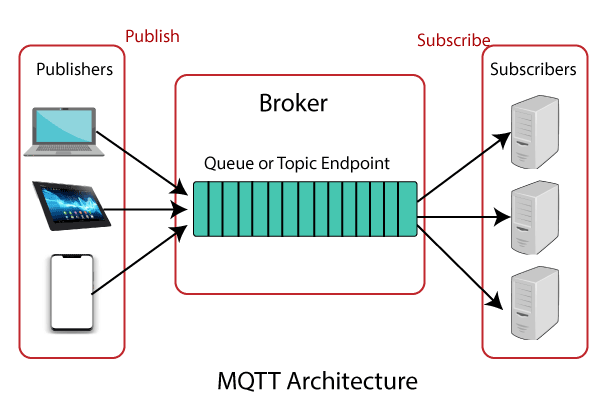
Message Queue Telemetry Transport

It follows the publish-subscribe architecture. The architecture has three main components: publisher, subscriber, and a broker.

The publisher collects the information and transmits the facts to subscribers through a broker. The broker guarantees security by controlling the movement of permission from publishers and subscribers. 

2) Secure MQTT (SMQTT)

SMQTT is the extended form of MQTT. SMQTT stands for Secure MQTT. It uses encryption based on lightweight attribute-based encryption. The main advantage of attribute-based encryption is, it uses the broadcast encryption function. In this function, the message is encrypted and transmitted to several nodes that are quite common in IoT applications.

In general, the algorithm consists of four steps: configuration, encryption, publishing, and decryption.

In the configuration phase, subscribers and publishers register with the broker and obtain a master secret key based on the key generation algorithm chosen by the developer. In SMQTT, key generation and encryption algorithms are not standardized. 

3) AMQP

Advanced Message Queuing Protocol (AMQP) is another session-layer protocol designed for the financial industry. It runs on TCP and provides a publishing/subscription architecture similar to that of MQTT. The difference is that the broker is broken into two main components: exchange and queues. The exchange component receives the publisher’s messages and distributes that massages in queues according to predefined roles and conditions.
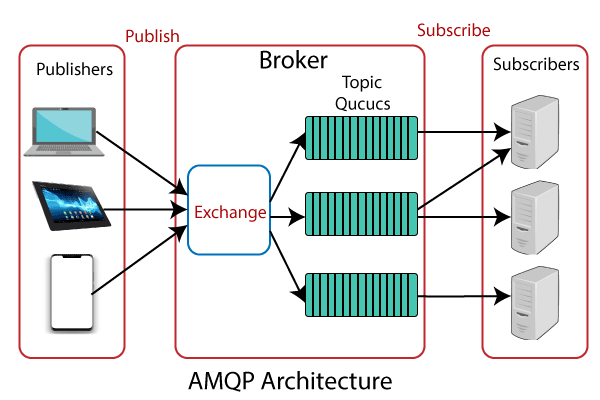
Advanced Message Queuing Protocol

4) Constrained Application Protocol (CoAP)

CoAP is an Internet utility protocol for restricted devices. It is designed to allow single and small devices to join the IoT through low bandwidth restricted networks. This protocol is mainly used for Machine-to-Machine (M2M) communication and is specially designed for IoT systems based on HTTP protocols.
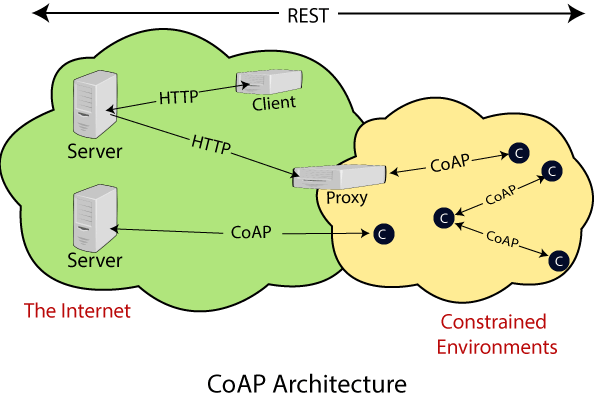
Constrained Application Protocol

CoAP uses the UDP protocol for a lightweight implementation. It also uses a silent architecture, which is similar to the HTTP protocol. Use DTLS (Datagram Transport Layer Security) for changing statistics in the slippery layer.


Related Topics

Session Layer Protocols

1) MQTT MQTT stands for Message Queue Telemetry Transport. It was introduced by IBM in 1999 and standardized by OASIS in 2013. It is used for remote monitoring in IoT. Its...

2 minutes read.

Major Boards of IoT

Major Boards of IoT Arduino:  Arduino UNO is the popular open-source electronics platform based on easy-to-use software and hardware. It is intended for artists, hobbyists, designers, and anyone interested in building interactive objects. It...

2 minutes read.

Network layer Protocols

Network layer Encapsulation ProtocolsNetwork Layer Routing Protocols 1. Network layer Encapsulation Protocols a) 6LoWPAN 6LoWPAN stands for IPv6 Over Low-Power Wireless Personal Area Network. It is mostly used standard in this category. It...

2 minutes read.

Detect darkness Using Arduino and LDR Sensor

Detect the darkness with the help of Arduino board and LDR Sensor In this project, Arduino and LDR Sensor turns on lights automatically, when an LDR sensor detects darkness. Requirements of hardware...

2 minutes read.

Challenges of IoT

Challenges of IoT There are two categories of challenges to overcome for the IoT organization to grow. It is accepted by all the technologies not only for IoT. Two significant challenges in IoT: Technological...

3 minutes read.

IoT - Platform

IoT Platform: As in IoT, all IoT devices are connected to other IoT devices and applications to transmit and receive information through protocols. There is a difference between the IoT...

2 minutes read.

Contiki OS

Contiki OS Contiki is an open-source operating system (OS) that works on small, low-power microcontrollers. It allows the development of applications. The application allows efficient use of hardware while providing standardized low-power wireless communication...

2 minutes read.

IoT GE Predix

The GE Predix stands for the General Electric Predix. GE Predix is a software platform that collects data from industrial instruments. It provides a cloud-based PaaS (platform as a service)...

1 minute read.

Salesforce IoT Cloud

Salesforce IoT Cloud IoT Cloud is a platform from Salesforce. Salesforce is designed to store and process IoT data. It is powered by Thunder. Thunder is an event processing engine designed to capture, filter, and...

2 minutes read.

Eclipse IoT

Eclipse IoT The two technologies IoT and M2M (Machine to Machine) are becoming trendy in the IT industry. The ability to connect sensors, actuators, and a wide range of devices open up a...

2 minutes read.

IoT Protocols

IoT Protocols A protocol is a set of basic rules that allow electronic devices to communicate with each other. These instructions include the types of data that can be sent, the...

1 minute read.

What is an IoT Device?

A device in which a sensor is connected and able to transfer data from one device to another over the internet is called an IoT device. IoT devices consist of software, wireless sensors, actuators,...

1 minute read.

Arduino UNO Radar Project

Arduino Radar Project In this project, we will explain how to create a simple radar system using Arduino and Processing IDE. The Arduino radar project is implemented using Processing Applications. Radar is a long-range object detection...

9 minutes read.

IoT Technologies

The IoT is based on three main technologies: Hardware (includes chips and sensors)Communication (includes wireless network)  Software (includes data storage, analytics, front-end applications) The reason the Internet of Things is emerging so rapidly today...

1 minute read.

5G

The next generation of mobile networks is a new global wireless standard after 1G, 2G, 3G, and 4G networks. It enables a new network to connect virtually everyone, including machines,...

5 minutes read.

3D Printing

3D printing is making 3D solid objects from a digital file, achieved using additive processes. In this process, an object is created by laying down successive layers of the material...

4 minutes read.

IoT Ecosystem

The following figure shows the seven-layer model of the IoT Ecosystem. The first layer represents the market or application domain that includes smart grid, connected home, smart health, or smart cities, etc.The second layer consists...

1 minute read.

Arduino UNO Home Automation

Build a Bluetooth controlled Home Automation Setup Using Arduino UNO board and Relay module Do you want to automate your home? Have you ever wanted to control your home appliances by swipe the screen...

4 minutes read.

Applications of IoT

Smart Home: A smart home encapsulates the connectivity inside our homes. It includes home appliances, smoke detectors, windows, light bulbs, door locks, etc. Smart City: A Smart City is a technically advanced...

2 minutes read.

IoT Tutorial

IoT stands for the Internet of Things. The term "Things" refers to objects (home appliances and devices) that we use in our daily life. These objects are accessible or connected...

4 minutes read.