×

Data Binding in Angular 8

What is Binding?

Binding is the process which generates the connection between the application UI and the data which comes from the business logic. In Angular, it is called the automatic synchronization of the data and the view.

Data Binding in Angular 8

Data binding is the most important and essential features in any software development language. It is a powerful feature of Angular. Angular Data binding is used for communication. It allows us to define the connection between the component and view. So, we can say that data binding is passed from component to view. It makes it easy to identify interactive applications without worrying about pushing and pulling the data. It is mainly used to communicate between our Typescript code and another component.

It has mainly two parts:

HTML Template

It contains view for the component (HTML elements: input, select, button, etc.)

Component Class

It contains logic for a component like classes, variables, functions, API calls, etc. The interaction between the HTML template and component class can be done through data binding.

In simple words,Data Binding is communication between typescript code of our component and our template which user sees.”

 Data binding can be one-way data binding or two-way data binding.
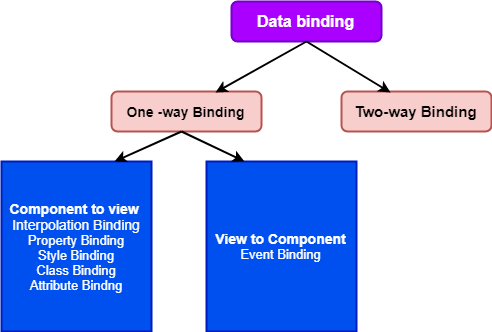
Data binding in Angular 8

One way data-binding:

It is a simple one-way communication where HTML template is changed when we make changes in typescript code. The value of the model is used in the view (HTML page), but we can't update the model from the view in one-way data binding.  Property binding,  Event binding, and String interpolation are an example of one-way data binding.
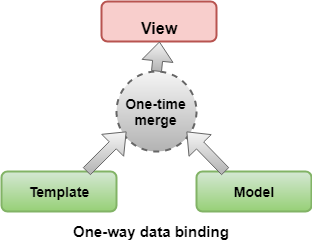
one way Data Binding in Angular 8

Two-way data binding

In two-way data binding, automatic synchronization of data happens between the model and the view. Here, changes are reflected in both components. When we make changes in the model from the view, and when we make changes in view, it will be reflected in the model.

This will happens immediately and automatically, ensures that the HTML template and the Typescript code are updated at all times.
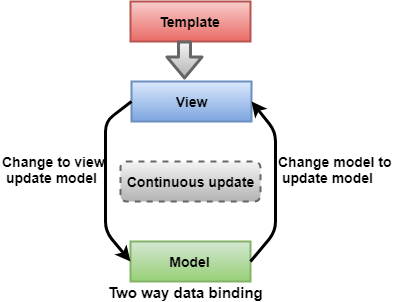
two way Data Binding in Angular 8

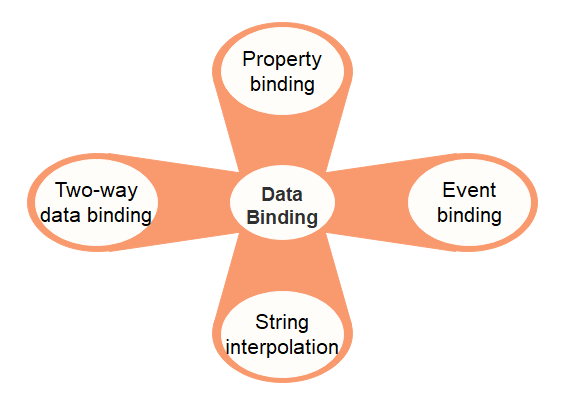
Types of Data Binding:

  • String Interpolation
  • Property binding
  • Event Binding
  • Two Way Data Binding
Types of Data Binding in Angular 8
Component of Data Binding

String Interpolation

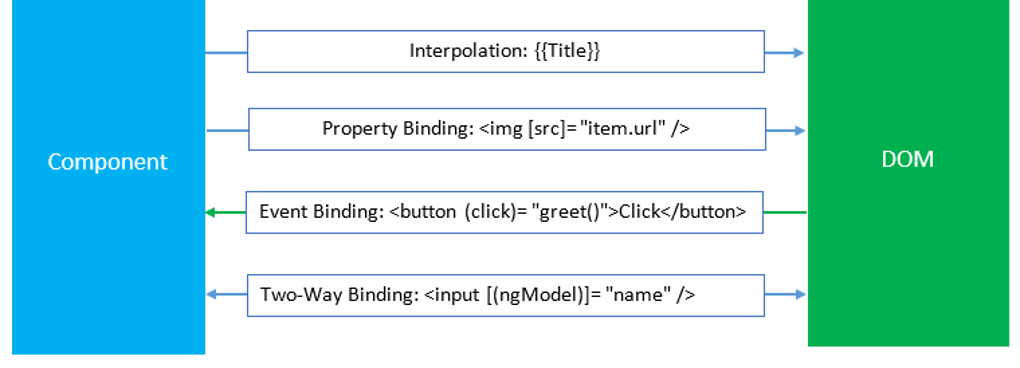
String Interpolation is a one-way data-binding technique which is used to output the data from a TypeScript code to HTML template (view).

It uses the template impression in double curly braces to show the data from the component to the view.

For example:

{{data}}

String interpolation sums the value of a property from the component.

Syntax:

  • Name: {{user.name}}
  • Email: {{user. Email}}
  • Property Binding

    Property binding is a technique, which will help to bind values to the properties of HTML elememts. It is also a one-way data binding approach.

    In property binding, we bind a characteristic of a DOM element in a field which defined property in our component Typescript code.

    Property binding helps us to bind the values to the target property of the element property surrounded within the square brackets.

    For example:

    Syntax:

    Event binding

    Event binding is used to hold the events lifted from the DOM such as button click, mouse move, etc. in Angular 8. When the DOM event happens (e.g., Click, change, key up), it calls the specified method in the component. In the following example, the cookbacon() method in the component is called when the button is clicked:

    For example:

    <button (click)=”cookBacon()”>

    Two-way Data Binding

    In one-way data binding, any changing in the template (view) was not considered in the component Typescript code. To solve this problem, Angular produces two-way data binding.

    The two-way binding has a vital feature to update data from component to view and view to the element.

    In two way data binding, property binding and event binding are combined. For two-way data binding, we have to enable the ngModel directive.

    Syntax:

    [(ngModel)]=”[property of our component]”

    Two-way Data Binding

    Related Topics

    Difference between Node.js and ASP.net

    Introduction to Node.js V8 (the JavaScript engine operating inside Google Chrome) is packaged with certain libraries and is mostly used for input & output, which includes creating data and managing connection...

    4 minutes read.

    Angular 8 Components

    Angular is used for building mobile and desktop web applications. The component is the basic building block of Angular. It has a selector, template, style, and other properties, and it...

    4 minutes read.

    Angular 8 Unit Testing

    What is unit testing? Unit testing is a type of software testing where individual components of the software are tested. It is done during the development of any application. A unit may be...

    6 minutes read.

    Node.js async.queue() Method

    Node.js async.queue() Method What is Async module? In Node.js, we have an async module that has a lot of functionality, but the main use case of this module is to do multiple...

    3 minutes read.

    Angular 8 ngIf Directive

    ngIf Directive is the part of structural directives.The NgIf is the most straightforward structural Directive and comfortable to understand. The ngIf Directives is used to add and remove HTML elements according to...

    2 minutes read.

    Angular 8 Architecture

    Architecture of Angular 8 Angular 8 is a platform and framework which is used to create clients applications in HTML and Typescript. Angular 8 is written in Typescript. Typescript is a...

    5 minutes read.

    Event Binding in Angular 8

    Event binding in Angular 8 Event binding is a data-binding from an element to a component. User actions such as keystrokes, mouse movement, clicks, and touches can be bound to the component property...

    1 minute read.

    Deployment of an Angular 8 app

    Deploying an Angular 8 app To implement our application, we have to compile it and then host the JavaScript, CSS, and HTML on a web server. Build an Angular application which is very portable...

    4 minutes read.

    Angular 8 Directives

    Angular 8 Directives: Directives are instructions in the DOM (Document Object Model). It specifies how to place our business logic in Angular. The directive is markers on a DOM element...

    3 minutes read.

    Scalability and Validation Forms in Angular 8

    Form Validation Validation is an essential part of managing any set of forms. If we are checking for required fields or querying an external API for a username. Angular 8 provides a set of...

    1 minute read.

    String Interpolation in Angular 8

    String Interpolation in Angular 8 String interpolation is a one-way data-binding technique which is used to output the data from a typescript code to HTML template. It uses the template expression. It uses the...

    2 minutes read.

    Dependency Injection in Angular 8

    Dependency injection (DI), is an essential application design pattern. Angular 8 has its own DI framework, which used in the design of Angular application to increase efficiency and portability. Dependencies are the services that...

    7 minutes read.

    Angular 8 Observables

    Observables provide support for passing messages between publisher and subscription in our application. The observables can deliver the multiple values of any type like literal, messages, depending on the content. It is an...

    6 minutes read.

    Angular 8 Forms

    Angular forms are used to handle the user's input. We use Angular form in our application to authorize users to log in, to update profile, to enter information, and to perform many other...

    3 minutes read.

    Routing in Angular 8

    Routing Angular Router is a powerful JavaScript router is built and maintained by the Angular core team that can install from the package @angular/router. Routing provides a complete routing library with the possibility of multiple...

    4 minutes read.

    $timeout service in AngularJS

    The discipline of web development is expanding quickly. A technology that is released today will inevitably become obsolete in a few months. The webpages were static in the past and...

    4 minutes read.

    Dynamic components in Angular 8

    Dynamic components in Angular 8 The dynamic component is one of the versatile and core concept introduced in Angular, Component template is not fixed. An application needs to load new elements...

    4 minutes read.

    Express.js app.get() Request Function

    Express.js Express is a flexible online application framework for Node.js that offers a strong set of functionality for both web and mobile applications. While preserving the familiar and adored Node.js features,...

    4 minutes read.

    Advantages | Disadvantages of Angular 8

    Advantages of Angular 8 There are some Advantages of angular 8 which are given below: It offers clean code developmentHigher PerformanceAn angular framework can take care of routing, which...

    1 minute read.

    Two-way Data Binding in Angular 8

    Two-way Data Binding in Angular 8 Two-way data binding is a synchronization between the model and the view. We can use the ngModel directive in two-way data binding. Custom two-way data binding is useful...

    2 minutes read.