
Cloud Computing Infrastructure

Cloud Computing Infrastructure

Cloud infrastructure contains storage devices, servers, networks, cloud management software, deployment software, and platform virtualization.
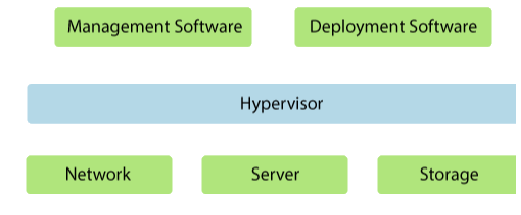
Cloud Computing Infrastructure

Components of Cloud Infrastructure

The components of cloud infrastructure are:

  1. Management software
  2. Deployment software
  3. Hypervisor
  4. Network
  5. Server
  6. Storage

Management Software: - Management software supports to construct and maintain the infrastructure.

Deployment Software: - Deployment software is used for deploying and merging the application on the cloud.

Hypervisor: - Hypervisor is also known as a virtual machine monitor. Hypervisor is software which acts like a virtual machine manager. It permits to share the single physical instance of cloud resources between various tenants.

There are two types of hypervisor:

  1. Native hypervisor
  2. Hosted hypervisor

         Network: - Network is the main component of cloud technology. It permits customers to connect to the cloud through the internet. It is possible to deliver a network as a utility via the internet, which means the user can customize the network route and the protocol.

Server: - The server is that component of cloud infrastructure which supports to compute the resource sharing and provides services like monitoring the resources, resource allocation, and de-allocation, providing security etc.

 Storage: - There are various copies of data that are kept stored in the cloud so that if in any case, any resource fails, then the data can be retrieved from another one. So, storage is another important component of cloud infrastructure.

Infrastructural Constraints

The infrastructural constraints are:

  1. Transparency
  2. Scalability
  3. Intelligent monitoring
  4. Security

Transparency: - Virtualization provides the facility of resource sharing in cloud environment. But in this, it is not possible to fulfill the demand with single resource, that’s why transparency in resources, load balancing and application are needed so that scaling is done efficiently when required.

Scalability: - Scaling up an application delivery solution is not an easy task like scaling up an application because it consists configuration overhead or even re-architecting the network. So, the application delivery solution is required to be scalable that will need the virtual infrastructure so that resource can be provisioned and de-provisioned in an easy way.

Intelligent Monitoring: - Application solution delivery will need to be capable of intelligent monitoring to achieve transparency and scalability.

Security:-The cloud's super data center should be safely architecture. There is also a need to protect the control node, an entry point in the mega data center.


Related Topics

Cloud Service Models

There are various types of cloud service model Software as a service (SaaS)Infrastructure as a service (IaaS)Platform as a service (PaaS)Identity as a service (IDaaS)Network as a service (NaaS) Let’s discuss each service model in detail. Software-as-a-service (SaaS):- SaaS is...

2 minutes read.

Identity as a Service

Identity as a Service (IDaaS) Identity as a service provides management of employee, client, or user’s identification-related information as a digital entity. It reduces the problem of remembering every different username and password combination...

2 minutes read.

Grid Computing vs Cloud Computing

What is Grid Computing? Grid computing is a distributed structure of a large number of computers connected to solve a complicated problem. In grid computing, servers and computers run independently and are loosely...

4 minutes read.

Introduction to Ms Azure

Cloud Computing The phrase "cloud computing" refers to the storage and retrieval of data over the internet. You get data from a remote server when you use cloud computing. It does...

7 minutes read.

Cloud Computing Management

Cloud providers are responsible for managing resources and their quality. Management of resources consists of several aspects of cloud computing such as load balancing performance, backups, deployment, capacity, etc. the management is vital to...

3 minutes read.

Platform as a Service

Platform as a Service (PaaS) Platform as a service (PaaS) is a programming platform for developer which is created for the programmer to develop, test, run and manage the applications. In PaaS...

2 minutes read.

Cloud Computing Application

The applications of cloud computing are in almost every field like in business, entertainment, data storage, management, education, and art, etc. Let’s discuss the most widely used cloud computing applications in detail: Business applications:...

2 minutes read.

Future of Cloud Computing

Future of Cloud Computing Cloud computing and cloud storage platforms have been discussed a lot in recent years, such as Amazon Web Service and google cloud. Various newcomers are also added in this space,...

3 minutes read.

Cloud Computing Technologies

Cloud Computing Technologies  Technologies used in cloud computing are: Grid ComputingService-Oriented Architecture (SOA)VirtualizationUtility Computing Grid Computing: - Grid computing is a distributed structure of large number of computers connected to solve a complicated problem. In grid computing, servers...

6 minutes read.

Hardware and Software virtualization

Hardware Virtualization Hardware virtualization is a type of virtualization; it is the abstraction of computing resources from the software that uses cloud resources. In this embedding virtual machine software into the servers hardware component....

3 minutes read.

History of Cloud Computing

1950:- In the 50s, mainframe computers were huge and occupied more space like an entire room. Due to the cost of buying and maintaining mainframes, organizations couldn’t afford to purchase one for each user....

3 minutes read.

Microsoft Azure Vocabulary

Cloud is a symbol, metaphor, and abstraction between your business and local computing infrastructure. While, there is globally distributed data centers, which will be owned by the firm and provided...

3 minutes read.

Storage Virtualization

Storage virtualization is the merging of physical storage from multiple storage devices so that it appears like a single storage device. This procedure consists of abstracting and covering the internal functions of a storage...

2 minutes read.

What is Virtualization?

Virtualization in Cloud Computing Virtualization is a technique, which permits to share single physical instance of an application or resources among various organizations. Virtualization is the designing of a virtual variant of something,...

2 minutes read.

Cloud Deployment Models

Cloud Deployment Model Because it's a virtual computing environment, there are various ways to deploy it, depending on the amount of data you want to store and who has access. Various Types...

7 minutes read.

Cloud Computing Storage

Cloud Storage is a service that permits to store data on the offsite storage system, and it is managed by third-party and is made accessible by a web service API. Storage Devices Storage devices are of...

2 minutes read.

Cloud Computing Strategy

Strategic Planning Before investing the money for cloud computing and developing cloud applications, the user must necessarily consider the needs, strategically plan them for business needs. Users must consider the following issues. Budget requirementPrivacy and data securityNeed...

3 minutes read.

Infrastructure as a Service

Infrastructure as a Service (IaaS) Infrastructure as a Service (IaaS) provides the facility of essential resources like physical machines, virtual machines, virtual storage, etc. Infrastructure as a service (IaaS) is a form of cloud computing...

1 minute read.

Server Virtualization

Server virtualization means partitioning of a physical server into various virtual servers. It is used to expand the server resources. In the server virtualization, the resources of the server are hidden from the...

2 minutes read.

Why Cloud Computing is Important in Data Science?

Introduction Data science & cloud computing, as you seem to be aware, are at the forefront of how contemporary firms function. Data science gives businesses the facts they need to customise...

7 minutes read.