
×

RAD Model in Software Engineering

RAD Model is an incremental process model and was developed by IBM in the 1980s and described in the book of James Martin entitled Rapid Application Development. Hence, user involvement is essential from the requirement phase to the delivery of the product. Continuous user participation ensures that the design of the system is made according to user expectations.

The RAD (Rapid Application Development) model is based on iterative prototyping and iterative development without involving any specific planning. The process of developing the software itself requires the planning necessary for product development. Rapid application development aims to gather customer needs through workshops or focus teams, initial testing of iterations, using iterative models, reusing existing designs, continuous integration, and faster delivery.
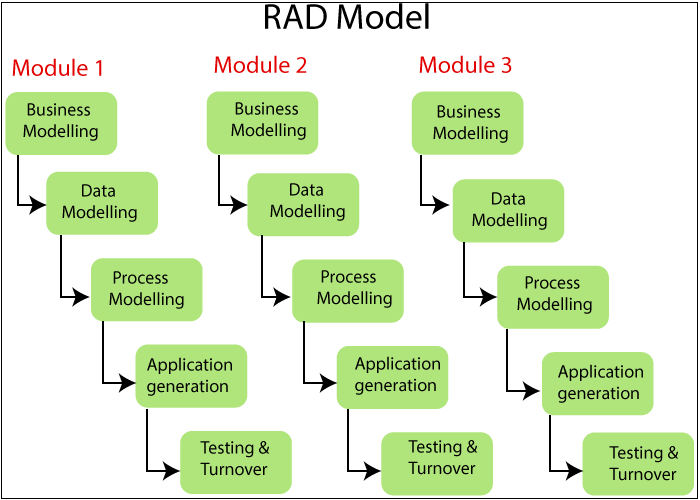
RAD Model in Software Engineering

RAD Model Design

The RAD model distributes the stages of analysis, modeling, construction, and testing into a series of short iterative development cycles.

The following stages of the RAD model are:-

Business Modeling

The business model for the product under development was structured for the flow of information and the distribution of information across different business channels. Complete business analysis is done to get information that is important for business, how it can be obtained, how and when the information is processed, and what are the factors that drive the successful flow of information.

Data Modeling

The information collected in the business modeling phase is reviewed, and the set of data objects important to the business is analyzed. The characteristics of all data sets are identified and defined. The relationship between these data objects is established and defined in detail in the relevance of business models.

Process Modeling

The data object set defined in the data modeling phase is transformed according to the business model to establish the business information flow necessary to achieve specific business objectives. The process model is defined in this step for any changes or enhancements to the data object set. Procedure details for adding, deleting, retrieving, or modifying data objects are given.

Application Generation

The system is built in this phase, and coding is done by using the automation tools to convert the process models and data into actual prototypes.

Testing and Turnover

In the RAD model, the total testing time is reduced because the prototype is independently tested at each iteration. However, the data stream and all component interfaces must fully cover the test. Because most programming components have already been tested, this reduces the risk of any major issues.

Advantages of RAD Model

  1. Changing requirements can be adjusted.
  2. Progress can be measured.
  3. Iteration time may be reduced with the use of powerful RAD tools.
  4. It requires fewer people and less time to develop the software.
  5. Increases component reusability.
  6. Instant initial reviews occur.
  7. It encourages feedback from the customer.
  8. Integration solves a lot of integration issues from the very beginning.

Disadvantages of RAD Model

  1. Reliance on technically strong team members to identify business needs.
  2. Only modular systems can be built using RAD.
  3. Highly skilled developers/designers are required.
  4. Unsuitable for inexpensive projects as the cost of modeling and automated code generation is too high.
  5. Suitable for systems based on components and scalable.
  6. It requires user participation throughout the life cycle.
  7. Suitable for projects with a short period of development

Related Topics

Routing Requests through Load Balancers

Let us first understand what load balancers are Assume a system works with multiple machines or servers, and as the requests arrive, they need to be routed to any one of...

3 minutes read.

Project Management

Project Management What is a software project? The project is a set of tasks that need to be completed to reach a clear result. The project is also defined as the set of inputs...

2 minutes read.

Some Important Quality Metrics

Important Quality Metrics The best quality of software has to pass through various software quality measures to attain standard in quality. The quality executive should consider these metrics to monitor the...

5 minutes read.

Software Metrics

Introduction Software metrics is the term used in software engineering. Software engineering is the detailed study of the step-by-step making of user-interactive software that fulfills users' needs. Let's discuss two terms...

4 minutes read.

Spiral Model

The problem with traditional software process models is that they do not adequately deal with uncertainty, which is inherent to software projects. Major software projects had failed because project risks were neglected, and...

3 minutes read.

Waterfall Model in Software Engineering

The most popular model is the waterfall model. This model has five phases: Requirement analysis and specification DesignImplementation & unit testing Integration and system testing phaseOperation and maintenance These phases often occur one...

3 minutes read.

Project Monitoring and Control

Project Monitoring and Control Project monitoring and control process includes procedures which are performed to observe project performance so that potential problems are identified, and appropriate action can be taken to meet the desired performance...

3 minutes read.

Caching in System Design

While surfing the web, you have usually wondered why the sites you have visited once load faster than the new ones. You would have also noticed how the texts and labels...

10 minutes read.

Incremental Model in Software Engineering

Incremental Model is a software development process where requirements are divided into several stand-alone software development modules. In this example, each module passes through the requirement, design, development, implementation, and testing phases. That subsequent...

2 minutes read.

Prototype Model in Software Engineering

The prototype creation model is a method of developing the software in which a prototype of software or app is constructed, tested, and then reworked as needed until an acceptable result is obtained...

4 minutes read.

Metrics for testing

There are different types of metrics used in software testing to measure different parameters. So, for different purposes, different metrics are used by the developer. For example: The type of metrics...

3 minutes read.

SDLC in Software Engineering

SDLC SDLC stands for the Software Development life cycle. It is a pictorial and diagrammatic representation of the software life cycle. A life cycle model represents all the techniques required to integrate software into the...

3 minutes read.

Software Engineering Tutorial

The software has become critical to advancement in almost all areas of human endeavor. The art of programming is no longer enough to construct large programs. There are serious problems with the...

8 minutes read.

Structured Analysis and Design (SA/SD)

When the software systems keep getting bigger and more complex, you need a way to represent the model systematically. Structured Design and Structured Analysis, often referred to as SA/SD, is...

4 minutes read.

Information Flow Metrics

This metric is purely based on information. Information flow metric is different from size metric, and data structure metric as size metric is based on the final size of program...

4 minutes read.

Big-Bang Model in Software Engineering

In the Big-Bang Model, developers do not adopt any specific process. Development begins only with the necessary funds and efforts as input, and output is developed software that may or may not be...

1 minute read.

Dropbox - System Design

While trying to upload or share any file, whether images, pdfs or documents, you would have come across the dropbox file posting service. Dropbox keeps all your data secure and...

9 minutes read.

Overall Equipment Effectiveness

Overall Equipment Effectiveness (OEE) Overall equipment effectiveness is a software development metric used to diagnose a product or machinery's manufacturing productivity and effeteness. The term OEE was introduced by Seiichi Nakajima San...

4 minutes read.

Scope of software metrics

Scope, Benefit, and Cycle of Software Metrics Software metrics have tremendous scope in software development to understand and fulfill various aspects of the project process. Software metrics help in estimation of...

6 minutes read.

Software Quality Metrics

In a software project, the software is designed to build a source code, but from time to time or step by step, checking source code is required. Check whether the work...

4 minutes read.