
JSP Directives

In JSP, the role of directive is to provide directions to the JSP container regarding the compilation of JSP page. Directives convey information from JSP page to container that give special instruction at translation time.

The three types of directive provided by JSP is as follows: -

Taglib Directive Taglib directive is used to define tag libraries in JSP page. It enables user to use custom tags within JSP file. A JSP page can contains more than one taglib directives. Syntax of Taglib Directive <@ taglib uri="uri" prefix="value"> Here, uri represents the path of tag library description and prefix represent the name of custom tag. Example of Taglib directive Here is a simple example of taglib directive. To run this code you need to add jstl jar file within lib directory of your project. It is better to run this code after learning JSTL.

index.jsp

<%@taglib uri="http://java.sun.com/jsp/jstl/core" prefix="c" %>

Output:
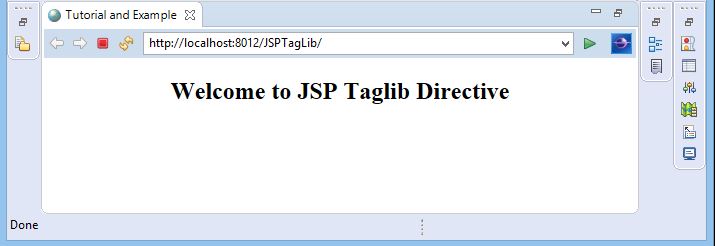
We will learn more about taglib directive in JSP custom tag.


Related Topics

JSP Scriptlet Tag

JSP scriptlet tag allows you to insert programming logic inside JSP page. Hence, you can put valid Java code within scriptlet tags. Each Java statement must be followed by a...

1 minute read.

JSP exception

Like Java, exceptions can also be occurred in JSP. To handle these exceptions, JSP exception object is used. Handling exceptions in JSP using exception object is much easier approach. This...

1 minute read.

JSP Control Statements

There are various standard programming languages like C, C++, Java etc. that supports control statements. On the basis of that, JSP also follows the same methodology. Let's study the flow...

2 minutes read.

JSTL Core Tags

In JSTL, core tags are most frequently used tags that provides variable support, manages URL and control the flow of JSP page. To use JSTL it is required to associate...

2 minutes read.

JSP Implicit Objects

In JSP, implicit objects are pre-defined objects, created by the web container. These objects are created during the translation phase from JSP to Servlet. JSP allows you to call these...

1 minute read.

JSP Cookie Handling

Cookie is a small piece of information sent by server to recognize the user. This information is stored at client side in the textual form. In JSP, cookie is an object...

1 minute read.

JSP Expression Language

JSP introduced the concept of expression language (EL) in JSP 2.0 version. The purpose of expression language is to access and manipulate data easily without using any type of scriptlet. Why...

1 minute read.

JSTL Function Tags

In JSTL, the purpose of function tags is similar to the various string methods in Java. Hence, these tag performs common string manipulation operations. Functional tag is represented by following URL:...

2 minutes read.

JSP Custom Tag

JSP custom tag provides flexibility to programmers, to declare their own tag. Thus, a user-defined tag can be created through custom tags to perform various operations. These custom tags behave as...

2 minutes read.

JSTL XML Tags

In JSTL, XML tags are used for creating and manipulating xml documents. The following syntax represent the URL of XML tag: - <%@ taglib uri="http://java.sun.com/jsp/jstl/xml" prefix="x" %> To utilize the functionality of...

1 minute read.

JSTL Formatting Tags

In JSTL, the role of formatting tag is to specify the type of format that represents date and time. The following syntax represent the URL of formatting tag: - <%@ taglib...

1 minute read.

JSP forward and include tag

In JSP, forward and include tags are the most frequently used action tags. Unlike Servlets, there is no need to create object of RequestDispatcher interface to use the functionality of...

1 minute read.

JSTL - Java Standard Tag Library

Java Standard tag library (JSTL) is a collection of various type of JSP tags. Each tag control the behavior of JSP page and perform specific task such as database access,...

1 minute read.

JSP out

In JSP, out is an implicit object that is associated with the response object. This object is used to write content to the output stream. Methods of JSP out Following are...

1 minute read.

JSP pageContext

The object pageContext is used to access all the information of JSP page. It is an instance of javax.servlet.jsp.PageContext. The scope of pageContext can be defined explicitly. The object is valid...

2 minutes read.

JSP page

In JSP, the purpose of page object is to create the servlet instance. The role of page object is similar to this keyword in Java. The page object represents the entire...

1 minute read.

JSTL SQL Tags

In JSTL, SQL tags are used to access and manipulate various operations of database. It is responsible to interact the JSP page with any type of Database such as MySQL,...

2 minutes read.

Scripting in JSP

JSP scripting provides an easy and efficient way to insert Java programming language in JSP pages. Here, Java is a default language. JSP also allows you to use any other...

1 minute read.

JSP config

JSP config object is used to send the configuration information to JSP page. Here, config is an instance of servlet's ServletConfig interface. In this case, the information is send to...

1 minute read.

JSP response

Basically, JSP response object is an instance of servlet's HttpServletResponse interface. It is used to resolve client request. Response object can be used to perform various functions such as encode...

1 minute read.