JSP forward and include tag

In JSP, forward and include tags are the most frequently used action tags. Unlike Servlets, there is no need to create object of RequestDispatcher interface to use the functionality of forward and include. Thus, JSP provides direct tag for the same purpose.

JSP forward Tag

In JSP, forward tag terminates the execution of current JSP page and forward the control to new page which can be JSP, Servlet, HTML or any other. The response of new page is displayed to the user.

JSP include Tag

The role of include tag is to dispatch the external resource in the JSP page. The external resource can be JSP, Servlet HTML or any other page. 

Syntax: -

Example of forward and include Tag

<jsp:include page="filename"></jsp:include>

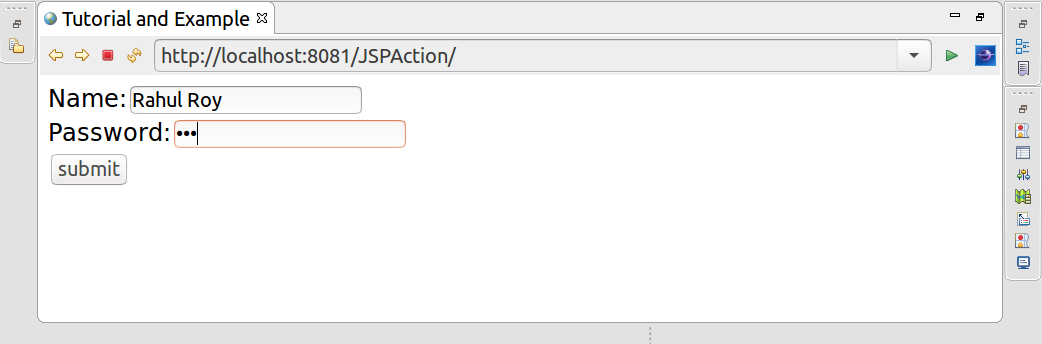
This example represents the functionality of both, forward and include tag.

index.jsp

Name:
Password:

CheckPage.jsp

<% String s=request.getParameter("pass"); if(s.length()>4) { %> <% } else { %> <% } %> 

WelcomePage.jsp  

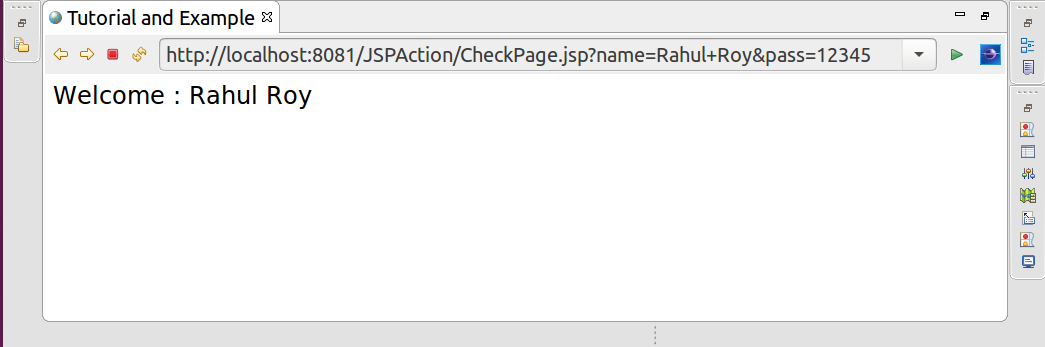
<% String s=request.getParameter("name"); %> <%="Welcome : "+s %>

Error.jsp  

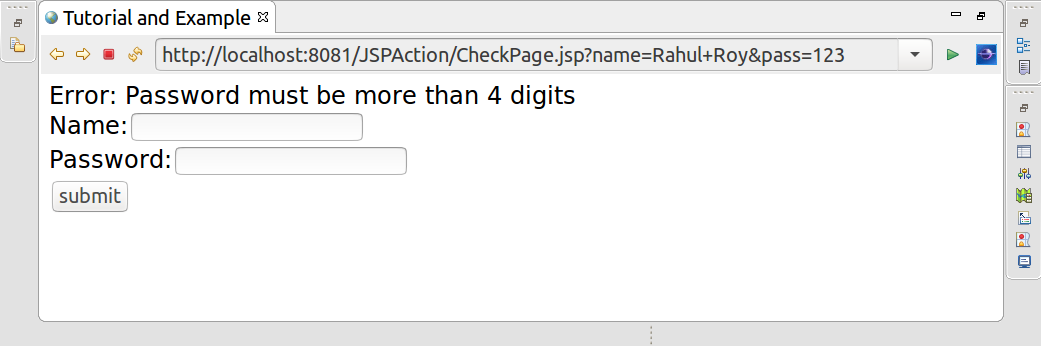
Error: Password must be more than 4 digits

Output
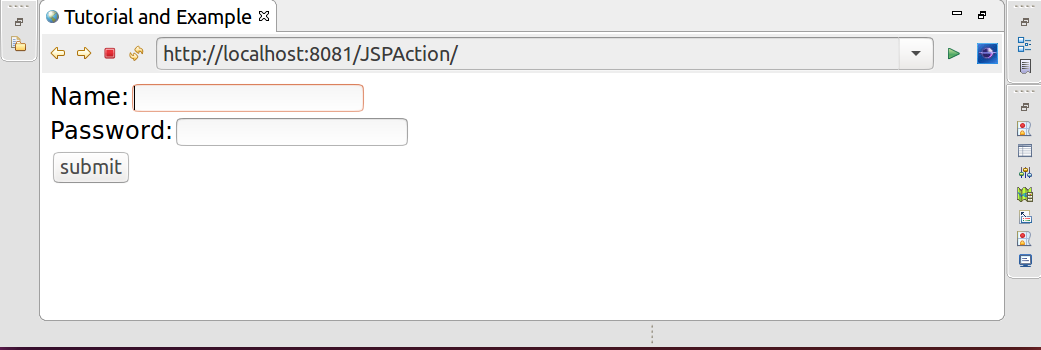
 

The entered password must be more than 4 digits.
Enter a strong password (i.e. more than 4 digits) to see welcome page.

Related Topics

JSP Life Cycle

JSP life cycle The life cycle of JSP page internally implemented as a Servlet. These are the following stages through which a JSP page has to pass: Translation – This is an...

2 minutes read.

JSP Scriptlet Tag

JSP scriptlet tag allows you to insert programming logic inside JSP page. Hence, you can put valid Java code within scriptlet tags. Each Java statement must be followed by a...

1 minute read.

JSP pageContext

The object pageContext is used to access all the information of JSP page. It is an instance of javax.servlet.jsp.PageContext. The scope of pageContext can be defined explicitly. The object is valid...

2 minutes read.

JSP Expression Tag

JSP expression tag allows you to place the result of Java expression in a convenient way. It can be seen as an alternative of out.print() method. Thus, if we want to...

1 minute read.

JSTL XML Tags

In JSTL, XML tags are used for creating and manipulating xml documents. The following syntax represent the URL of XML tag: - <%@ taglib uri="http://java.sun.com/jsp/jstl/xml" prefix="x" %> To utilize the functionality of...

1 minute read.

JSP Comments

JSP provides separate tag for comment section. The content inside these tag is completely ignored by JSP engine.    The syntax of comment tag is mentioned below. <%-- This is a comment...

1 minute read.

JSP Declaration Tag

JSP declaration tag is used to declare variables and methods in JSP page. Unlike scriptlet tag, JSP container placed the content of declaration tag outside the jspService() method. So, variables...

1 minute read.

JSTL Function Tags

In JSTL, the purpose of function tags is similar to the various string methods in Java. Hence, these tag performs common string manipulation operations. Functional tag is represented by following URL:...

2 minutes read.

JSP Expression Language

JSP introduced the concept of expression language (EL) in JSP 2.0 version. The purpose of expression language is to access and manipulate data easily without using any type of scriptlet. Why...

1 minute read.

JSP Request

The request object is used to fetch the user's data from the browser and pass this data to the server. The working of JSP request object is similar to the...

1 minute read.

JSP Control Statements

There are various standard programming languages like C, C++, Java etc. that supports control statements. On the basis of that, JSP also follows the same methodology. Let's study the flow...

2 minutes read.

JSP session

In JSP, session object is used to establish a connection between a client and a server. It maintains the state between them so that server recognize the user easily. The session...

1 minute read.

JSP Include Directive

As the name implies, include directive is used to include the content of other files such as HTML, JSP, text into the current JSP page. These files are included during...

1 minute read.

JSP page

In JSP, the purpose of page object is to create the servlet instance. The role of page object is similar to this keyword in Java. The page object represents the entire...

1 minute read.

JSTL Core Tags

In JSTL, core tags are most frequently used tags that provides variable support, manages URL and control the flow of JSP page. To use JSTL it is required to associate...

2 minutes read.

JSTL Formatting Tags

In JSTL, the role of formatting tag is to specify the type of format that represents date and time. The following syntax represent the URL of formatting tag: - <%@ taglib...

1 minute read.

JSP EL Implicit Objects

Apart from operators, JSP also provide expression language implicit objects. The role of these implicit objects is to get the attribute associated with various object. Here, is the list of...

1 minute read.

JSP Directives

In JSP, the role of directive is to provide directions to the JSP container regarding the compilation of JSP page. Directives convey information from JSP page to container that give...

1 minute read.

JSP Implicit Objects

In JSP, implicit objects are pre-defined objects, created by the web container. These objects are created during the translation phase from JSP to Servlet. JSP allows you to call these...

1 minute read.

JSP config

JSP config object is used to send the configuration information to JSP page. Here, config is an instance of servlet's ServletConfig interface. In this case, the information is send to...

1 minute read.