
JSP Expression Language

JSP introduced the concept of expression language (EL) in JSP 2.0 version. The purpose of expression language is to access and manipulate data easily without using any type of scriptlet.

Why Expression language?

Before JSP 2.0, scriptlets are used to handle the business logic. But it is difficult task for web designers to understand and code the java part in scriptlets. Hence, now expression language is used to overcome this difficulty. 

Syntax

This is the simple syntax of expression language.

${expression}

Expression Language Operator

JSP expression language provides an easy way to perform various arithmetic, relational, logical operations. These are some of the frequently used operators: -

  • Arithmetic operators – It contains various mathematical operators such as addition (+), subtraction (-), division (/ or div), module (% or mod), multiplication (*).
  • Logical operators – It contains operators like && (and), || (or).
  • Relational operators – It contains operators like < (less than), > (greater than), <= (less than or equal to), >= (greater than or equal to).

Example of JSP Expression Language Operator

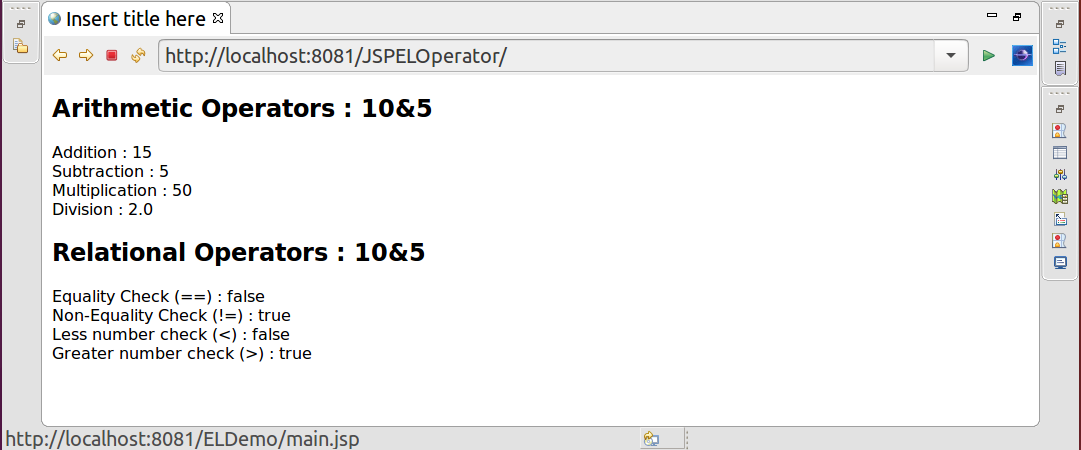
This is a simple example of JSP operators that perform various mathematical operations between two numbers (10 & 5) directly.

Index.jsp  

Arithmetic Operators : 10&5

Addition : ${10+5}
Subtraction : ${10-5}
Multiplication : ${10*5}
Division : ${10/5}

Relational Operators : 10&5

Equality Check (==) : ${10==5}
Non-Equality Check (!=) : ${10!=5}
Less number check (<) : ${10<5}
Greater number check (>) : ${10>5}

Output:

Related Topics

JSP page

In JSP, the purpose of page object is to create the servlet instance. The role of page object is similar to this keyword in Java. The page object represents the entire...

1 minute read.

JSP Expression Tag

JSP expression tag allows you to place the result of Java expression in a convenient way. It can be seen as an alternative of out.print() method. Thus, if we want to...

1 minute read.

JSTL SQL Tags

In JSTL, SQL tags are used to access and manipulate various operations of database. It is responsible to interact the JSP page with any type of Database such as MySQL,...

2 minutes read.

JSP EL Implicit Objects

Apart from operators, JSP also provide expression language implicit objects. The role of these implicit objects is to get the attribute associated with various object. Here, is the list of...

1 minute read.

JSP Directives

In JSP, the role of directive is to provide directions to the JSP container regarding the compilation of JSP page. Directives convey information from JSP page to container that give...

1 minute read.

JSP exception

Like Java, exceptions can also be occurred in JSP. To handle these exceptions, JSP exception object is used. Handling exceptions in JSP using exception object is much easier approach. This...

1 minute read.

JSP Custom Tag

JSP custom tag provides flexibility to programmers, to declare their own tag. Thus, a user-defined tag can be created through custom tags to perform various operations. These custom tags behave as...

2 minutes read.

JSTL Function Tags

In JSTL, the purpose of function tags is similar to the various string methods in Java. Hence, these tag performs common string manipulation operations. Functional tag is represented by following URL:...

2 minutes read.

JSP Include Directive

As the name implies, include directive is used to include the content of other files such as HTML, JSP, text into the current JSP page. These files are included during...

1 minute read.

JSP Life Cycle

JSP life cycle The life cycle of JSP page internally implemented as a Servlet. These are the following stages through which a JSP page has to pass: Translation – This is an...

2 minutes read.

JSP Implicit Objects

In JSP, implicit objects are pre-defined objects, created by the web container. These objects are created during the translation phase from JSP to Servlet. JSP allows you to call these...

1 minute read.

JSP Page Directive

JSP page directive provides various attributes with unique properties. These attributes can be applied to an entire JSP page. The syntax of Page directive is as follows: - <@page attribute="value"> Page directive...

3 minutes read.

JSP Taglib Directive

Taglib directive is used to define tag libraries in JSP page. It enables user to use custom tags within JSP file. A JSP page can contains more than one taglib...

1 minute read.

JSP application

JSP application object is an instance of servlet's ServletContext interface. It is used initialize parameter of one or more JSP pages in an application. Thus, the scope of application object...

1 minute read.

JSTL - Java Standard Tag Library

Java Standard tag library (JSTL) is a collection of various type of JSP tags. Each tag control the behavior of JSP page and perform specific task such as database access,...

1 minute read.

JSP Comments

JSP provides separate tag for comment section. The content inside these tag is completely ignored by JSP engine.    The syntax of comment tag is mentioned below. <%-- This is a comment...

1 minute read.

Scripting in JSP

JSP scripting provides an easy and efficient way to insert Java programming language in JSP pages. Here, Java is a default language. JSP also allows you to use any other...

1 minute read.

JSP useBean, getProperty and setProperty tags

Java bean is a special type of Java class that contains private variables and public setter and getter methods. Java bean class implements Serializable interface and provides default constructor. JSP allows...

1 minute read.

JSTL Core Tags

In JSTL, core tags are most frequently used tags that provides variable support, manages URL and control the flow of JSP page. To use JSTL it is required to associate...

2 minutes read.

JSTL Formatting Tags

In JSTL, the role of formatting tag is to specify the type of format that represents date and time. The following syntax represent the URL of formatting tag: - <%@ taglib...

1 minute read.