
JSP Scriptlet Tag

JSP scriptlet tag allows you to insert programming logic inside JSP page. Hence, you can put valid Java code within scriptlet tags. Each Java statement must be followed by a semicolon.

Syntax: -

 <% Java code %>

Whatever the code written inside scriptlet tag <% %> is compiled as Java code. This code can be accessible anywhere inside the JSP page. Any number of Java statements and local variables can be inserted in scriptlet tag. Although, scriptlet doesn't allow method declaration within it.

Example of JSP Scriptlet Tag

Here is a simple example of JSP scriptlet tag having a Java code within it.

index.jsp

Welcome to Tutorial and example 
<% java.util.Date date = new java.util.Date(); 
out.print("Last Accessed Time: "+date); %>

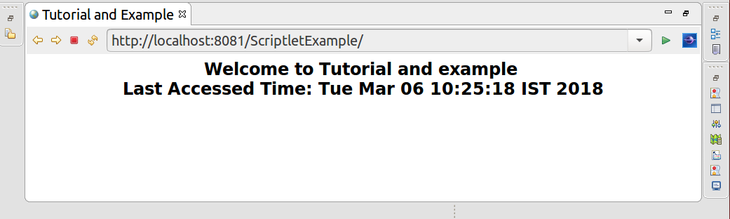
Output:
Internal Procedure

Internally, JSP container inserts the content of scriptlet tag into the jspService() method.

Internal code:

public void jspService(HttpServletRequest request, HttpServletrResponse response) throws ServletException, IOException
{
PrintWriter out=response.getWriter();
response.setContentType("text/html");
java.util.Date date = new java.util.Date();
out.print("
Last Accessed Time: "+date);
}

Related Topics

JSP Action Tags

As the name implies, JSP action tags are used to perform various actions during the execution of JSP page. Here, each action performs some specific task. These tasks include:  Forwarding the...

1 minute read.

JSP pageContext

The object pageContext is used to access all the information of JSP page. It is an instance of javax.servlet.jsp.PageContext. The scope of pageContext can be defined explicitly. The object is valid...

2 minutes read.

JSP out

In JSP, out is an implicit object that is associated with the response object. This object is used to write content to the output stream. Methods of JSP out Following are...

1 minute read.

JSP Implicit Objects

In JSP, implicit objects are pre-defined objects, created by the web container. These objects are created during the translation phase from JSP to Servlet. JSP allows you to call these...

1 minute read.

JSP Scriptlet Tag

JSP scriptlet tag allows you to insert programming logic inside JSP page. Hence, you can put valid Java code within scriptlet tags. Each Java statement must be followed by a...

1 minute read.

JSTL SQL Tags

In JSTL, SQL tags are used to access and manipulate various operations of database. It is responsible to interact the JSP page with any type of Database such as MySQL,...

2 minutes read.

JSP exception

Like Java, exceptions can also be occurred in JSP. To handle these exceptions, JSP exception object is used. Handling exceptions in JSP using exception object is much easier approach. This...

1 minute read.

JSP Life Cycle

JSP life cycle The life cycle of JSP page internally implemented as a Servlet. These are the following stages through which a JSP page has to pass: Translation – This is an...

2 minutes read.

JSTL Function Tags

In JSTL, the purpose of function tags is similar to the various string methods in Java. Hence, these tag performs common string manipulation operations. Functional tag is represented by following URL:...

2 minutes read.

JSP Tutorial

Java Server Pages (JSP) is a server-side technology used to create static and dynamic web applications. The static content is expressed by text-based format files such as HTML, XML, SVG...

2 minutes read.

JSP Page Directive

JSP page directive provides various attributes with unique properties. These attributes can be applied to an entire JSP page. The syntax of Page directive is as follows: - <@page attribute="value"> Page directive...

3 minutes read.

JSP Taglib Directive

Taglib directive is used to define tag libraries in JSP page. It enables user to use custom tags within JSP file. A JSP page can contains more than one taglib...

1 minute read.

JSP Expression Language

JSP introduced the concept of expression language (EL) in JSP 2.0 version. The purpose of expression language is to access and manipulate data easily without using any type of scriptlet. Why...

1 minute read.

JSP response

Basically, JSP response object is an instance of servlet's HttpServletResponse interface. It is used to resolve client request. Response object can be used to perform various functions such as encode...

1 minute read.

JSTL XML Tags

In JSTL, XML tags are used for creating and manipulating xml documents. The following syntax represent the URL of XML tag: - <%@ taglib uri="http://java.sun.com/jsp/jstl/xml" prefix="x" %> To utilize the functionality of...

1 minute read.

JSP Custom Tag

JSP custom tag provides flexibility to programmers, to declare their own tag. Thus, a user-defined tag can be created through custom tags to perform various operations. These custom tags behave as...

2 minutes read.

JSP forward and include tag

In JSP, forward and include tags are the most frequently used action tags. Unlike Servlets, there is no need to create object of RequestDispatcher interface to use the functionality of...

1 minute read.

JSP config

JSP config object is used to send the configuration information to JSP page. Here, config is an instance of servlet's ServletConfig interface. In this case, the information is send to...

1 minute read.

JSP page

In JSP, the purpose of page object is to create the servlet instance. The role of page object is similar to this keyword in Java. The page object represents the entire...

1 minute read.

JSTL - Java Standard Tag Library

Java Standard tag library (JSTL) is a collection of various type of JSP tags. Each tag control the behavior of JSP page and perform specific task such as database access,...

1 minute read.