
×

Linux Path Completion

Every operating system has some features which make them special. The Linux operating system primarily works on the command line interface, and we do have many features for this CLI. But, one of the most used features is called "auto path completion."

This feature is initiated with the help of the "tab" key, and it is used to speed up the typing of CLI. To use this feature, you have to type a few letters of the path or command you want to use and then press the "tab" key. Either your path or command will be auto-completed, or you will get some suggestions of various commands that start with the same letters.

Linux Path Completion

In the above screenshot, we typed "cd" and pressed the "tab" key. The "tab" key returns various commands that start with the "cd." The below screenshots are the example for suggestions and auto-completion of the path. The first screenshot shows that it will print them on the screen when there is more than one available path. In the second screenshot, when there was only one path available, it auto-completed. We typed "cd Pi" and then pressed the "tab" key, and it automatically gets completed.
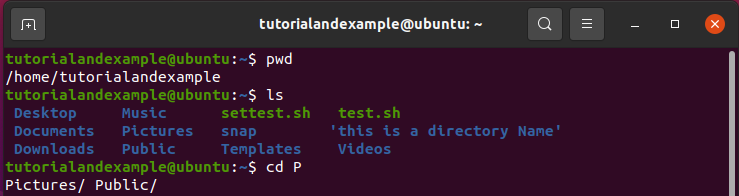

Linux Path Completion Linux Path Completion

In case of any wrong input, you will not get the suggestion or auto-completion on pressing the "tab" key.


Related Topics

du Command in Linux/Unix with Examples

The "du" command in Linux (and other Unix-like operating systems) is used to estimate the space used by a file or directory. The du command stands for "disk usage," and...

4 minutes read.

rename Command in Linux/Unix with Examples

The rename command in Linux is used to rename multiple files at once, using a specified pattern. The command is also known as rename, ren, and mv. This command is...

3 minutes read.

Linux ls

The primary use case of the ls command is to list the content available in the directory. The default directory is the current directory of the user. The below screenshot...

5 minutes read.

mv Command in Linux/Unix with Examples

The 'mv' command in Linux is used to move or rename files and directories. The command stands for "move" and it allows you to move files and directories from one...

3 minutes read.

Linux Bash

Linux Bash In this tutorial, we are going to learn what the shell is? And how many various shells we have, we have also covered most of the bash shell features....

4 minutes read.

Linux Admin Tutorial

In publishing and graphic design, lorem ipsum is a placeholder text commonly used to demonstrate the visual form of a document without relying on meaningful content....

1 minute read.

wget Command in Linux/Unix with Examples

The wget command is a command-line utility in Linux that is used to download files from the internet. It supports various protocols including HTTP, HTTPS, and FTP and can be...

5 minutes read.

find Command in Linux/Unix with Examples

The find command in Linux is a command-line utility that is used to search for files and directories in a file system. It is a versatile command that can be...

5 minutes read.

Top 20 Linux Commands

1) clear command clear is a standard operating system command which is used to clear the terminal screen. This command brings the command line on the top of the terminal. By pressing the...

10 minutes read.

rm Command in Linux/Unix with Examples

The "rm" command in Linux (and other Unix-like operating systems) is used to remove files and directories. The "rm" command stands for "remove" and it is used to delete files...

4 minutes read.

adduser Command in Linux with Examples

What is the adduser command? The adduser command creates a new user, and this command may be used to add apre-existing user to a group that already exists. How to use the...

4 minutes read.

unzip Command in Linux/Unix with Examples

The 'unzip' command in Linux is used to extract files from a ZIP archive file. The command allows you to decompress and extract the files and directories stored in a...

3 minutes read.

Linux Commands with Examples

Linux Commands with Examples All the Linux commands are executed on the terminal provided by the Linux system. This terminal is a command-line interface to implement and display command outputs. Linux...

10 minutes read.

gzip Command in Linux/Unix with Examples

The gzip command in Linux is used for compressing and decompressing files. It uses the Lempel-Ziv coding (LZ77) algorithm to compress files, which is known for its high compression ratio...

6 minutes read.

cp Command in Linux/Unix with Examples

The cp (copy) command in Linux is a command-line utility that is used to copy files and directories. It is one of the most basic and commonly used commands in...

5 minutes read.

mkdir Command in Linux/Unix with Examples

The "mkdir" command in Linux (and other Unix-like operating systems) is used to create new directories. The "mkdir" command stands for "make directory" and it is used to create a...

3 minutes read.

cat Command in Linux/Unix with Examples

The cat command in Linux is a command-line utility that is used to display the contents of a text file. It stands for "concatenate" and it is used to view...

4 minutes read.

tar Command in Linux/Unix with Examples

The 'tar' command in Linux is used to create, maintain, and extract files from archive files called tarballs. The command stands for "tape archive" and it allows you to combine...

4 minutes read.

Rename Folder in Linux

Rename Folder in Linux In the Linux system, there is not any single dedicated command for renaming the files and directories. Mostly, the mv command is used extensively for the purpose...

3 minutes read.

pwd Command in Linux/Unix with Examples

The "pwd" command in Linux (and other Unix-like operating systems) stands for "print working directory." When executed, it simply displays the current directory (or folder) that the user is currently...

3 minutes read.