×

Biconnectivity in a Graph

What is a Graph?

A graph is a structure where values are stored at the vertex, and the relation between vertices is denoted by edges.

In a graph, if there is only one component, it is said to be a connected graph. So, a biconnected graph means a graph where there does not exist any articulation point.

What is an Articulation point?

If a graph contains an vertex that after removing that vertex, if the graph is divided into two or more components, then this vertex is called articulation point. For any articulation point, there will be the removal of that vertex and all its edges connected to it.

For getting an articulation point, the brute-force approach is by removing each vertex and checking if the graph is connected or not. If connected, then add it again and move to the next vertex. If not connected, then return true for articulation point.

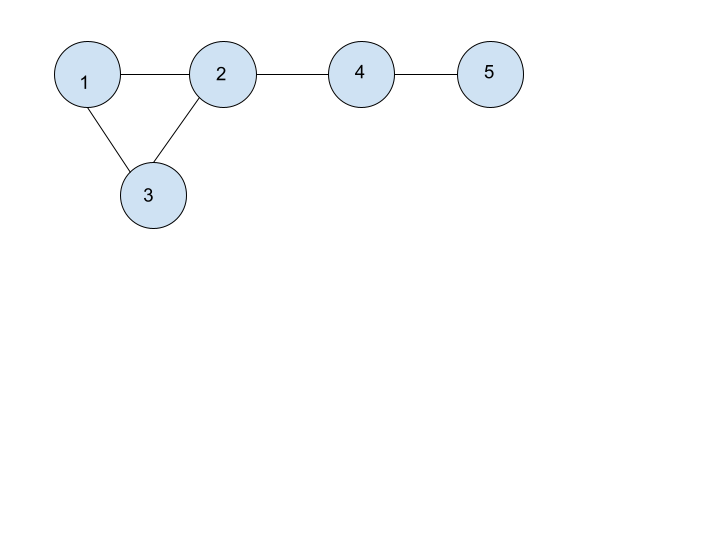
For example:
Biconnectivity in a Graph

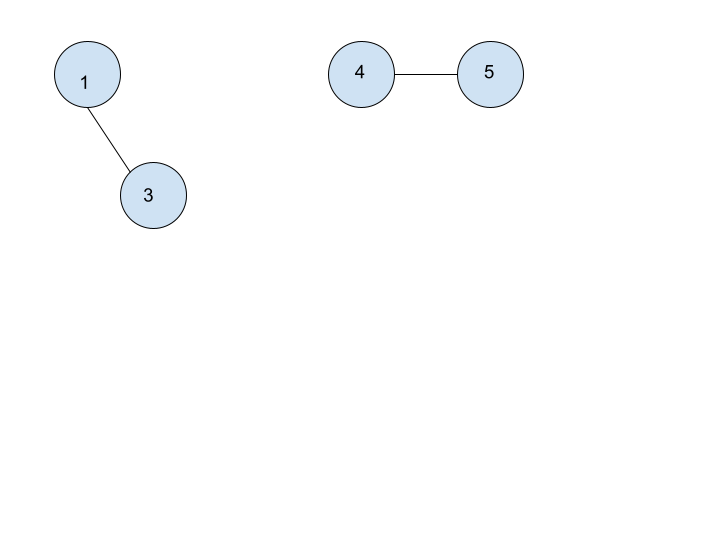
In the above graph, vertex 2 and vertex 4 are articulation points because if you remove any of them, the graph will be divided into two parts, and it will not be connected.

After removing vertex2:
Biconnectivity in a Graph

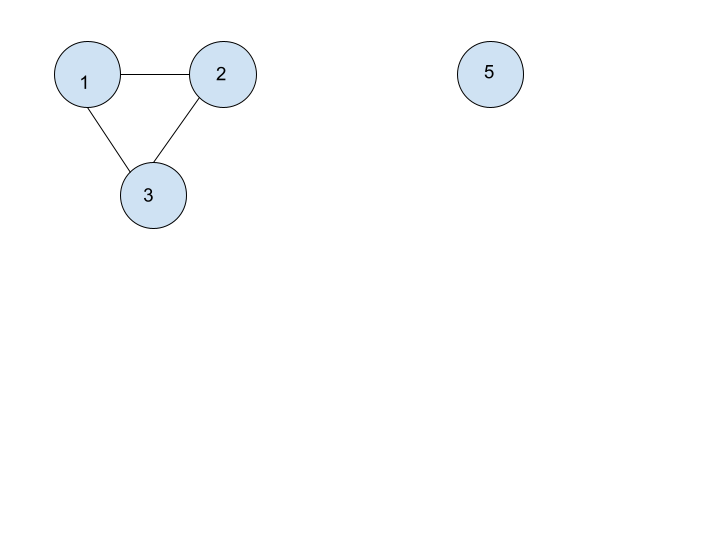
After removing 4:

Biconnectivity in a Graph

If we try the brute-force approach, then it will not be an optimal solution. Let's suppose the number of vertices is V and edges is E. so, Time complexity would be: O(V*(V+E)).

For an optimal solution, we will use the DFS approach. The basic idea would be that during DFS, we will assign two variables for each node. The first one is the time for the node to be introduced, and the second one is the minimum to get to the node.

Initially, we will use the timer variable and assign them the same as the time and increment time variable.

During dfs, if the node is unvisited, make it visited.

Visit its adjacent node except the parent.

If the adjacent node is not visited, then call the recursive DFS function for this adjacent node.

When the adjacent node of any node is visited, then compare its minimum time to the node’s minimum time.

If (min_time[adjacent]>=min_time[node]), it means if we remove the current node, then we can't reach the adjacent node because the adjacent node’s path is dependent on the current node. So the current node is an articulation point for this adjacent node.

Else we can simply put min_time[node] = min_time[adjacent] because it shows adjacent node’s minimum time to reach is lesser than current. It means we can reach the adjacent node also without the current node. So the current node can’t be an articulation point.

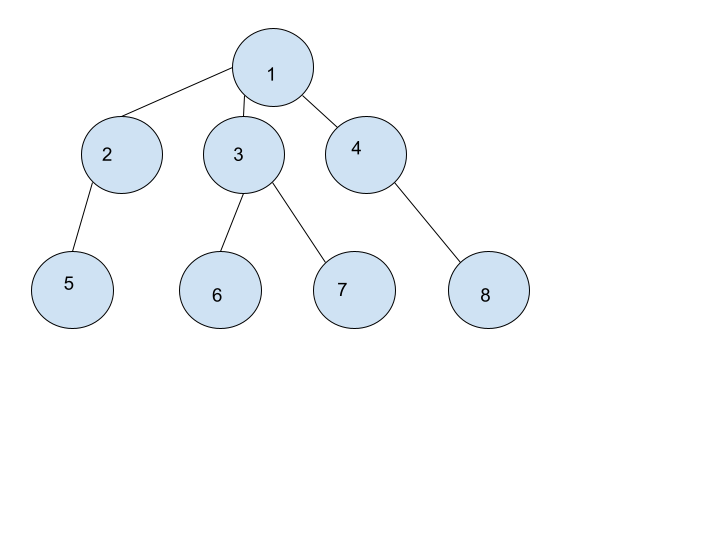
Note: if there is any source vertex from where we are starting the DFS, and it has more than one child who is not connected, then it can be an articulation point

For example:
Biconnectivity in a Graph

For the above, if we remove node 1, then it will be divided into more than one component.

So if there is any node whose parent is no node and it has more than one child, then it will definitely be an articulation point.

For implementing the code, we use a HashSet. If we encounter any articulation point, then we will add it to the HashSet.

In the end, if the HashSet contains more than zero elements, then the graph is not biconnected, else the graph is considered to be connected.

JAVA Code:

import java.util.*;
public class Main {
  public static void dfs(int node, int parent, int vis[], int tin[], int low[], ArrayList < ArrayList < Integer >> adj, int timer, HashSet < Integer > articulation) {
    vis[node] = 1;
    tin[node] = low[node] = timer++;
    int child = 0;
    for (Integer it: adj.get(node)) {
      if (it == parent) continue;


      if (vis[it] == 0) {
        dfs(it, node, vis, tin, low, adj, timer, articulation);
        low[node] = Math.min(low[node], low[it]);


        if (low[it] >= tin[node] && parent != -1) {
          articulation.add(node);
        }
        child++;
      } else {
        low[node] = Math.min(low[node], tin[it]);
      }
    }
    if (parent != -1 && child > 1) articulation.add(node);
  }


  public static void printBridges(ArrayList < ArrayList < Integer >> adj, int n) {
    int vis[] = new int[n + 1];
    int tin[] = new int[n + 1];
    int low[] = new int[n + 1];


    HashSet < Integer > articulation = new HashSet < > ();


    int timer = 0;
    for (int i = 0; i < n; i++) {
      if (vis[i] == 0) {
        dfs(i, -1, vis, tin, low, adj, timer, articulation);
      }
    }


    if (articulation.size() > 0)
      System.out.println("not biconnected");
    else
      System.out.println("bi-connected graph");
  }
  public static void main(String[] args) {
    int n = 5;
    ArrayList < ArrayList < Integer > > adj = new ArrayList < ArrayList < Integer > > ();
    for (int i = 0; i < n + 1; i++)
      adj.add(new ArrayList < Integer > ());


    adj.get(1).add(2);
    adj.get(2).add(1);


    adj.get(2).add(3);
    adj.get(3).add(2);


    adj.get(1).add(3);
    adj.get(3).add(1);


    adj.get(2).add(4);
    adj.get(4).add(2);


    adj.get(4).add(5);
    adj.get(5).add(4);


    printBridges(adj, n);
  }
}

So the time complexity for the above code is O(V+E) as we are doing normal DFS traversal.


Related Topics

Local Broadcast Address and loopback address

In computer networking, if you send the data from one source to another source or group of sources in the form of packets, then this is called casting. We can categorize...

3 minutes read.

CarryLook Ahead Adder

What is Adder? Adder is the combinational circuit that is used to add the bits in digital electronics. As we know, in the digital system, every number is represented in the...

4 minutes read.

Basic Terminologies Related to COA

Some Basic Terminologies Related to COA Computer organization and architecture is the detailed study of the internal components of the computer with their functionality. It describes how components arranged together and...

7 minutes read.

Control Unit Organization

Control Unit Organization The Control Unit is the unit in the CPU, which controls the various components like input  & output devices, logic unit and memory. The Control Unit is the...

7 minutes read.

8255 Microprocessor Operating Modes

8255 microprocessor was invented by intel in the year 1980s. 8255 microprocessor is a general-purpose microprocessor that can be programmed. 8255 is mostly used as an interface between devices like...

3 minutes read.

Digital Number System

Digital Number System: The computer understands digital language only. Many number systems are used in digital technology. The most common are Decimal, Binary, Octal and Hexadecimal number systems. Types of the...

7 minutes read.

Micro-Operations

Micro-Operations If CPU wants to perform any operation, suppose execution of only one instruction or even break it down one particular execution phase (like fetch instruction, write back, decode, operand fetch...

9 minutes read.

8085 Pin Configuration

Introduction: Intel 8085 is consist 40 pin IC. The pin name of 8085 is A8 – A15; AD0 – AD7; ALE; IO/M; S0, S1; RD; WR; READY; HOLD; HLDA; INTR; INTA;...

6 minutes read.

Fixed and Floating-Point Number

Fixed and Floating-Point Number: In digital technology, data is stored in memory registers with binary bits 0’s and 1’s because the computer only understands binary language. When we enter data...

6 minutes read.

Use Case Diagram for the online bank system

What is a Use Case Diagram? A tool is called a Use Case Diagram which is used to create, present, and comprehend the functional requirements for a system. The Use Case...

3 minutes read.

74138 IC DECODER

74138 DECODER Decoder A combinational circuit called a decoder can have up to 2n output lines and 'n' input lines. When a decoder is enabled, depending on the mix of inputs,...

4 minutes read.

Microprocessor classification

Introduction: Microprocessor is known as the computer processor. The IC or integrated Circuit makes the microprocessor. that is the brain of the computer machine. The microprocessor is known as the...

6 minutes read.

Data Path, ALU and Control Unit

Data Path, ALU(Arithmetic Logic Unit) and Control Unit What is the Data path? Suppose any data processing operation should be performed in the CPU like transferring the content of register from one...

5 minutes read.

Pipelining: Computer Organization and Architecture

Introduction to Pipelining Before learning pipeline, we have to understand about the Parallel processing. Parallel processing is the processing of data simultaneously. There are three techniques of parallel processing. Types of Processing: Vector ProcessingArray...

7 minutes read.

IEEE Standard 754 Floating Point Numbers

Floating Point Representation: IEEE- 754 There were many problems in the conventional representation of floating-point notation like we could not express 0(zero), infinity number. To solve this, scientists have given a...

8 minutes read.

Convert a number from base 2 to base 6

Base 2 Base 2 is the format where you can represent any number with just two values which are 0 and 1. With the help of 0s and 1s, we can...

4 minutes read.

Computer Organization and Architecture Tutorial

Introduction to Computer Organization and Architecture In this modern era, or we can say computer era, Technology from all around surrounds us. Human is conserved, connected and absorbed by Technology. From...

4 minutes read.

8085 Arithmetic Instructions

Arithmetic instructions are a type of instruction in a computer's instruction set that perform arithmetic operations on data. These operations can include addition, subtraction, multiplication, and division. Arithmetic instructions can...

4 minutes read.

Addressing Modes

Introduction: Addressing Modes An instruction consists of two parts opcode and operands. Opcode tells the operation going to perform, and operand information is the address of the operand. The CPU interprets...

8 minutes read.

Interfacing DAC with the 8051 Microcontroller

A wide range of applications calls for microcontrollers, including measuring and controlling physical quantities like temperature, pressure, speed, and distance. In these systems, the microcontroller creates digital output, but the controlling...

2 minutes read.