×

Instruction Cycle: Computer Organization and Architecture

What is an effective Address?

“Effective address is the address of operand in a computation-type instruction.” Computation type instructions are like ADD, SUB, MOV, OR, AND, etc., which require operand to operate. Whenever the operand is present, its address is known as its effective address.

                                                                  or

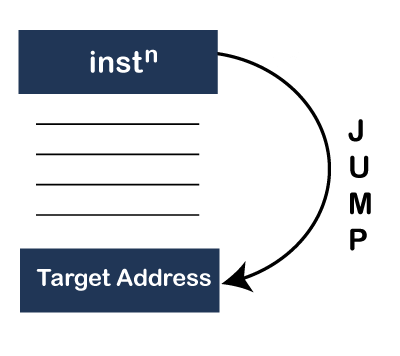
“Effective address is the target address in a branch type instruction.” Branch type instructions are like JUMP type of instructions. Suppose, if sequential instruction execution is stopped suddenly and it has to JUMP from one address to another. So, wherever (on an address) an instruction has to jump, that place is called target and its address is called as target instruction address also known as effective address in-branch type instruction.
COA: Instruction Cycle

Instruction cycle

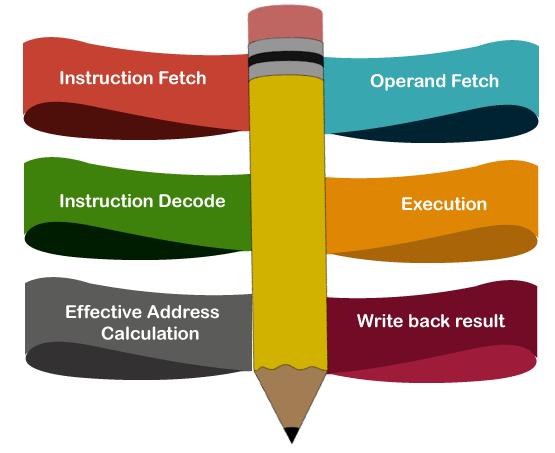
If the CPU wants to execute one instruction, it must follow a series of 6 phases.

                                 One instruction = 6 phases

                                 Next instruction= 6 phases

                      Another next instruction= 6 phases

The CPU performs 6 phases to execute an instruction, and phases are repeated repeatedly. This cycle of phases is called as Instruction cycle.

Six phases of the Instruction Cycle is divided into two parts.

a) Fetch cycle

  • Instruction Fetch

b) Execution cycle

  • Instruction decode
  • Effective Address Calculation
  • Operand Fetch
  • Execution
  • Write back result
COA: Instruction Cycle

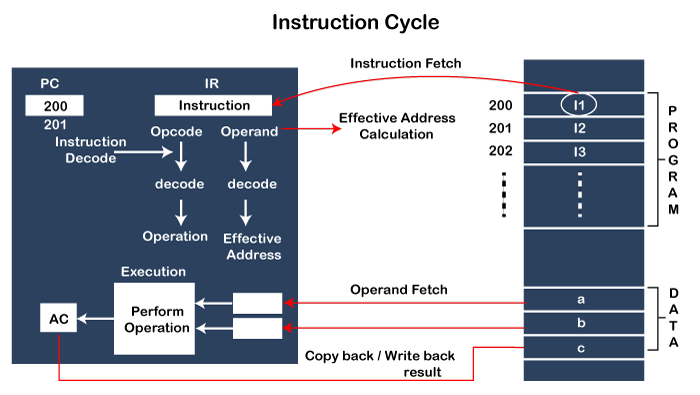
The instruction cycle is explained with the help of an example.
COA: Instruction Cycle
  1. Instruction fetch

It is the process in which we bring the instruction from memory to the CPU. When the CPU wants to execute the first Instruction I1 of the program, it fetches an instruction from memory to the CPU. For example, in the above figure, when the CPU wants to execute the first instruction, it must have a program counter having a value of 200. The next instruction is going to execute on address 200. CPU brings this instruction from memory, and it is stored in the Instruction Register.

                                          IR ? Memory[PC]

Note: The value of the program counter increases by the same number of addresses on which the instruction is stored in memory. CPU wants to execute instruction I1 copied to CPU from memory, then the value of program counter increased, and it becomes 201.   

2. Instruction decode

When instruction is copied to the instruction register from memory to CPU, it contains the instruction's opcode, which is decoded by CPU. When the CPU decodes the instruction's opcode and gets to know what operation to perform, this process is called Instruction Decode.

3. Effective Address Calculation

Every instruction has two parts, one is the opcode, another is operand information. Opcode has already been decoded by CPU, and now CPU decodes the operand information from where it obtained the effective address.

4. Operand Fetch

To execute the program, operands are needed, stored in somewhere memory in the form of data, and that are fetched by CPU from memory; the process is called operand fetch. For example, a, b is the data stored somewhere in the memory. It is fetched by CPU from memory.  

5. Execution

When the operation is performed on data, and the result is generated to the Accumulator. This process is called execution. For example, the operation is performed on data a, b, and generated to Accumulator.

6. Write back result

Finally, after the result is generated in Accumulator, it is copied to destination c. the result is written back or copied back to the destination in memory.

 Note: Every instruction doesn’t require all 6 phases every time. It depends on every instruction requirement; otherwise, by default, it is considered that all instruction requires 6 phases for execution.


Related Topics

Instruction Cycle: Computer Organization and Architecture

What is an effective Address? “Effective address is the address of operand in a computation-type instruction.” Computation type instructions are like ADD, SUB, MOV, OR, AND, etc., which require operand to...

4 minutes read.

Micro-Operations

Micro-Operations If CPU wants to perform any operation, suppose execution of only one instruction or even break it down one particular execution phase (like fetch instruction, write back, decode, operand fetch...

9 minutes read.

Control Signals in 8155 Microprocessor

Intel designed the chip 8155 used to interface with I/O devices. Basically, the 8085 microprocessor is directly unable to deal with its peripheral input output devices for reading data or...

3 minutes read.

Local Broadcast Address and loopback address

In computer networking, if you send the data from one source to another source or group of sources in the form of packets, then this is called casting. We can categorize...

3 minutes read.

Convert a number from base 2 to base 6

Base 2 Base 2 is the format where you can represent any number with just two values which are 0 and 1. With the help of 0s and 1s, we can...

4 minutes read.

Computer Organization and Architecture Tutorial

Introduction to Computer Organization and Architecture In this modern era, or we can say computer era, Technology from all around surrounds us. Human is conserved, connected and absorbed by Technology. From...

4 minutes read.

BCD to 7 Segment Decoder

What is BCD? BCD is called Binary Coded Decimal. As you know there are a lot of forms in which we can represent the number like Binary, decimal, hexadecimal, and octal...

3 minutes read.

Basic Terminologies Related to COA

Some Basic Terminologies Related to COA Computer organization and architecture is the detailed study of the internal components of the computer with their functionality. It describes how components arranged together and...

7 minutes read.

IEEE Standard 754 Floating Point Numbers

Floating Point Representation: IEEE- 754 There were many problems in the conventional representation of floating-point notation like we could not express 0(zero), infinity number. To solve this, scientists have given a...

8 minutes read.

Assembly Language Register

Assembly Language Register Assembly language was introduced during the late 1940s in the second generation. It is a low-level language that helps in communication between the user and the computer. It...

6 minutes read.

8255 Microprocessor Operating Modes

8255 microprocessor was invented by intel in the year 1980s. 8255 microprocessor is a general-purpose microprocessor that can be programmed. 8255 is mostly used as an interface between devices like...

3 minutes read.

Ethernet Frame Format

What is Ethernet? As we know in computer networking, LAN (Local Area Network) is used to connect devices in limited geographical areas like schools or a building.LAN uses different topologies (arrangement...

3 minutes read.

Addressing mode in 8085 microprocessor

What is a Microprocessor? Microprocessor is a unit which is able to perform arithmetic and logical operations and is built on a single chip. The 8085 microprocessor is built by Intel which...

4 minutes read.

Use Case Diagram for the online bank system

What is a Use Case Diagram? A tool is called a Use Case Diagram which is used to create, present, and comprehend the functional requirements for a system. The Use Case...

3 minutes read.

Flag Register of 8086 Microprocessor

In this article, we are going to study about the one of the registers named flag registers of 8086 microprocessor. We are also going to know where and how to...

3 minutes read.

8086 Microprocessor Pin Configurations

8086 microprocessor is invented and developed by Intel in 1976. The 8086 Microprocessor is an enhanced version of the 8085 Microprocessor. There are 20 address lines and 16 data lines...

6 minutes read.

Addressing Modes

Introduction: Addressing Modes An instruction consists of two parts opcode and operands. Opcode tells the operation going to perform, and operand information is the address of the operand. The CPU interprets...

8 minutes read.

Types of Microprocessors

Introduction:Microprocessor is known as the computer processor. The IC or integrated Circuit makes the microprocessor. That is the brain of the computer machine.  The microprocessor is the Processor or CPU (Central...

3 minutes read.

Digital Number System

Digital Number System: The computer understands digital language only. Many number systems are used in digital technology. The most common are Decimal, Binary, Octal and Hexadecimal number systems. Types of the...

7 minutes read.

Bipartite Graph

A graph is said to be bipartite if and only if we can divide all the vertices of a graph into two sets such that these sets are mutually exclusive...

4 minutes read.