3d Scaling

The 2D and 3D scaling are similar, but the key difference is that the 3D plane also includes the z-axis along with the x and y-axis.

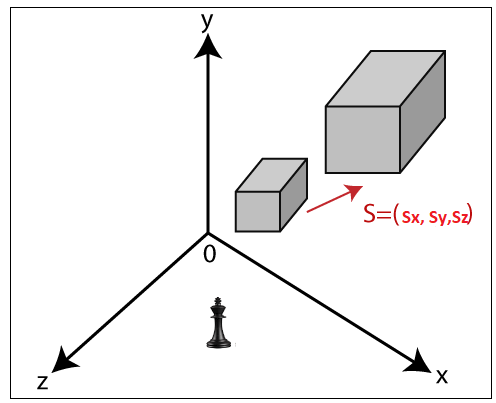
In scaling, we can expend or compress the size of any object. We can apply scaling on the object by multiplying the original coordinates with scaling factors.

The term scaling factor is used to define whether the size of the object is increased or decreased. We can represent the scaling factor by ‘Sxfor the x-axis, ‘Syfor the y-axis, and ‘Szfor the z-axis.

The increment and decrement of an object is depends on two conditions. They are-

If scaling factor (Sx, Sy, Sz) > 1, then the size of the object increased.

If scaling factor (Sx, Sy, Sz) < 1, then the size of the object decreased.

For Example: Let us assume,

The initial coordinates of object = P (x0, y0, z0)

Scaling factor for x-axis = Sx

Scaling factor for y-axis = Sy

Scaling factor for z-axis = Sz

The coordinates after Scaling = Q (x1, y1, z1)

We can represent the 3D Scaling in the form of equation-

X1 = x0. Sx

Y1 = y0. Sy

Z1 = z0. Sz
3d Scaling

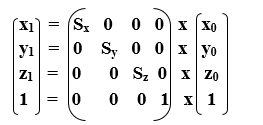
Matrix representation of 3D Scaling-

3d Scaling

Example: A 3D object that have coordinates points P(1, 4, 4), Q(4, 4, 6), R(4, 1, 2), T(1, 1, 1) and the scaling parameters are 3 along with x-axis, 4 along with y-axis and 4 along with z-axis. Apply scaling to find the new coordinates od the object?

Solution: we have,

The initial coordinates of object = P (1, 4, 4), Q (4, 4, 6), R (4, 1, 2), S (1, 1, 1)

Scaling factor along with x-axis (Sx) = 3

Scaling factor along with y-axis (Sy) = 4

Scaling factor along with z-axis (Sz) = 4

Let the new coordinates after scaling = (x1, y1, z1)

For coordinate P-

x1 = x0 x Sx = 1 x 3 = 3

y1 = y0 x Sy = 4 x 4 = 16

z1 = z0 x Sz = 4 x 4 = 16

The new coordinates = (3, 16, 16)

For coordinate Q-

x1 = x0 x Sx = 4 x 3 = 12

y1 = y0 x Sy = 4 x 4 = 16

z1 = z0 x Sz = 6 x 4 = 24

The new coordinates = (12, 16, 24)

For coordinate R-

x1 = x0 x Sx = 4 x 3 = 12

y1 = y0 x Sy = 1 x 4 = 4

z1 = z0 x Sz = 2 x 4 = 8

The new coordinates = (12, 4, 8)

For coordinate S-

x1 = x0 x Sx = 1 x 3 = 3

y1 = y0 x Sy = 1 x 4 = 4

z1 = z0 x Sz = 1 x 4 = 4

The new coordinates = (3, 4, 4)

Thus, the new coordinates after scaling = P (3, 16, 16), Q (12, 16, 24), R (12, 4, 8), S (3, 4, 4).


Related Topics

Composite Transformation in Computer Graphics

Composite transformation in Computer Graphics It is possible to integrate a range of transformations or series of transformations into some kind of a single one which is known as composition. The...

6 minutes read.

Display Processor

It is a part of hardware or interpreter which is used to transform display processor code into pictures. It is used to convert digital information from CPU to analog data. It...

4 minutes read.

Types of Computer Graphics

Types of Computer Graphics The computer graphics contains two types. They are- Raster (Bitmap) graphicsVector graphics Many individuals are likely to consider pictures on computers (or phones, tablets, or some other electronic gadget...

5 minutes read.

Line Drawing Algorithm in Computer Graphics

“The Line drawing algorithm is a graphical algorithm which is used to represent the line segment on discrete graphical media, i.e., printer and pixel-based media.” A line contains two points....

3 minutes read.

Scan Conversion of a Circle Computer Graphics

A circle is an eight-way symmetric shape. All quadrants of a circle are the same. There are two octants in each quadrant of a circle. If we know the value of any...

3 minutes read.

Midpoint Circle Drawing Algorithm in Computer Graphics

The midpoint circle drawing algorithm helps us to calculate the complete perimeter points of a circle for the first octant. We can quickly find and calculate the points of other...

12 minutes read.

2D Rotation

The Rotation of any object depends upon the two points. Rotation Point: It is also called the Pivot point. Rotation Angle: It is denoted by Theta (). We can rotate an object in...

1 minute read.

DDA line Drawing Algorithm in Computer Graphics

DDA (Digital Differential Analyzer) Line Drawing Algorithm The Digital Differential Analyzer helps us to interpolate the variables on an interval from one point to another point. We can use the digital Differential Analyzer algorithm...

5 minutes read.

Bresenham’s Circle Drawing Algorithm in Computer Graphics

Bresenham’s algorithm is also used for circle drawing. It is known as Bresenham’s circle drawing algorithm. It helps us to draw a circle. The circle generation is more complicated than...

11 minutes read.

Point Clipping

“Point clipping is a process which is used to define the point position.” The point is either inside the view pane (window) or outside the view pane. In computer graphics, the computer...

2 minutes read.

Image Representation in Computer Graphics

Image Representation: In computer science, we can represent an image in various forms. Most of the time, it refers to the way that brings information, such as color is coded digitally, and...

4 minutes read.

2D Translation

We can move any object from one to another place without changing the shape of the object. For Example- Translation of a Point:If we want to translate a point from P (x0,...

1 minute read.

Display Devices in Computer Graphics

The display device is an output device used to represent the information in the form of images (visual form). Display systems are mostly called a video monitor or Video display unit (VDU). Display devices are designed to model, display, view, or display information. The...

6 minutes read.

Mid-Point Line Drawing Algorithm in Computer Graphics

The Mid-point Subdivision algorithm is the extension of the Cyrus-Beck algorithm. The Mid-Point line plotting algorithm was introduced by “Pitway and Van Aken.” It is an incremental line drawing algorithm....

8 minutes read.

Rendering in Computer Graphics

Rendering in Computer Graphics Rendering is the operation, by virtue of a software system, of creating a picture from a template. In a specifically defined term or information structures, the model is a...

9 minutes read.

Text Clipping

“Text Clipping is a process in which we remove those part (portion) of string that is outside the view pane (window).” Various methods and techniques can do the text clipping. These techniques depend...

2 minutes read.

3D Translation

A 3D Translation process contains the x-axis, y-axis, and z-axis. We can move any object from one place to another without changing the shape of the object. For Example-Translation of a...

1 minute read.

Transformation

Introduction The term Transformation is generally referred to as converting a graphic into another graphic by applying some rules or algorithms. Sometimes an image or picture can be a combination of lines, rectangle,...

2 minutes read.

Projection in Computer Graphics

Projection Introduction: The technique projection was invented by the Swiss mathematician, engineer, and astronomer "Leonhard Euler Around" in 1756. The "Episcope" was the first projection system. “Projection is a technique or process which...

4 minutes read.

Bresenham’s Line Drawing Algorithm in Computer Graphics

This algorithm was introduced by “Jack Elton Bresenham” in 1962. This algorithm helps us to perform scan conversion of a line. It is a powerful, useful, and accurate method. We...

8 minutes read.