
3D Translation

A 3D Translation process contains the x-axis, y-axis, and z-axis. We can move any object from one place to another without changing the shape of the object.

For Example-
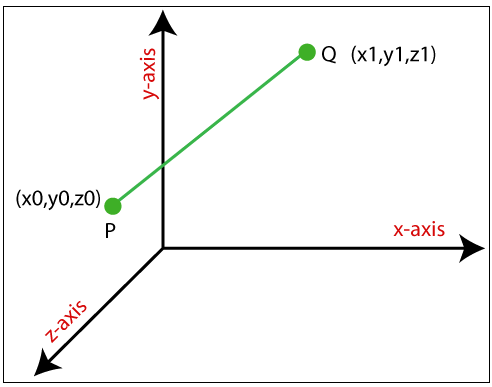
Translation of a Point: If we want to translate a point from P (x0, y0, z0) to Q (x1, y1, z1), then we have to add Translation coordinates (Tx, Ty, Tz) with original coordinates.
3D Translation

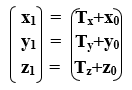
We can also represent the 3D Translation in matrix form-
3D Translation

We can apply Translation on the following objects-

  • Line
  • Rectangle
  • Polygon
  • Square

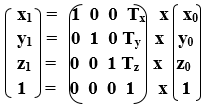
3D Translation Matrix Representation:

The above Translation is also shown in the form of 3 x 3 matrix-
3D Translation

Here Translation coordinates (Tx, Ty, Tz) are also called “Translation or Shift Vector.

Example: A Point has coordinates P (1, 2, 3) in x, y, z-direction. Apply the translation with a distance of 2 towards x-axis, 3 towards y-axis, and 4 towards the z-axis. Find the new coordinates of the point?

Solution: We have,

Point P = (x0, y0, z0) = (1,2,3)

Shift Vector = (Tx, Ty, Tz)

Let us assume the new coordinates of P = (x1, y1, z1)

Now we are going to add translation vector and given coordinates, then

X1 = x0 + Tx = (1 + 2) = 3

Y1 = y0 + Ty = (2 + 3) = 5

Z1 = z0 + Tz = (3 + 4) = 7

Thus, the new coordinates are = (3, 5, 7)


Related Topics

Color Models in Computer Graphics

"Color model is a 3D color coordinate system to produce all range of color through the primary color set." There are millions of colors used in computer graphics. The light...

3 minutes read.

2D Scaling

In scaling, we can expend or compress the size of any object. We can apply scaling on the object by multiplying the original coordinates with scaling factors. The term scaling factor...

2 minutes read.

Panning

“Panning is a process or photographic technique that is used to combine slow shutter speed with camera movement to make a speed sense around the moving object.” We can define panning as...

2 minutes read.

Homogenous Coordinates in Computer Graphics

Homogenous Coordinates in Computer Graphics The orbit of a point, a line graph or the whole picture on the computer, a point besides the origin, is accomplished by first shifting the...

7 minutes read.

Aspect Ratio in Computer Graphics

Aspect Ratio in Computer Graphics You might well understand the concept of Aspect ratio as of now if you know regarding aerial photography or see the configuration portion of any computer...

5 minutes read.

History of Computer Graphics

History of Computer Graphics Computer Graphics (CG) was first developed as a visualization tool. Computer graphics were basically introduced for scientists and engineers in government and corporate research centers, i.e., Bell Labs and Boeing...

4 minutes read.

Text Clipping

“Text Clipping is a process in which we remove those part (portion) of string that is outside the view pane (window).” Various methods and techniques can do the text clipping. These techniques depend...

2 minutes read.

Line Clipping in Computer Graphics

The line clipping is a process in which we can cut the part of the line, which lies outside the view pane. Only those lines are visible, which lie inside the view pane....

13 minutes read.

Projection in Computer Graphics

Projection Introduction: The technique projection was invented by the Swiss mathematician, engineer, and astronomer "Leonhard Euler Around" in 1756. The "Episcope" was the first projection system. “Projection is a technique or process which...

4 minutes read.

Types of Computer Graphics

Types of Computer Graphics The computer graphics contains two types. They are- Raster (Bitmap) graphicsVector graphics Many individuals are likely to consider pictures on computers (or phones, tablets, or some other electronic gadget...

5 minutes read.

Rendering in Computer Graphics

Rendering in Computer Graphics Rendering is the operation, by virtue of a software system, of creating a picture from a template. In a specifically defined term or information structures, the model is a...

9 minutes read.

Image Representation in Computer Graphics

Image Representation: In computer science, we can represent an image in various forms. Most of the time, it refers to the way that brings information, such as color is coded digitally, and...

4 minutes read.

Transformation

Introduction The term Transformation is generally referred to as converting a graphic into another graphic by applying some rules or algorithms. Sometimes an image or picture can be a combination of lines, rectangle,...

2 minutes read.

Computer Graphics Tutorial

Introduction to Computer Graphics Computer graphics is commonly seen as a computer science branch that deals with the computerized image fusion theory and technology. As simple as a triangle outline, a...

6 minutes read.

Animation in Computer Graphics

The word Animation is extracted from a Latin language, "Anima," which means "Soul." TheAnimation is a technology that allows any image object, an entity to walk, talk, or do some...

3 minutes read.

2D Reflection

The Reflection is a mirror image of the original object. In the Reflection process, the size of the object does not change. We can represent Reflection by using four ways- Reflection along...

2 minutes read.

Filled Area Primitives Computer Graphics

Filled Area Primitives: Area filling is a method or process that helps us to fill an object, area, or image. We can easily fill the polygon. The polygon filling is...

4 minutes read.

Input Devices in Computer Graphics

An Input device is the piece of computer hardware equipment used to give input to the computer. The input can be in the form of graphics, text, sound, audio, video,...

7 minutes read.

Zooming

In computer graphics, the term “Zoom is referred as a function, focuses on a particular portion or part of an image and also enlarging the image’s size for greater details.” In windows...

2 minutes read.

3D Translation

A 3D Translation process contains the x-axis, y-axis, and z-axis. We can move any object from one place to another without changing the shape of the object. For Example-Translation of a...

1 minute read.