Clipping in Computer Graphics

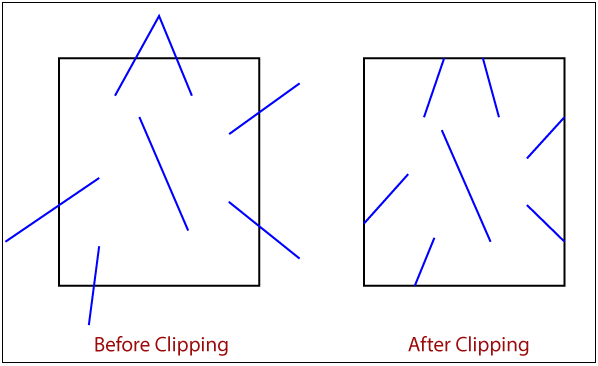
“The Clipping is a type of transformation used in computer graphics to remove lines, objects, and segments of lines that are outside the computer screen or viewing pane.” The clipping is a process of deciding the visible and invisible part of the image, object, or any line segment.

We only select the visible part and remove the invisible part of the line. The process clipping can be used in two-dimensional and three-dimensional graphics.

Clipping in two-dimensional (2D) Graphics

We can also describe clipping in two-dimensional graphics. In the two-dimensional graphics system, the clipping is a process in which all pixels of an image lies inside the boundary of view pane (window). We can also control pixel rendering to make creative and functional clip area.

Clipping in three-dimensional (3D) Graphics

In three-dimensional graphics, we can use the term clipping in many ways to define various features. The clipping is a term that describes some operations that work in a three-dimensional plane with rectangular shapes. We can extend the clipping to higher dimensionality. We can use various methods and algorithms to increase the dimensionality of clipping.        

Applications of clipping

We can use clipping for drawing operations.

  • It is used for separating the important part of an image.
  • The Solid modeling technique in clipping helps to build three-dimensional objects.
  • We can perform various operations that correlate with the pointing of an object. For example, delete, copy, insert, and moving selected parts of an object, etc.
  • Clipping helps us to describe the visible and invisible parts of 3D objects.  

Types of lines

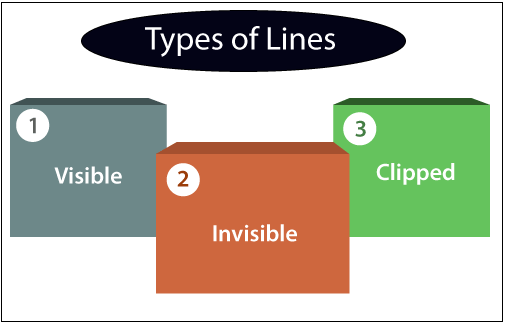
The lines are divided into three types.

  • Visible Line
  • Invisible Line
  • Clipped Line
Clipping
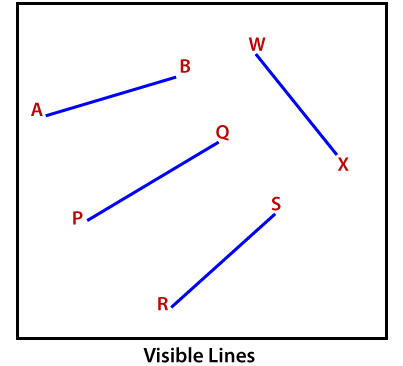
  • Visible Line: The line lying inside the view pane, is a visible line.
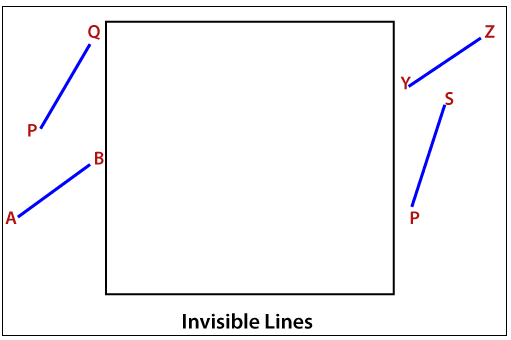
  • Invisible Line: The line lying outside the view pane, is an invisible line.
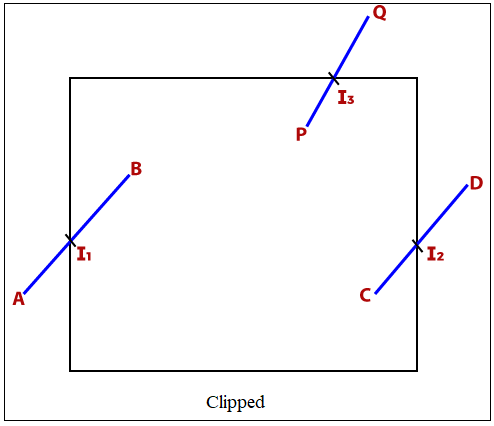
  • Clipped Line: “A line that lies inside or outside the window is called clipped line.A point where the line cut the view pane is known as the Intersection point of the line

Examples of Lines

There are some figures given below that represents the types of line.
Clipping2
Clipping3
Clipping4

We can use the clipping process with world coordinates. The object and images in view pane can be mapped to device coordinates.                     
Clipping5

Types of clipping

We can divide clipping into following types-

  1. Line clipping
  2. Point clipping
  3. Text clipping
  4. Exterior Clipping
  5. Curve clipping
  6. Polygon clipping

Related Topics

Transformation

Introduction The term Transformation is generally referred to as converting a graphic into another graphic by applying some rules or algorithms. Sometimes an image or picture can be a combination of lines, rectangle,...

2 minutes read.

Point Clipping

“Point clipping is a process which is used to define the point position.” The point is either inside the view pane (window) or outside the view pane. In computer graphics, the computer...

2 minutes read.

2D Transformation in Computer Graphics

Some visuals are transformed into some other graphics by implementing several of the principles known as transformation. There are multiple kinds of transformation, including translation, scaling, rotation, shearing, etc. Whenever...

2 minutes read.

Homogenous Coordinates in Computer Graphics

Homogenous Coordinates in Computer Graphics The orbit of a point, a line graph or the whole picture on the computer, a point besides the origin, is accomplished by first shifting the...

7 minutes read.

Pointing and Positioning Technique Computer Graphics

Pointing and Positioning Technique: The pointing and positioning are interactions used in computer graphics. A pointing device is also called a Pointing tool. A pointing tool is a hardware component,...

4 minutes read.

Filled Area Primitives Computer Graphics

Filled Area Primitives: Area filling is a method or process that helps us to fill an object, area, or image. We can easily fill the polygon. The polygon filling is...

4 minutes read.

Scan Conversion in Computer Graphics

“When we represent regular objects in the form of discrete pixels, it is called Scan Conversion.” Every graphics system must transform the primitives into a collection of pixels. The scan conversion is also...

2 minutes read.

Rendering in Computer Graphics

Rendering in Computer Graphics Rendering is the operation, by virtue of a software system, of creating a picture from a template. In a specifically defined term or information structures, the model is a...

9 minutes read.

Illumination Model in Computer Graphics

Illumination Model in Computer Graphics The series of methods used to depict light in computer graphics scenarios is computer graphics illumination. Although lighting strategies provide versatility in the degree of detail...

8 minutes read.

Output Devices in Computer Graphics

Computer Graphics Output Devices An output device is a component of hardware or the main physical part of a computer that can be touched and seen. An output device is an electromechanical device. “The...

5 minutes read.

3d Scaling

The 2D and 3D scaling are similar, but the key difference is that the 3D plane also includes the z-axis along with the x and y-axis. In scaling, we can expend...

2 minutes read.

Zooming

In computer graphics, the term “Zoom is referred as a function, focuses on a particular portion or part of an image and also enlarging the image’s size for greater details.” In windows...

2 minutes read.

3D Translation

A 3D Translation process contains the x-axis, y-axis, and z-axis. We can move any object from one place to another without changing the shape of the object. For Example-Translation of a...

1 minute read.

3D Reflection

The Reflection is a mirror image of the original object. We can differentiate 2D and 3D reflection by adding Z-axis. The Z-axis shows the depth of the surface. In the...

1 minute read.

Line Drawing Algorithm in Computer Graphics

“The Line drawing algorithm is a graphical algorithm which is used to represent the line segment on discrete graphical media, i.e., printer and pixel-based media.” A line contains two points....

3 minutes read.

Projection in Computer Graphics

Projection Introduction: The technique projection was invented by the Swiss mathematician, engineer, and astronomer "Leonhard Euler Around" in 1756. The "Episcope" was the first projection system. “Projection is a technique or process which...

4 minutes read.

Scan Conversion of an Ellipse Computer Graphics

Scan Conversion of an Ellipse: An ellipse can be defined as a closed plane curve, which is a collection of points. It is the cause of the intersection of a...

8 minutes read.

2D Translation

We can move any object from one to another place without changing the shape of the object. For Example- Translation of a Point:If we want to translate a point from P (x0,...

1 minute read.

Bresenham’s Circle Drawing Algorithm in Computer Graphics

Bresenham’s algorithm is also used for circle drawing. It is known as Bresenham’s circle drawing algorithm. It helps us to draw a circle. The circle generation is more complicated than...

11 minutes read.

Computer Graphics Tutorial

Introduction to Computer Graphics Computer graphics is commonly seen as a computer science branch that deals with the computerized image fusion theory and technology. As simple as a triangle outline, a...

6 minutes read.