
Zooming

In computer graphics, the term “Zoom is referred as a function, focuses on a particular portion or part of an image and also enlarging the image’s size for greater details.”

In windows in GUI (Graphical user interface), the term “zoom can be defined as the maximization of the size of the image.” In Apple computers, we use a box to increase the size of the window or image called “Zoom box.” The process of zooming represents the pixels instead of scan lines.

There are following zooming processes:

  • Zoom In: It is aprocess to compress the size of an image. It is also called “Minimization.”
  • Zoom Out: It is a process to expandor increase the size of an image. It is also known as “Maximization.”
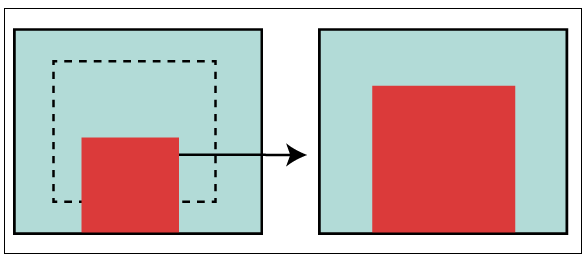
Zooming

We can zoom in 1600% an image of the original size of the image.                               

Optical Zoom

In a digital camera, the zoom is a feature. It uses optics in the lens to zoom in the size of any object in the image without moving closer. The digital camera is also having a concept of digital zoom. Digital zoom uses digital technology to get closer shots. It is actually beyond the capabilities of the camera lens. A digital zoom has 300x zooms in capability.

How to Use Zoom In and Zoom Out

Some programs and browsers allow us to use keyboard shortcuts to zoom in and zoom out an image and a web page also.

Ctrl + Plus key =   To zoom in the image or web page.

Ctrl + Minus key =   To zoom out the image or web page.

Ctrl + 0 =   To reset zoom of an image or web page to default size.

Difference between digital zoom and optical zoom

In Digital Zoom-

  • It crops the image and zoom in the selected portion of the image
  • Sometimes it results in the loss of quality.

In Optical Zoom-

  • The focal length and magnification of the lens are changed when it is zoom in.
  • It results in high zooming quality with a zooming range.

Advantages of Optical Zoom

  1. Adjustable focal length.
  2. Provide a zoom ring on the lens.

Disadvantages of Optical Zoom

  1. Difficult to maintain.
  2. Sometimes susceptible due to dust and bad weather.   

Related Topics

Image Representation in Computer Graphics

Image Representation: In computer science, we can represent an image in various forms. Most of the time, it refers to the way that brings information, such as color is coded digitally, and...

4 minutes read.

Aspect Ratio in Computer Graphics

Aspect Ratio in Computer Graphics You might well understand the concept of Aspect ratio as of now if you know regarding aerial photography or see the configuration portion of any computer...

5 minutes read.

Computer Graphics Window

“The process of selecting and viewing an image with different views, called windowing.” All the objects in the real world have a size. We can measure the size and location of...

4 minutes read.

Display Processor

It is a part of hardware or interpreter which is used to transform display processor code into pictures. It is used to convert digital information from CPU to analog data. It...

4 minutes read.

Filled Area Primitives Computer Graphics

Filled Area Primitives: Area filling is a method or process that helps us to fill an object, area, or image. We can easily fill the polygon. The polygon filling is...

4 minutes read.

2D Rotation

The Rotation of any object depends upon the two points. Rotation Point: It is also called the Pivot point. Rotation Angle: It is denoted by Theta (). We can rotate an object in...

1 minute read.

2D Reflection

The Reflection is a mirror image of the original object. In the Reflection process, the size of the object does not change. We can represent Reflection by using four ways- Reflection along...

2 minutes read.

2D Translation

We can move any object from one to another place without changing the shape of the object. For Example- Translation of a Point:If we want to translate a point from P (x0,...

1 minute read.

3D Rotation

The 3D rotation is different from 2D rotation. In 3D Rotation we also have to define the angle of Rotation with the axis of Rotation. For Example- Let us assume, The initial...

2 minutes read.

3D Reflection

The Reflection is a mirror image of the original object. We can differentiate 2D and 3D reflection by adding Z-axis. The Z-axis shows the depth of the surface. In the...

1 minute read.

2D Scaling

In scaling, we can expend or compress the size of any object. We can apply scaling on the object by multiplying the original coordinates with scaling factors. The term scaling factor...

2 minutes read.

Bresenham’s Line Drawing Algorithm in Computer Graphics

This algorithm was introduced by “Jack Elton Bresenham” in 1962. This algorithm helps us to perform scan conversion of a line. It is a powerful, useful, and accurate method. We...

8 minutes read.

Panning

“Panning is a process or photographic technique that is used to combine slow shutter speed with camera movement to make a speed sense around the moving object.” We can define panning as...

2 minutes read.

Computer Graphics Tutorial

Introduction to Computer Graphics Computer graphics is commonly seen as a computer science branch that deals with the computerized image fusion theory and technology. As simple as a triangle outline, a...

6 minutes read.

Midpoint Circle Drawing Algorithm in Computer Graphics

The midpoint circle drawing algorithm helps us to calculate the complete perimeter points of a circle for the first octant. We can quickly find and calculate the points of other...

12 minutes read.

Types of Computer Graphics

Types of Computer Graphics The computer graphics contains two types. They are- Raster (Bitmap) graphicsVector graphics Many individuals are likely to consider pictures on computers (or phones, tablets, or some other electronic gadget...

5 minutes read.

Mid-Point Line Drawing Algorithm in Computer Graphics

The Mid-point Subdivision algorithm is the extension of the Cyrus-Beck algorithm. The Mid-Point line plotting algorithm was introduced by “Pitway and Van Aken.” It is an incremental line drawing algorithm....

8 minutes read.

Composite Transformation in Computer Graphics

Composite transformation in Computer Graphics It is possible to integrate a range of transformations or series of transformations into some kind of a single one which is known as composition. The...

6 minutes read.

Illumination Model in Computer Graphics

Illumination Model in Computer Graphics The series of methods used to depict light in computer graphics scenarios is computer graphics illumination. Although lighting strategies provide versatility in the degree of detail...

8 minutes read.

Homogenous Coordinates in Computer Graphics

Homogenous Coordinates in Computer Graphics The orbit of a point, a line graph or the whole picture on the computer, a point besides the origin, is accomplished by first shifting the...

7 minutes read.