Animation in Computer Graphics

The word Animation is extracted from a Latin language, "Anima," which means "Soul." TheAnimation is a technology that allows any image object, an entity to walk, talk, or do some movement that cannot be physically moved.

We use many images to create an animation. The images which have a different reaction, run it together one after another at high speed than the images look- real.

Computer Animation is an art to produce moving images. We can define it as a subfield of computer graphics and animation. When we use animation in a movie or film, it is called CGI (Computer Generated Imaging).
Computer Animation

Application Areas of Animation

Animation is used in various fields. They are:

  1. Education: An animated video or animated tutorial is used to increase the learning of the students. The animation is mostly used in schools, colleges, and training centers.
  2. Entertainment: It is a vast area where we can use animations. Various animation methods are used in cartoons, movies, motion pictures, and TV shows.
  3. Advertisement: Animation is also used to make ad films that take less space and captures the vast attention of the people. It is a better way to provide more information about products.
  4. Medical: Animation is used in medical science. The professionals and the students can easily visualize the details of human anatomy through medical animation.
  5. Retail: The marketers use animation to present the attributes of products to the customers.
  6. Computer-Aided Design: Animation plays an important role in CAD. We can use CAD in automobile designing and many other designing.
  7. Gaming: Animation is widely used in gaming. We can develop 3D games by using animation.
  8. Presentation: We can present anything through an animated presentation. Animated presentation is a better way to represent an idea.

Types of Animation

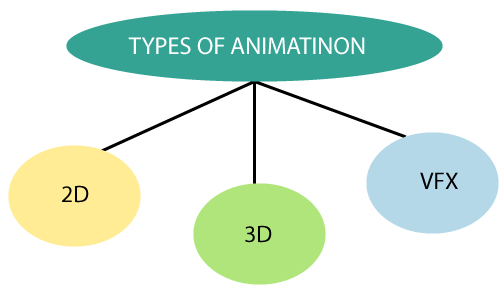
The Animation is divided into three parts.
Computer Animation 1
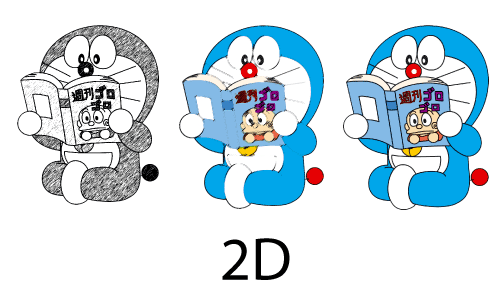
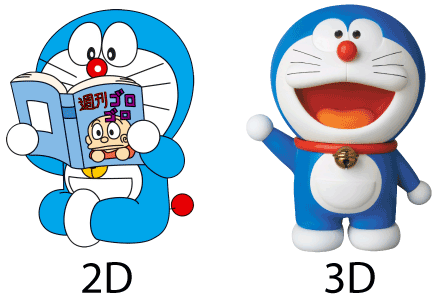
  • 2D: It is also called “2 Dimensional.”2D animation is defined as a process of producing characters, storyboards, and backgrounds in a two-dimensional environment.

2D animation is a flat animation that only works on two coordinates x-axis(horizontal) and y-axis(vertical).

The 2D animation uses raster and vector graphics to produce and edit animated images.

For Example- Cartoons (Daffy Duck, Snow White, the jungle book, etc.)

The software used in 2D animation is:

  1. Adobe Photoshop
  2. Adobe Flash
  3. After Effects
  4. Encore
Computer Animation 2

Advantages:

  1. Easy to Control.
  2. Less Time-Consuming.
  3. Less Production Cost.
  4. Easy to change.

Disadvantages:

  1. Need proper skills to use animation software.
  • 3D: It is also called "3 Dimensional." 3D animation is defined as the process of producing three-dimensional motion images in the digital environment. 3D Animation is used to create animated scenes through the computer.

We can manipulate 3D objects or models through the 3D animation software.

3D animation works on all three coordinates x-axis(height), y-axis(width) and z-axis(depth).

For Example-

  1. Toy Story
  2. Jurassic Park
  3. The Transformers
Computer Animation 3

The software used in 3D animation is:

  1. ZBrush
  2. Houdini
  3. Blender
  4. Autodesk Maya

The process of producing 3D animations is divided into three parts:

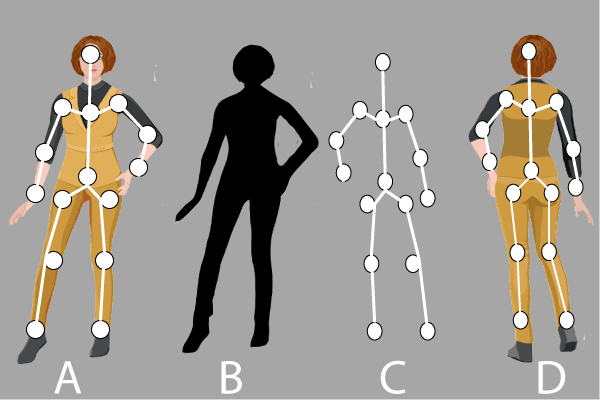
  1. Modeling: It is a phase in which we can describe the creation of 3D objects within a specific scene.
  2. Layout and Animation: It is a phase in which we can describe how objects are positioned and animated within a scene.
  3. Rendering: It is a final process. It is a phase in which we can convert 3D objects or images into 2D objects or images.

Advantages:

  1. Motion Communication
  2. More Realistic
  3. Reusable

Disadvantages:

  1. Lack of purity
  2. Limited Thought and Ideas
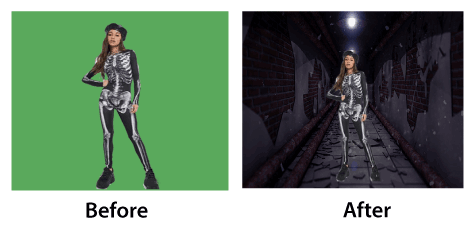
  3. VFX: It is also called “Visual Effects.” It is a process in which we can make a mixture of real shooting (special effects) with animated images (digital effects). It is mostly and widely used in movie making.
Computer Animation 4

For Example-

In a movie, we will see the hero flying into the air by using VFX effects.

In the Jurassic Park movie, the dinosaurs are also created by using VFX effects.

The Software used in VFX animation:

  1. Nuke
  2. After effects
  3. 3D Studio Max
  4. Adobe Creative Suite 4

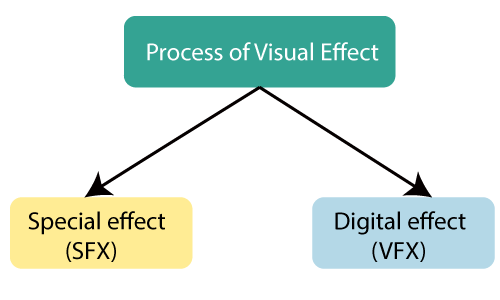
This process has been done in two parts-
Computer Animation 5
  • Special effects (SFX): The special effects cover all visual effects that occur in live-action.

For Example- Stunt, Any Explosion on set.

  • Digital Effects (VFX): It is also called “Visual effects.” It includes different steps by which photographic assets can create, and imagery can manipulate.

Digital effects mostly include a combination of real photography and computer-aided imagery to create a realistic environment. The environment would be impossible, costly, and sometimes very dangerous to shoot in-camera.

Advantages:

  1. It helps to show unreal objects.
  2. It saves a lot of time.

Disadvantages:

  1. Need a Lot of Planning.
  2. Overuse of Visual Effects

Related Topics

DDA line Drawing Algorithm in Computer Graphics

DDA (Digital Differential Analyzer) Line Drawing Algorithm The Digital Differential Analyzer helps us to interpolate the variables on an interval from one point to another point. We can use the digital Differential Analyzer algorithm...

5 minutes read.

3D Rotation

The 3D rotation is different from 2D rotation. In 3D Rotation we also have to define the angle of Rotation with the axis of Rotation. For Example- Let us assume, The initial...

2 minutes read.

Animation in Computer Graphics

The word Animation is extracted from a Latin language, "Anima," which means "Soul." TheAnimation is a technology that allows any image object, an entity to walk, talk, or do some...

3 minutes read.

Zooming

In computer graphics, the term “Zoom is referred as a function, focuses on a particular portion or part of an image and also enlarging the image’s size for greater details.” In windows...

2 minutes read.

Mid-Point Line Drawing Algorithm in Computer Graphics

The Mid-point Subdivision algorithm is the extension of the Cyrus-Beck algorithm. The Mid-Point line plotting algorithm was introduced by “Pitway and Van Aken.” It is an incremental line drawing algorithm....

8 minutes read.

Text Clipping

“Text Clipping is a process in which we remove those part (portion) of string that is outside the view pane (window).” Various methods and techniques can do the text clipping. These techniques depend...

2 minutes read.

Color Models in Computer Graphics

"Color model is a 3D color coordinate system to produce all range of color through the primary color set." There are millions of colors used in computer graphics. The light...

3 minutes read.

Computer Graphics Tutorial

Introduction to Computer Graphics Computer graphics is commonly seen as a computer science branch that deals with the computerized image fusion theory and technology. As simple as a triangle outline, a...

6 minutes read.

Anti-aliasing in Computer Graphics

Anti-aliasing in Computer Graphics “Anti-aliasing is a method for eliminating the aliasing effect used in computer graphics. In a 2-dimensional object, the ambient occlusion impact is the existence of sharp edges...

7 minutes read.

2D Scaling

In scaling, we can expend or compress the size of any object. We can apply scaling on the object by multiplying the original coordinates with scaling factors. The term scaling factor...

2 minutes read.

Display Devices in Computer Graphics

The display device is an output device used to represent the information in the form of images (visual form). Display systems are mostly called a video monitor or Video display unit (VDU). Display devices are designed to model, display, view, or display information. The...

6 minutes read.

Line Drawing Algorithm in Computer Graphics

“The Line drawing algorithm is a graphical algorithm which is used to represent the line segment on discrete graphical media, i.e., printer and pixel-based media.” A line contains two points....

3 minutes read.

Image Representation in Computer Graphics

Image Representation: In computer science, we can represent an image in various forms. Most of the time, it refers to the way that brings information, such as color is coded digitally, and...

4 minutes read.

Projection in Computer Graphics

Projection Introduction: The technique projection was invented by the Swiss mathematician, engineer, and astronomer "Leonhard Euler Around" in 1756. The "Episcope" was the first projection system. “Projection is a technique or process which...

4 minutes read.

Scan Conversion in Computer Graphics

“When we represent regular objects in the form of discrete pixels, it is called Scan Conversion.” Every graphics system must transform the primitives into a collection of pixels. The scan conversion is also...

2 minutes read.

Scan Conversion of a Circle Computer Graphics

A circle is an eight-way symmetric shape. All quadrants of a circle are the same. There are two octants in each quadrant of a circle. If we know the value of any...

3 minutes read.

Line Clipping in Computer Graphics

The line clipping is a process in which we can cut the part of the line, which lies outside the view pane. Only those lines are visible, which lie inside the view pane....

13 minutes read.

2D Translation

We can move any object from one to another place without changing the shape of the object. For Example- Translation of a Point:If we want to translate a point from P (x0,...

1 minute read.

Bresenham’s Line Drawing Algorithm in Computer Graphics

This algorithm was introduced by “Jack Elton Bresenham” in 1962. This algorithm helps us to perform scan conversion of a line. It is a powerful, useful, and accurate method. We...

8 minutes read.

Aspect Ratio in Computer Graphics

Aspect Ratio in Computer Graphics You might well understand the concept of Aspect ratio as of now if you know regarding aerial photography or see the configuration portion of any computer...

5 minutes read.