
×

Blockchain Merkle Trees

Blockchain Merkle Trees

Merkle Trees are foundation components of the blockchain mechanism. The methodical, systematic, and reliable verification of content in unbounded and dispersed data sets is enabled with the use of Merkle Trees. Blockchain implementations such as Bitcoin and Ethereum use Merkle Trees as essentials. Merkle Trees help in validating the stability and essence of data. It provides a hashed structure, which not only protects data cryptographically but also maintains its integrity.

History of Merkle Trees

The concept of Merkle Trees came into existence in the year 1979. A student at Standford University named Ralph Merkle wrote a paper labeled "A Certified Digital Signature," which proved to be a major breakthrough to initiate the development of blockchain. The paper discussed new methodologies for creating proofs. The process of verifying data much faster than existing methods made Merkle’s paper a success. The pattern of encrypting computer protocol functions radically changed after the introduction of Merkle Trees. Since then, the popularity and use of Merkle Trees have grown tremendously.   

Working of Merkle Trees

Each block in a blockchain network has thousands of transactions stored in it, along with a transaction ID for its authentication. Thus, a considerable amount of the space and time is required to manage and process these transactions. Employing the least amount of data in verifying and processing these transactions is preferable. This is what exactly Merkle Trees do.

  • Merkle Tree collects every transaction in a block and creates a digital fingerprint of the complete set of operations. This fingerprint is a 64 character code labeled as Merkle Root.  It permits a user to substantiate the inclusion of a transaction in a block.
  • The process of the generation of Merkle Roots takes place in pairs. For 600 transaction IDs, grouping into 300 pairs will be done.
  •  Repetitive hashing of each pair of nodes is done until there is only one hash left, called the Root Hash (or the Merkle Root). Bottom up approach is followed for the construction of Root, starting from hashing singular transaction IDs.
  • There are two kinds of nodes in a Merkle Tree-
  • Leaf node- Contains hash of Transactional data
  • Non-Leaf node- Contains hash or previous hashes
  • The Merkle Tree is binary in nature and thus requires an even number of leaf nodes. In the case of an odd number of nodes, the hash of the last node is copied, and one extra node is created for uniformity.

Example of Merkle Tree

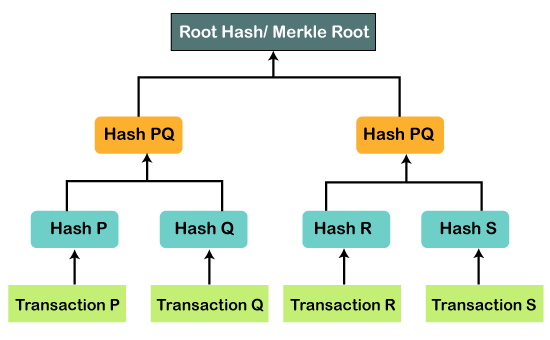
  1. In the example given below, there are four transactions, labeled P, Q, R, and S. Each Transaction has an associated transaction ID, which is hashed, and each hash is stored in an individual leaf node.
Blockchain Merkle Trees
  • The nodes are grouped successively in pairs and then hashed, the hash is stored in the parent node. For the given example, the nodes containing hash (P) and hash (Q) are paired, and the combined hash value i.e., hash (PQ), is stored in the parent node. Similarly, hash (RS) is stored in the other parent node. The same process is repeated for all pairs of successive nodes.
  • For the final step, the parent nodes are summarized, the nodes containing hash (PQ) and hash (RS) are combined and hashed. This hashed value, hash (PQRS), is stored in the Merkle Root.

Advantages of Using Merkle Tree           

  • It provides integrity and authentication at the most fundamental level.
  • It consumes comparatively very limited data storage for the process of proofing.
  • Little information needs to be transmitted over the unbounded network to carry out the process of substantiation and management.
  • Merkle Trees help advocate that later versions of a log include everything from an earlier version.

Applications of Merkle Trees

  1. Merkle Trees are used by Certification Authorities as a means of certificate transparency. Both public and private key pairs are considered as Merkle Tree leaves. This strategy is opted to avoid rejection if any one of the CA might turn out to be a defaulter and certify a domain without bringing it to the knowledge of the domain's owner.
  • The Root of the Merkle Tree is treated like a public key, and the discrete nodes are used as one-time signatures. The advanced and revised updates of this are robust against quantum attacks.
  • Simplified Payment Verification (SPV) is a technique of authentication, which is used when a specific transaction is included in a block without completely downloading it. Merkle trees are used thoroughly by SPV nodes.
  • These are used as building blocks of data structure by Ethereum and Bitcoin.

Related Topics

What does the IT industry mean by BaaS (Blockchain as a Service)?

Technology is developing quite quickly and all businesses are racing to catch up with these technological advancements or face the danger of going out of business in the long term....

5 minutes read.

History of Blockchain

History of Blockchain: Satoshi Nakamoto modeled the first Blockchain and explained the details of how a technology was well-found to enhance digital trust, given the immutable and decentralization aspect that...

2 minutes read.

Introduction and Features of Cryptography

What is Cryptography? Secret coding has been a part of military activities for many years. In old times people know how to communicate privately. So we can say that private communication...

3 minutes read.

Difference between Blockchain and Database

A Blockchain is a distributed database or ledger in which data is stored in blocks. It is built on distributed ledger technology, which may be utilized between parties that do...

3 minutes read.

Top Blockchain Project Ideas for Beginners

Blockchain is a distributed, unchangeable ledger that makes it easier to record transactions and track assets within a business network. An asset can be either physical (a house, car, money,...

6 minutes read.

Sending and Receiving Bitcoin

The goal of this part is to show you how to get started with Bitcoin in a simple way. 1. Get to Know Bitcoin Bitcoin has certain unusual characteristics. It behaves similarly...

4 minutes read.

IP Security in Cryptography

IPsec (Internet Protocol Security) is a collection of algorithms and protocols used to secure the data transmitted over a public network. The Internet Engineering Task Force (IETF) was developed in...

6 minutes read.

Cryptography in Blockchain

What is Cryptography? Cryptography is a method for developing codes that prevent third parties from viewing private data. It helps in protecting data and information by using codes, such that it can only be...

4 minutes read.

Coinbase Transaction

Several transactions occur on a cryptocurrency network, but these transactions may not be transactions between two people. Some transactions which take place are a bit different from other transactions. &...

4 minutes read.

Blockchain Tutorial

The 21st century is all about digitalization and technology. With the rising need for modernization in our daily lives, people are exploring new technologies. Blockchain technology has created a stir...

6 minutes read.

Blockchain Hash Function

A hash function is a type of function which takes input in string format (alphabets, media files, numbers) of any length provided by the users and converts it to a...

3 minutes read.

HMAC Algorithm in Cryptography

HMAC stands for Hash-Based Message Authentication Code. It is a type of message authentication code that is obtained by executing a cryptographic hash function that is used to be authenticated...

3 minutes read.

ECB Mode in Cryptography

What is Electronic Code Book (ECB)? Electronic Code Book (ECB) is a simple type of operational technique associated with a block cipher and performs symmetric key encryption. It is also a technique...

3 minutes read.

What are the steps to becoming a Blockchain developer

What do you need to do to become a Blockchain Developer? Blockchain is one of the most rapidly emerging technology and industry in today's IT market. The world market for Blockchain...

5 minutes read.

Blockchain Data Management

As we all know, Blockchain is a distributed systems that follows peer-to-peer network and acquire the benefits of peer-to-peer networks such as speed, single-point failure avoidance, and so on. The Peer-to-Peer...

4 minutes read.

Decentralized Voting System using Blockchain

In the era of Industry 4.0, Blockchain is a technology that is fast gaining traction. It is widely utilized in supply chain management systems, healthcare, payments, business, IoT, voting systems,...

3 minutes read.

How can Blockchain Technology help IoT to reach its full potential

The Blockchain technology has huge potential to speed up the IoT's efficient operation. Since then, security has been a big worry with IoT, which has hampered its widespread adoption. IoT...

4 minutes read.

Ethereum 2.0

What is Eth2? Eth2 refers to a set of improvements to security, Ethereum's scalability and long-term sustainability. These improvements are being worked on by a number of teams from throughout the Ethereum...

6 minutes read.

Feistel Cipher in Cryptography

What is Feistel Cipher? A Feistel Cipher is a structural model that is used to build various symmetric block Ciphers similar to DES. This structural model can be self in veritable....

4 minutes read.

Who sets the Bitcoin Price

The function of Bitcoin is very similar to a commodity. Bitcoin's price is decided by the market where it is traded. To put it another way, how much someone is...

4 minutes read.