
Smart Contracts
What is a Smart Contract?
A smart contract is a self-executing computer program. It is a decentralized computation program, which directly controls the transfer of digital assets between different parties under certain pre-defined conditions. Smart contracts exist on the internet and are executed on the software program.
Smart contracts are stored on a Blockchain and automatically executed when pre-set terms and conditions are met. It can execute transactions in a wide range of fields, from cryptocurrency to insurance premiums.
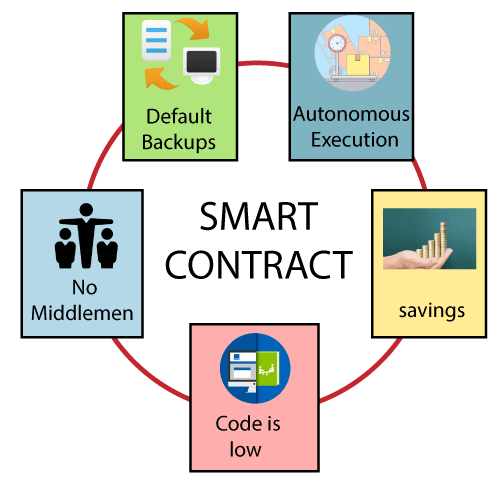
We can create a sample smart contract using solidity interface, following are the steps:
- Setting up an ethereum node or bitcoin node
- Establishing our own private cryptocurrency network
- Interact with Matamask(Digital Wallet)
- Download the mist browser & connect to our network
- Inject with web3 js library
- Hands-on Solidity
- Building out the contracts in Mist
What is the Solidity interface?
Solidity interface refers to an object-oriented contract-based programming language for writing a smart contract. It means smart contracts are responsible for recording all the programming logics that transact with the blockchain. It is statically captured scripting language similar to javascript that does the process of verifying & enforcing the constraints at compile time as conflicting to run-time.
Ethereum network is the best platform for creating and executing smart contracts. The smart contract is one of the most successful blockchain applications that helps in reducing transactions cost-effectively. Smart contracts offer you exchange property, money, shares, data, or anything transparently while avoiding the services of a third party or lawyer.
Smart Contract Use Cases
Smart Contracts are really impressive, as their prospective goes beyond the transfer of digital assets. There are various use cases of a smart contract as its self-executing nature makes it better for some industries. These uses cases are given below:
1. Banking and Financial Services
The traditional banking and payment structures are time taking and annoying. There is a third party to authenticate the transaction, and we have to pay extra money for this. The smart contract can speed up transactions and simplify commercial processes. Smart contracts completely avoid the role of any third party entity in the network.
As there is no central administration involved, transactions become fast and money-saving. Smart contracts can be used in many sectors like insurance claims, medical, bank loans, online payments, to accelerate the transactions fast and transparent.
2. Smart contract in Health Care
Smart contracts are not only for fast and secure transactions but also help in various other sectors like health care, health insurance, and health record, etc. Smart contract stores records and information on a shared ledger. It means a patient can quickly move from one hospital to another without filling numerous forms. These processes may take a long time without Smart contracts.
3. Prediction Markets and Gambling
The internet is full of things, including prediction and gambling. Prediction markets are not new but never become mainstream due to the high involvement of risk. However, technically educated players can gain a good amount with the help of a Smart Contract.
Smart contracts provide a transparent and honest environment for gambling. There are already few prediction platforms like gnosis, and Augar that are working on the Blockchain Smart contract.
4. Real Estate Recording
Smart contracts allow real estate assets to be stored and transferred digitally from one client to another without any hustle. Nobody will be able to challenge the legitimacy of the transferred assets as the record is shared on a public ledger. Smart contracts minimize the chances of fraud.
5. Digital Identity
Nowadays, to collect all the personal information in one place, you need to carry many papers at a time as different organizations ask for various details like bank records, dob, job details, ownership, etc. Smart contracts allow us to keep all the personal or professional data in single place. It make easy KYC (know your customer) verification.
Advantages of Smart contract
Smart contracts have number of advantages over the previous provisions. The number of benefits is likely to increase in the future as the Blockchain technology grows and improves. Here are a few benefits of using smart contract:
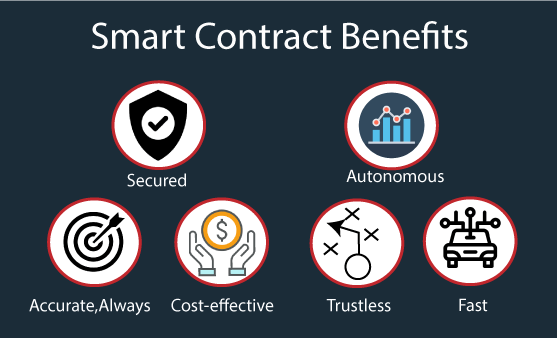
- Autonomy: We are the one making the agreement. It allows us to make our own decisions without being controlled by anyone else in the network. Users have the authority to make terms and conditions on their own.
2. Trust: Your documents are encrypted on a shared ledger. Immutable ledger means transactions are unalterable. These records are trackable and irreversible.
3. Backup: Traditional storage may fail to contain backup of the documents, but here your documents are duplicated many times over the network. That allows you to recover your data quickly.
4. Safety: Smart contract executes transaction very fast. Blockchain technology creates distributed ledgers that record proof of mined transactions. It saves your money and documents significantly.
5. Accuracy: Smart contracts are the faster and cheaper in nature and also avoid the chances of errors that occur from manual filling of records. Smart contracts improve speed and accuracy as they are automatic. They store data digitally on a shared ledger to save your time and provide accurate output.
6. Efficiency: Fast transaction saves more time when compared to traditional methods. It improves the effectiveness of the platform on which they operate. The self-execution of code improves the efficiency of the server.
Disadvantages of Smart contracts
Smart contracts and blockchain also have some difficulties. Here are a few disadvantages of Smart contract:
- Users have lack of technical knowledge as the blockchain is a new technology. Self-executable codes can also make mistakes as they are developed by humans.
- You cannot change your mind once data is registered. It is not possible to make a correction in the stored record.
- Smart contracts are executed only with the help of programming, which is done by an experienced developer to avoid the fail. This needs a high implementation cost.
- Smart contracts are programmers dependent hence there is always the possibility for bugs in the code.
Most of the disadvantages are because of the lack of technical knowledge. Smart Contracts have chances to become a great asset of Blockchain technology as it is still in the improvement phase.