
×

Look Disk Scheduling

Look Disk Scheduling

Look disk scheduling is another type of disk scheduling algorithm. Look scheduling is an enhanced version of SCAN disk scheduling. Look disk scheduling is the same as SCAN disk scheduling, but in this scheduling, instead of going till the last track, we go till the last request and then change the direction.

Advantages of Look Disk Scheduling

The advantages of look disk scheduling are:

  1. In Look disk scheduling, there is no starvation.
  2. Look disk scheduling offers low variance in waiting time and response time.
  3. Look disk scheduling offers better performance as compared to the SCAN disk scheduling.
  4. In look disk scheduling, there is no requirement of disk head to move till the end to the disk when we do not have any request to be serviced.

 Disadvantages of Look Disk Scheduling

The disadvantages of Look disk scheduling are:

  1. In look disk scheduling, there is more overhead to find the end request.
  2. Look disk scheduling is not used in case of more load.

Example of Look Disk Scheduling

Consider a disk contains 200 tracks (0-100). The request queue includes track number 82, 170, 43, 140, 24, 16, 190, respectively. The current position of the read/write head is 50. The direction is towards the larger value. Calculate the total number of cylinders moved by head using look disk scheduling.

Solution:

As mentioned in the following example, disk contains 200 tracks, so we take a track line between 0 to 199.

The current position of the read/write head is 50, So we start at 50, then we move the read/write head. (the disk head is moved towards the larger value as mentioned in the given example). When all the requests are addressed, then we calculate the total number of cylinders moved by the head.
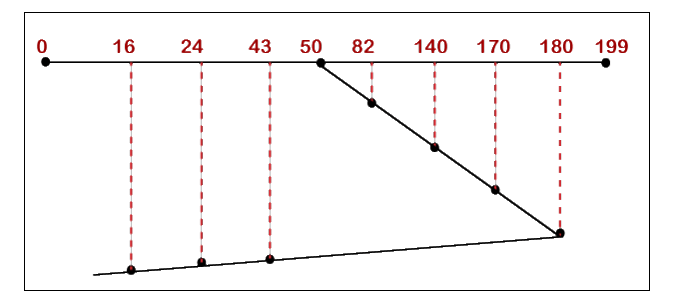
Look Disk Scheduling

                                                               Figure: Look Disk Scheduling

 Total number of cylinders moved by the head = (190-50) + (190-16)

                                                                             = 314

C-Look Disk Scheduling

C-look means circular-look. It takes the advantages of both the disk scheduling C-SCAN, and Look disk scheduling. In C-look scheduling, the disk arm moves and service each request till the head reaches its highest request, and after that, the disk arm jumps to the lowest cylinder without servicing any request, and the disk arm moves further and service those requests which are remaining.

Advantages of C-Look Disk Scheduling

The advantages of C-look disk scheduling are:

  1. There is no starvation in C-look disk scheduling.
  2. The performance of the C-Look scheduling is better than Look disk scheduling.
  3. C-look disk scheduling offers low variance in waiting time and response time.

Disadvantages of C-Look Disk Scheduling

The disadvantages of C-Look disk scheduling are:

  1. In C-Look disk scheduling there may be more overhead to determine the end request.
  2. There is more overhead in calculations.

Example of C-Look Disk Scheduling

Consider a disk containing 200 tracks (0-100). The request queue contains the track number 93, 176, 42, 148, 27, 14,183 respectively. The current position of the R/W head is 55. The direction is towards the larger value. Calculate the total number of cylinders moved by head using look disk scheduling.

Solution:

As mentioned in the following example, disk contains 200 tracks, so we take a track line between 0 to 199.

The current position of the read/write head is 55, So we start at 55, then we move the read/write head (the disk head is moved towards the larger value as mentioned in the given example). When all the requests are addressed, then we calculate the total number of cylinders moved by the head.
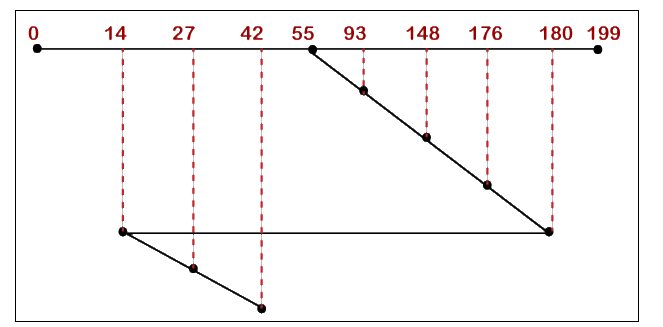
Look Disk Scheduling

                                                                   Figure: C-Look Disk Scheduling  

Total number of cylinders moved by the head = (180-55) + (180-14) + (42-14)

                                                                    = 125 + 166 + 28

                                                                             = 319


Related Topics

Interested Variable Mechanism

Interested Variable Mechanism It is a must to provide progress to the process synchronization mechanism. In variable mechanism, if there is a process that doesn’t need to enter into the critical section, then due...

5 minutes read.

Booting Process in Operating System

What is Booting? Booting is defined as the term which says that the process of loading the operating system into the memory. The process of booting begins when we switch on...

4 minutes read.

HRRN Scheduling in OS

Highest Response Ratio Next (HRRN) Scheduling in OS Highest Response Ratio Next Scheduling is a Non-Preemptive Scheduling algorithm. This algorithm provides the benefits of the shortest job first scheduling algorithm and also removes...

6 minutes read.

Evolution of Operating System

Evolution of Operating System The evolution of various types of operating systems can be briefly described as follows: Serial Processing Since 1950, the operating system started to be in use. Before 1950, there...

5 minutes read.

Difference between Rotational Latency and Disk Assess Time in Disk Scheduling

Disk scheduling is used by operating systems to arrange the arrival of I/O requests to the disc. Disk scheduling is necessary because several I/O requests may occur from various processes,...

4 minutes read.

Deadlock Avoidance

Deadlock Avoidance In an operating system, for deadlock avoidance, we perform the following: We only grant the request of the resources if the resulting state of the system will not cause any deadlock in the...

3 minutes read.

Advantages of UNIX Operating System

What is UNIX OS? UNIX is a family of multitasking, multiuser operating systems that are used on a wide variety of computer platforms. It was developed in the late 1960s and...

4 minutes read.

Linux Operating System

What is Linux? The Linux operating system is used on various devices, including cellphones, automobiles, supercomputers, household gadgets, personal computers, and business servers. You can find Linux on your phones, thermostats, vehicles,...

8 minutes read.

Feedback Queue in Operating System

In a computer or a laptop, there is a processor which do all the tasks. The processor cannot do all the tasks at a time. So, the tasks will be...

3 minutes read.

Page Table in Operating System

What is a Page Table? A page table is a data structure used by an operating system (OS) to store information about the physical location of the pages in a computer's...

6 minutes read.

Difference between Protection and Security in Operating System

Some operating system mechanisms facilitate us to stop tampering with logical and physical resources. Some of these methods are security and protection. Protection and security are distinct concepts, despite the...

3 minutes read.

Single-User Operating System

An operating system designed and intended to be used on a computer or device with a single user at a time is known as a single-user operating system. Devices like...

8 minutes read.

Look Disk Scheduling

Look Disk Scheduling Look disk scheduling is another type of disk scheduling algorithm. Look scheduling is an enhanced version of SCAN disk scheduling. Look disk scheduling is the same as SCAN disk scheduling,...

4 minutes read.

CPU Scheduling in OS

What is Scheduling? Scheduling is the process that is used to share the computing resources such as memory, processor time, and bandwidth to the different processes, data flows, threads, and applications that need...

5 minutes read.

Strategies for Handling Deadlock

Strategies for Handling Deadlock The Strategies for handling Deadlock are: Deadlock IgnoranceDeadlock PreventionDeadlock AvoidanceDeadlock Detection and Recovery Deadlock Ignorance Deadlock Ignorance is the most popular deadlock handling strategy. We can use this in the various operating systems for...

2 minutes read.

Turn Variable or Strict Alternative Approach

Turn Variable or Strict Alternative Approach Turn Variable Approach is used for process synchronization mechanism, which offers synchronization between two processes. Turn variable is implemented on user mode, and it is a software mechanism. We...

3 minutes read.

Operating System Tutorial

What is an Operating System? An Operating System is a System Software that handles the resources of a computer such as computer hardware and software and offers frequent services to the...

7 minutes read.

Android Operating System

What is Android Operating System? Android is a Linux-based and open-source operating system mainly established for mobile devices like tablet computers and Smartphones. The Android operating system was established by the...

5 minutes read.

Difference between Seek Time and Disk Access Time in Disk Scheduling

Seek Time The time taken for the hard disk controller to detect a specific piece of recorded data is known as the seek time. The amount of time it takes to...

4 minutes read.

DOS Operating System

What is DOS Operating System? An operating system that runs from a hard disk drive is known as the DOS (Disk Operating System).In other words, DOS (Disk Operating System) is defined...

7 minutes read.