
×

Operating System Properties

The Properties of Operating System are:

  1. Batch processing
  2. Multitasking
  3. Multi-programming
  4. Interactivity
  5. Real-Time System
  6. Distributed Environment
  7. spooling

1. Batch Processing

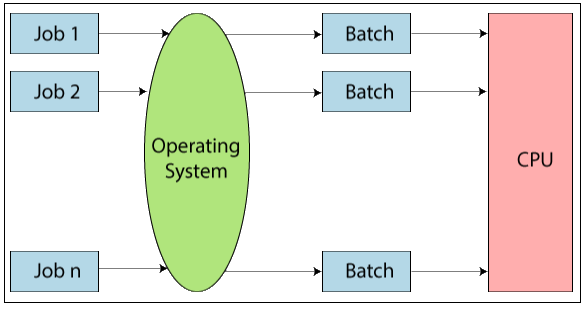
In Batch Processing, the OS first gathers the data and programs together in a batch, then processing starts.

The operating system performs various types of activities related to batch processing:

  • In this, the operating system defines the set of jobs that are re-assigned to a command sequence, data, and programs within a single unit.
  • The operating system keeps the list of jobs in the memory then executes it one by one according to the scheduling algorithm.
  • In this, the job is processed based on FCFS scheduling means first-come, first-serve.
Operating System Properties

Advantage of Batch Processing

The performance is increased because a new job is started early when the old job gets completed without any manual interference.

Disadvantages of Batch Processing

  • Sometimes jobs are entered in an infinite loop.
  • Debugging the program is tough.

2. Multitasking

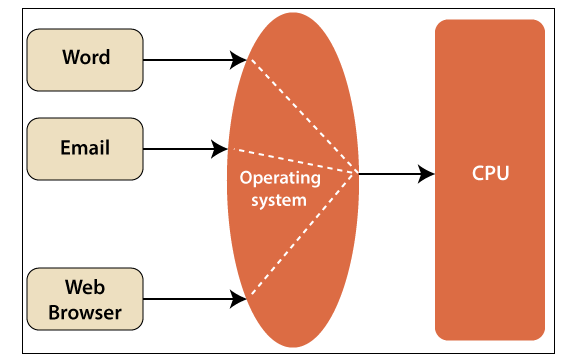
Multitasking is a technique in which the CPU executes a number of jobs within the same time by switching among the jobs. The task of switching the job is so frequent that the user will be able to communicate with each program when the program is running.

The operating system performs the following activities in the context of multitasking.

  • In this, the user directly instructs the OS or the program, and then obtain a fast response.
  • The Operating system manages multitasking in such a way so that multiple operations can be handled at the same time.
  • It is also known as a time-sharing system.
  • Multitasking operating systems are developed so that we can use the computer system interactively at a less price.
Operating System Properties

3. Multi-programming

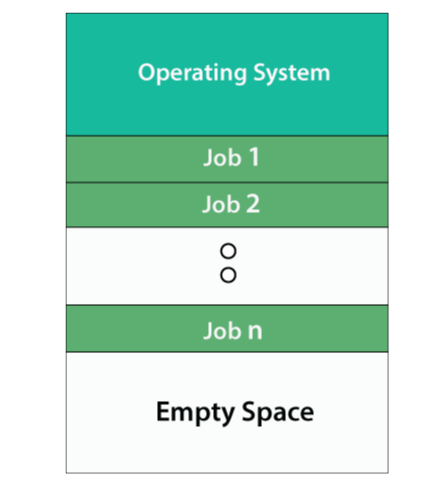
Multi-programming is defined as sharing of the processor when two or more programs exist in the memory at a time. With the help of multi-programming, the CPU utilization efficiency can be increased. In other words, Multi-programming is defined as the capability of an Operating system to run more than one program on a single processor. Example of Multi-programming: A computer can run excel and firebox browser simultaneously.
Operating System Properties

Advantages of Multi-programming

  • Efficient CPU utilization.
  • The users assume that CPU is simultaneously working on multiple programs.

Disadvantages of Multi-programming

  • It needs CPU scheduling.
  • Memory management is needed to accommodate different jobs in memory.

4. Interactivity

Interactivity means the user’s ability to interact with a computer system.

The operating system performs various activities related to interactivity.

  • Handling input devices in order to take the input from the user. Example: - keyboard.
  • It also helps to handle output devices to display output to the user. Example: - Monitor.
  • It provides an interface to the user, so that the user can interact with the system.

5. Real-Time System

We can understand the Real-time system as the dedicated embedded systems,

An operating system performs various tasks related to a real-time system.

  • In a real-time system, the operating system reads and reacts with the help of sensor data.
  • The Operating system provides the assurance that the event is completed within a fixed interval of time to provide accurate performance.

6. Distributed Environment

A Distributed environment defines a set of multiple independent processors or CPUs in a single computer system.

The Operating system performs various activities, such as:

  • The Operating system handles the communications between processors, and communication is done with the help of communication lines.
  • Operating system share computation logic's among different physical processors.
  • The processors will not share the memory; rather, each processor has its own local memory.

7. Spooling

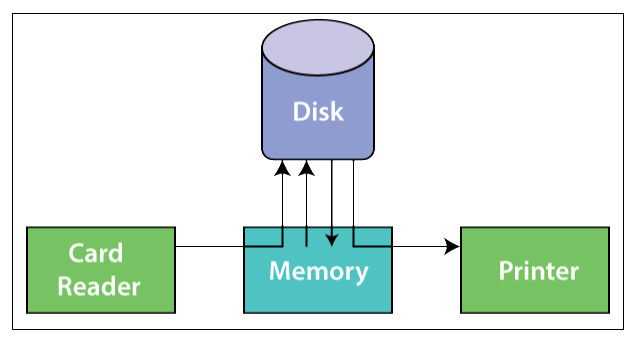
Spooling stands for Simultaneous peripheral operation online. Spooling is a process in which jobs are put into a buffer, disk, or a particular area in the memory so that a device can access these jobs when it is ready.

Spooling is effective because, with the help of spooling devices can access the data with different rates. Buffer offers a waiting station so that data can respite at the time when the slower device catches up. The application of spooling is Print Spooling.

The operating system performs various tasks related to spooling:

  • It manages the I/O device data spooling when devices have multiple data access rates.
  • Handles parallel computation because the process of spooling is done I/O in a parallel way.
  • Handles the spooling buffer that provides the waiting station for the data to take rest in that time when the slower device catches up.
Operating System Properties

 Advantages of Spooling

  • Spooling can overlap the I/O operation for one process with processor operations for another process.
  • It uses disk as a huge buffer for the spooling operations.

Related Topics

Non-Contiguous Memory Allocation in Operating System

Memory is nothing but a storage space where various data are stored. We can store data in temporary and permanent memory as per our future requirements for data. We can...

9 minutes read.

Banker’s Algorithm in Operating System

What is Banker’s Algorithm? Bankers algorithm is an algorithm which is used for deadlock avoidance and resource allocation. It was established by Edsger Dijkstra. The reason behind the name ‘banker’s algorithm’...

8 minutes read.

How to implement Monitors using Semaphores

Monitors Monitor is a type of synchronization device designed to solve difficulties caused by semaphores, such as timing errors. Monitors are the type of data types that are abstract by nature...

2 minutes read.

Multitasking Operating Systems

An operating system is the fundamental piece of software that enables a computer system to function and execute a command as intended. The user interface, hardware, and every other piece...

7 minutes read.

What is Scheduling on OS

Scheduling is the process which is used to share the computing resources such as memory, processor time, and bandwidth to the different processes, data flows, threads, and applications which need them. Scheduling is...

5 minutes read.

What is Thread and Types of Thread

What is Thread A thread means a lightweight process. Thread is the basic unit of CPU execution, which consists of thread ID, Program counter, set of registers to hold the information of current...

7 minutes read.

Booting Process in Operating System

What is Booting? Booting is defined as the term which says that the process of loading the operating system into the memory. The process of booting begins when we switch on...

4 minutes read.

Can a Computer Run Without the Operating System

Computers may function right out of the box, mostly due to operating systems. Nowadays, there are probably already some pre-installed apps in a new computer when you buy one. Have...

9 minutes read.

Android Operating System

What is Android Operating System? Android is a Linux-based and open-source operating system mainly established for mobile devices like tablet computers and Smartphones. The Android operating system was established by the...

5 minutes read.

Paging and Segmentation in OS

What is Paging in OS? Paging is a storage technique used for memory management. In paging, the (OS) Operating System retrieves the processes from the secondary memory into the main memory,...

6 minutes read.

File Allocation Methods in Operating System

A file allocation method is a way that an operating system stores and retrieves files on a storage device, such as a hard drive or SSD. The file allocation method...

4 minutes read.

Starvation in Operating System

Starvation is one of the major problems occurring when resource management is not done properly. This problem arises in the operating system when the resources are not being allocated for...

4 minutes read.

Strategies for Handling Deadlock

Strategies for Handling Deadlock The Strategies for handling Deadlock are: Deadlock IgnoranceDeadlock PreventionDeadlock AvoidanceDeadlock Detection and Recovery Deadlock Ignorance Deadlock Ignorance is the most popular deadlock handling strategy. We can use this in the various operating systems for...

2 minutes read.

Multiprogramming Operating System

You will discover more about the multiprogramming operating system in this post, including how it functions and its benefits and drawbacks. Each process needs several types of system time, including CPU...

4 minutes read.

Page Table in Operating System

What is a Page Table? A page table is a data structure used by an operating system (OS) to store information about the physical location of the pages in a computer's...

6 minutes read.

Virtual Memory in Operating System

What is Virtual Memory Virtual Memory is a storage scheme in which the users have an illusion that users have a significant amount of Main Memory. We can perform this by taking a...

3 minutes read.

Semaphore in Operating System

What is Semaphore in Operating System Semaphore is defined as an integer variable which is used to solve the problem of the critical section in process synchronization. In semaphore, we use...

3 minutes read.

Partitioning Algorithms

Partitioning Algorithms There are various types of Partitioning Algorithm: First-Fit AlgorithmNext-Fit AlgorithmBest-Fit AlgorithmWorst-Fit AlgorithmQuick-Fit Algorithm 1. First-Fit Algorithm: - In the First-Fit Partitioning algorithm, first, the linked list is scan, and when it...

3 minutes read.

Components of Operating System

Components of Operating System: An operating system is a complex and vast system. We can only create the operating system by dividing it into small parts. Each part must be...

5 minutes read.

Single-User Operating System

An operating system designed and intended to be used on a computer or device with a single user at a time is known as a single-user operating system. Devices like...

8 minutes read.