
×

Unix Operating System

Unix Operating System

Unix Operating System is a multiuser, portable, time-sharing, and multitasking operating system that was developed in 1969. Unix operating system was developed by a group of AT & T Laboratory employees Dennis Ritchie, Joe Ossanna, Douglas Mcllroy, and Ken Thompson at Bell Labs.  The first language that was used to developed a Unix operating system was Assembly Language and then the Unix operating system was developed by using the C language in 1973.

There are several types of Unix operating system which are present in the market such as AIX, BSD, Solaris, and HP Unix. Unix operating system is known as multiuser system because multiple users can use it simultaneously.

Unix operating system is a multitasking environment because in this, we can run number of programs simultaneously.

Unix operating system is mainly made up of three parts such as Kernel, Shell, and File.

Features of Unix Operating System

There are various features of Unix operating System:

  1. Open Source
  2. Multitasking capability
  3. Multi user capability
  4. Security
  5. Portability
  6. Communication
  1. Open Source: - The Unix operating system is an open source code. So anyone can modify the code of the Unix operating system as per the requirements.
  2. Multitasking Capability: - The Unix operating system is a multitasking operating system because in Unix operating system, multiple programs can be run simultaneously. And this feature increases the utilization of the CPU resources. In Unix operating system, we can type a program in a program editor and concurrently we can also run some other commands.
  3. Multiuser Capability: - The Unix operating system is a multiuser operating system because it allows multiple users to use a system simultaneously.
  4. Security: - The Unix operating system is a highly secured operating system because Unix use different provisions to protect the data. Every Unix user is happy to work with the Unix operating system because it provides a virus-free environment to the user.

There are two security levels provided by the Unix operating system:

  1. File Level Security: - File level security is managed or, controlled by the owner of the file.
  2. System Level Security: - System level security is managed or controlled by the system administrator.
  3. Portability: - Portability is the wonderful feature of the Unix operating system. In the Unix operating system, the term portability means that Unix is able to port to every type of operating system. Unix operating system is portable because it is written in C language and the C language is also a portable language.
  4. Communication: - The Unix operating system provides a tremendous communication among the users. The communication can be of any kind means the communication can be within network of the one main computer or in between the network of two or more computer.

In the Unix operating system, we can easily exchange data, programs and mail via networks.

Architecture of Unix Operating System

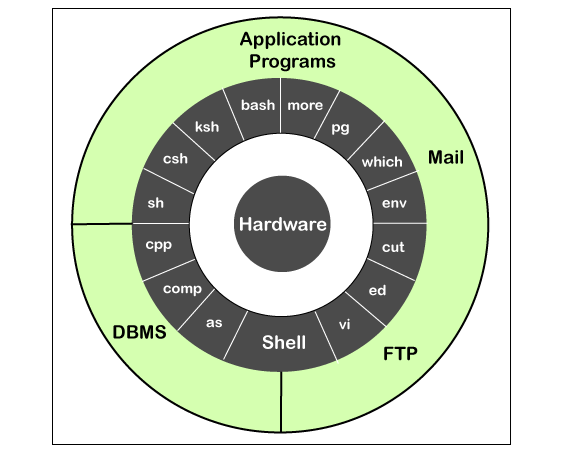
The operating system is mainly made up of four components:

  1. Kernel
  2. Shell
  3. Files and Directories
  4. Commands and Utilities
  1. Kernel: - Kernel is the main component of the operating system. It is like the heart of the operating system. The main task of the kernel is to interact with the hardware and various types of task such as File management, Memory management, and Task management.
  2. Shell: - Another component used to implement a Unix operating system is Shell. Shell is the essential component of the Unix operating system. The shell is a command line interpreter. When the user types the command, the shell interprets it and then shell call that program which need a user. There are various types of standard syntax shell used for the commands such as Korn Shell, C Shell, and Bourne Shell.
  3. Commands and Utilities: - Another component of the Unix operating system is commands and utilities. There are different types of command and utilities which is used to develop the Unix operating system such as grep, mv, cp, and cat.
  4. Files and Directories: - In Unix operating system, files are used to organize the data. Then we organize the files into the directories. Again, organize the directories into a Tree-structure.
Unix Operating System

Related Topics

Inter Process Communication in Operating System

Inter-Process Communication or IPC refers to the methods and techniques that allow processes (programs or tasks) to communicate with each other within a computer system. This is typically done through...

3 minutes read.

Virtual Memory in Operating System

What is Virtual Memory Virtual Memory is a storage scheme in which the users have an illusion that users have a significant amount of Main Memory. We can perform this by taking a...

3 minutes read.

Difference between Protection and Security in Operating System

Some operating system mechanisms facilitate us to stop tampering with logical and physical resources. Some of these methods are security and protection. Protection and security are distinct concepts, despite the...

3 minutes read.

Bit Vector in Operating System

What is Bit vector? Bit vector is one of the most important methods used in the free space management of operating system. Free space management which is used by the operating...

3 minutes read.

Real-time Operating System

In this essay, we will thoroughly understand the real-time operating system. Real-Time Operating System: What do you mean? For any task to be completed, a real-time operating system (RTOS), a special-purpose operating...

5 minutes read.

Trap vs Interrupt in Operating System

What is Trap in Operating System? A trap is a synchronous interrupt used to perform functionality when an error occurs in a user process. A trap in an operating system can...

4 minutes read.

Difference between SCAN and FCFS Disk Scheduling Algorithm

SCAN / Elevator Algorithm A different form of disc scheduling method is the SCAN disc scheduling algorithm. We move the disc arm in a certain direction in this process (the direction...

3 minutes read.

Linux Operating System

What is Linux? The Linux operating system is used on various devices, including cellphones, automobiles, supercomputers, household gadgets, personal computers, and business servers. You can find Linux on your phones, thermostats, vehicles,...

8 minutes read.

Advantages of UNIX Operating System

What is UNIX OS? UNIX is a family of multitasking, multiuser operating systems that are used on a wide variety of computer platforms. It was developed in the late 1960s and...

4 minutes read.

DOS Operating System

What is DOS Operating System? An operating system that runs from a hard disk drive is known as the DOS (Disk Operating System).In other words, DOS (Disk Operating System) is defined...

7 minutes read.

Can a Computer Run Without the Operating System

Computers may function right out of the box, mostly due to operating systems. Nowadays, there are probably already some pre-installed apps in a new computer when you buy one. Have...

9 minutes read.

Deadlock Prevention in Operating System

Deadlock Prevention The conditions which we used for deadlock prevention are: Mutual ExclusionHold and WaitNo PreemptionCircular Wait 1. Mutual Exclusion: - From the resource point of view, the mutual exclusion means that simultaneously more...

4 minutes read.

Free Space Management in Operating System

What is Free Space Management? The system always keeps the records of the free disks blocks for allocating space to files when they are created. To use the space free from...

4 minutes read.

Operating System Tutorial

What is an Operating System? An Operating System is a System Software that handles the resources of a computer such as computer hardware and software and offers frequent services to the...

7 minutes read.

Why is it critical for the Scheduler to distinguish between I/O-bound and CPU-bound programs

A CPU-bound process is one that spends most of its time executing instructions on the processor. A process that is I/O-bound spends most of its time waiting for input and...

2 minutes read.

Evolution of Operating System

Evolution of Operating System The evolution of various types of operating systems can be briefly described as follows: Serial Processing Since 1950, the operating system started to be in use. Before 1950, there...

5 minutes read.

Resource Allocation Graph in Operating System

Resource Allocation Graph in OS We use the resource allocation graph for the pictographic representation of the state of a system. The resource allocation graph contains all the information related to the processes that...

5 minutes read.

Booting Process in Operating System

What is Booting? Booting is defined as the term which says that the process of loading the operating system into the memory. The process of booting begins when we switch on...

4 minutes read.

File Allocation Methods in Operating System

A file allocation method is a way that an operating system stores and retrieves files on a storage device, such as a hard drive or SSD. The file allocation method...

4 minutes read.

Difference between Multi-programming and Multitasking

Difference between Multiprogramming and Multitasking         Multiprogramming  Multitasking In Multiprogramming, at the same time, we can run the multiple processes concurrently on one...

2 minutes read.