
×

Memory Management in Operating System

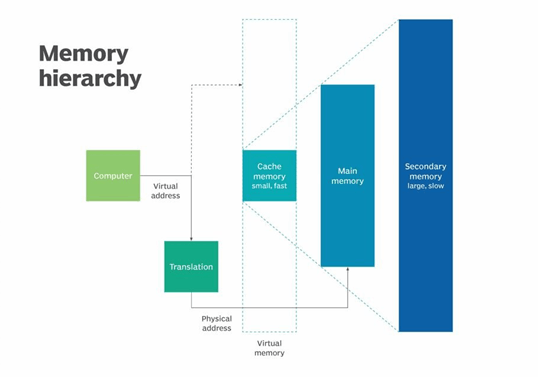
The term "Main Memory" refers to the computer's internal physical memory. It is distinguished from external mass storage devices like disk drives by using the term "main." RAM is another name for the main memory. The computer can only alter data in the main memory. As a result, the system's main memory must be dragged from a memory device for each program and file we run.

In order to run the programs, the main memory is loaded with them all. This mechanism is known as Dynamic Loading, and it improves performance by packing intact software into memory, but only rarely a crucial routine or part of the program is loaded into most of the memory.

Additionally, a program may depend on another program at times. When necessary, the CPU links the dependent programs to the most actively running program rather than loading all of them. This component is perceived as Dynamic Linking.
Memory Management in OS

What is Memory Management in Operating System?

Memory management is the process of coordinating and controlling a computer's memory. Blocks assign portions to various running programs to improve the system's overall performance. This method makes it easier to keep track of every memory location, regardless of whether it has been allocated to a process or is free.

This method decides when and which processes will receive memory. It likewise keeps the count of how much memory can be dispensed to a process. Because it keeps track of everything, any time memory is freed or unallocated, the status changes accordingly.

Memory management is a component of this activity that takes into account the memory device's capacity limitations by allocating memory space when it is no longer required or extending that space through virtual memory. Memory management aims to reduce memory usage so that the central processing unit (CPU) can quickly access the data and instructions it needs to carry out the various processes.

Methods for Memory Management

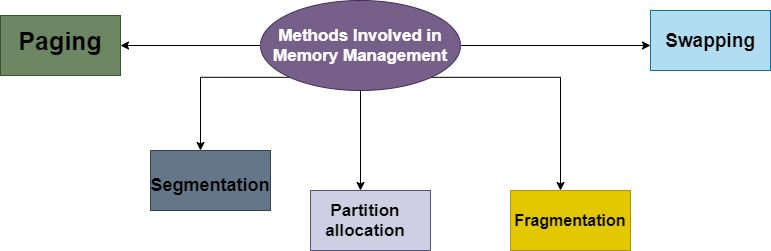
There are a variety of methods for memory management. The Operating System can use these methods to intelligently manage memory:
Memory Management in OS

Swapping in OS

In order to run the OS, a process needs to be in memory. However, there are times when a timesharing system's main memory is insufficient to accommodate all of the currently running processes. As a result, the extra process is brought in to run dynamically and stored on disk. The process of bringing each process in main memory, running it for some time, and then putting it back on the disk is known as swapping.

Contiguous Memory Allocation

In contiguous memory allocation, each process occupies a single, contiguous block of memory. Memory is divided into several partitions of the same size. One process is contained in each partition. A process from the input queue is selected and loaded into a free partition. Holes are the memory's unoccupied blocks. The best hole to allocate is searched through the set of holes.

Memory Protection

Memory protection is the process by which memory access rights on a computer can be controlled. Its primary objective is to prevent a process from accessing unallocated memory. After that it prevents a bug in a process from affecting other processes or the operating system as a whole, resulting in the sending of a segmentation fault or storage violation exception to the troublesome process and, typically, its termination.

Fragmentation

In a dynamic memory allocation system, fragmentation occurs when the majority of the free blocks are insufficient to fulfill any request. The inability to utilize the available memory is the most common name for it.

Processes are loaded into and out of memory in such a scenario. As a consequence of this, free holes are present in order to fulfill a request, but they are non-contiguous, or the memory is divided into large number of tiny cracks. This peculiarity is known as Outer Discontinuity.

Additionally, memory is allocated in terms of block sizes whenever the physical memory is divided into fixed-size blocks. It is possible that the requested memory is slightly larger than the space-allocated memory. Internal fragmentation refers to the memory that is internal to a partition but is of no use the difference between allocated and required memory.

Paging

Paging is one method for dealing with the fragmentation issue. Paging is a memory management technique that prevents a process's physical address space from spreading. Physical memory is here divided into Pages, equal-sized blocks. The pages of a particular process are loaded into memory frames that are available.

Page Table

A Page Table is the information structure involved by a virtual memory framework in a PC working framework to store the planning between the virtual location and actual addresses.

The CPU is responsible for creating the virtual address, which is also referred to as the logical address. While the actual memory address is known as the physical address.

Segmentation in OS

Another memory management method that allows users to view memory is OS Segmentation. Segmentation makes it possible to divide a single process's virtual address space into segments that can be stored in physical memory in non-contiguous locations.


Related Topics

File in Operating System

What is File in Operating System?  A file is defined as a collection of the interrelated information that is stored in the secondary memory or the non-volatile memory such as optical...

4 minutes read.

SJF Scheduling in OS

Shortest Job First (SJF) Scheduling in OS Shortest Job First is a Preemptive or Non-Preemptive algorithm. In the shortest job first algorithm, the job having shortest or less burst time will...

4 minutes read.

File Allocation Methods in Operating System

A file allocation method is a way that an operating system stores and retrieves files on a storage device, such as a hard drive or SSD. The file allocation method...

4 minutes read.

Non-Contiguous Memory Allocation in Operating System

Memory is nothing but a storage space where various data are stored. We can store data in temporary and permanent memory as per our future requirements for data. We can...

9 minutes read.

What is Demand Paging?

Demand Paging is defined as a process in which the pages are loaded into the memory (when the page fault occurs) or on-demand. It consists of the following steps: If there is...

4 minutes read.

What is Context Switching

Context Switching is the switching of CPU from one process to another process. Context switching means storing the process state so that we can reload the process when needed, and the execution...

3 minutes read.

Difference between SCAN and FCFS Disk Scheduling Algorithm

SCAN / Elevator Algorithm A different form of disc scheduling method is the SCAN disc scheduling algorithm. We move the disc arm in a certain direction in this process (the direction...

3 minutes read.

Inter Process Communication in Operating System

Inter-Process Communication or IPC refers to the methods and techniques that allow processes (programs or tasks) to communicate with each other within a computer system. This is typically done through...

3 minutes read.

Dining Philosophers Problem in Operating System

Edsger Wybe Dijkstra was a well-known Dutch scientist. He was the first person ever to present the Dining Philosophers Problem in the stream of Computer Science. The dining philosophers problem...

5 minutes read.

What is Thread and Types of Thread

What is Thread A thread means a lightweight process. Thread is the basic unit of CPU execution, which consists of thread ID, Program counter, set of registers to hold the information of current...

7 minutes read.

Operating System Services

The Operating System provides various types of services:   I/O operationProgram executionFile system manipulationCommunicationError HandlingResource allocationAccountingProtection 1. I/O Operation: - To execute a program, needs I/O, which consists of a file, or I/O device. Due to the protection...

3 minutes read.

Disk Scheduling Algorithms

Disk Scheduling Algorithms Disk scheduling algorithms are the algorithms that are used for scheduling a disk. Generally, the scheduling refers to a time-table for completing any task or a job. With the help...

2 minutes read.

Scheduling Algorithms in OS

There are various types of scheduling algorithm which are used by the operating system to schedule the process on the processor. Objective of Scheduling Algorithms There are the following objectives of Scheduling Algorithms: Fare allocation...

2 minutes read.

How to implement Monitors using Semaphores

Monitors Monitor is a type of synchronization device designed to solve difficulties caused by semaphores, such as timing errors. Monitors are the type of data types that are abstract by nature...

2 minutes read.

Operating System Properties

The Properties of Operating System are: Batch processingMultitaskingMulti-programmingInteractivityReal-Time SystemDistributed Environmentspooling 1. Batch Processing In Batch Processing, the OS first gathers the data and programs together in a batch, then processing starts. The operating system...

3 minutes read.

Page Table in Operating System

What is a Page Table? A page table is a data structure used by an operating system (OS) to store information about the physical location of the pages in a computer's...

6 minutes read.

Trap vs Interrupt in Operating System

What is Trap in Operating System? A trap is a synchronous interrupt used to perform functionality when an error occurs in a user process. A trap in an operating system can...

4 minutes read.

Need of Operating System

There are various needs of operating system: Managing Input-Output UnitThe Operating system as a platform for application programsMultitaskingConsistent user interface Managing Input-Output Unit: - With the help of the operating system, the...

2 minutes read.

Difference between Seek Time and Disk Access Time in Disk Scheduling

Seek Time The time taken for the hard disk controller to detect a specific piece of recorded data is known as the seek time. The amount of time it takes to...

4 minutes read.

Round-Robin Scheduling Algorithm in OS

Round-Robin is a Preemptive Scheduling Algorithm and is the most commonly used algorithm in CPU Scheduling.In this, each Process is assigned with a fix time interval to execute, which is...

5 minutes read.