
×

Semaphore in Operating System

What is Semaphore in Operating System

Semaphore is defined as an integer variable which is used to solve the problem of the critical section in process synchronization. In semaphore, we use two types of atomic operations, and that operations are wait and signal.

The definitions of wait and signal are as follows:

Wait: - In wait operation, the argument ‘S’ value is decrement by 1 if the value of the ‘S’ variable is positive. If the value of the argument variable ‘S’ is zero or negative, no operation is performed.
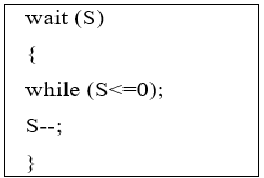
Semaphore in Operating System

Signal: - In Signal atomic operation, the value of the argument variable ‘S’ is incremented.
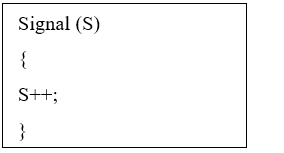
Semaphore in Operating System

Characteristic of Semaphore

There are following characteristics of Semaphore:

  1. Semaphore carries a non-negative integer value always.
  2. We use semaphore mechanism to offer synchronization of tasks.
  3. It is a low-level synchronization mechanism.

Types of Semaphores

We have following two types of Semaphores:

  1. Counting Semaphores
  2. Binary Semaphores
  1. Counting Semaphores: - Counting Semaphore is defined as a semaphore that contains integer values, and these values have an unrestricted value domain. A counting semaphore is helpful to coordinate the resource access, which includes multiple instances.
  2. Binary Semaphores: - Binary Semaphores are also called Mutex lock. There are two values of binary semaphores, which are 0 and 1. The value of binary semaphore is initialized to 1. We use binary semaphore to remove the problem of the critical section with numerous processes.

Advantages of Semaphore

There are following advantages of semaphore:

  1. In the Semaphore, only one process is allowed to enter into the critical section. In this, the principle of mutual exclusion is to be followed strictly. And the semaphore mechanism is a more efficient mechanism than other methods which we use in process synchronization.
  2. It is machine-independent because it is implemented in the microkernel’s machine-independent code.
  3. With the help of the semaphore, the resources are managed flexibly.
  4. In semaphore, there is a busy waiting, so there is no wastage of resources and process time.
  5. In the semaphore, more threads are permitted to enter into the critical section.

Disadvantages of Semaphore

There are following disadvantages of Semaphore:

  1. There is a priority inversion in the semaphore, and this is the biggest drawback of the semaphore.
  2. In the semaphore, due to program error violation of mutual exclusion, deadlock can be happened.
  3. In the semaphore, there are more chances of programmer errors.
  4. For the purpose of large-scale use, the semaphore is not a practical method, and due to this, there may be loss of modularity.
  5. The Programming of the semaphore is tough, so there may be a possibility of not achieving mutual exclusion.
  6. In the semaphore, the OS has to preserve all calls to wait and signal semaphore.

Difference between Counting Semaphore and Binary Semaphore

Counting SemaphoreBinary Semaphore
In counting semaphore, there is no mutual exclusion.In binary semaphore, there is mutual exclusion.
In the counting semaphore, any integer value can be possible.It contains only two integer values that are 1 and 0.
In counting semaphore, there are more than one slots.In the binary semaphore, there is only one slot.
The counting process offers a set of processes.Binary semaphore contains mutual exclusion mechanism.

Difference between Semaphore and Mutex

 Parameter Semaphore Mutex
Data TypeIt is an integer variable.It is an object.
MechanismSemaphore is a signaling mechanism.Mutex is a type of locking mechanism.
TypesThere are two types of semaphore, which are binary semaphore and counting semaphore.There are no types of mutex.
OperationIn semaphore, wait() and signal() operations are performed to modify the value of semaphore.In mutex, locked or unlocked operation is performed.
ThreadIn semaphore, there may be multiple program threads.In mutex, there may also be a multiple program thread but not simultaneously.

Related Topics

What is Thread and Types of Thread

What is Thread A thread means a lightweight process. Thread is the basic unit of CPU execution, which consists of thread ID, Program counter, set of registers to hold the information of current...

7 minutes read.

Operating System Tutorial

What is an Operating System? An Operating System is a System Software that handles the resources of a computer such as computer hardware and software and offers frequent services to the...

7 minutes read.

Unix Operating System

Unix Operating System Unix Operating System is a multiuser, portable, time-sharing, and multitasking operating system that was developed in 1969. Unix operating system was developed by a group of AT &...

3 minutes read.

Can a Computer Run Without the Operating System

Computers may function right out of the box, mostly due to operating systems. Nowadays, there are probably already some pre-installed apps in a new computer when you buy one. Have...

9 minutes read.

Simple Structure in Operating System

An operating system is a piece of software that lets the user applications talk to the hardware of the system. Because it is such a complicated structure, the operating system...

3 minutes read.

Evolution of Operating System

Evolution of Operating System The evolution of various types of operating systems can be briefly described as follows: Serial Processing Since 1950, the operating system started to be in use. Before 1950, there...

5 minutes read.

Swapping in Operating System

Swapping in operating systems refers to temporarily transferring a program or process from main memory to a secondary storage device, such as a hard drive or solid-state drive when there...

4 minutes read.

Monitors in Operating System

Monitors in Operating System Monitors are used for process synchronization. With the help of programming languages, we can use a monitor to achieve mutual exclusion among the processes. Example of monitors:...

3 minutes read.

HRRN Scheduling in OS

Highest Response Ratio Next (HRRN) Scheduling in OS Highest Response Ratio Next Scheduling is a Non-Preemptive Scheduling algorithm. This algorithm provides the benefits of the shortest job first scheduling algorithm and also removes...

6 minutes read.

Kernel in OS

What is Kernel in OS? The kernel is the core component in the operating system. The job of the kernel is to handle the communication between the hardware and the software. ...

2 minutes read.

Deadlock Avoidance

Deadlock Avoidance In an operating system, for deadlock avoidance, we perform the following: We only grant the request of the resources if the resulting state of the system will not cause any deadlock in the...

3 minutes read.

Commercial Mobile Operating Systems

Introduction to Commercial Mobile Operating Systems A computer program's common services are managed by an operating system (OS), which also handles computer hardware and software resources. The user can communicate with...

7 minutes read.

Ubuntu Operating System

Ubuntu Operating System Ubuntu is an open-source and a Linux based operating system. Ubuntu is developed for the Network Servers, Computers, and Smartphones. The Ubuntu operating system was developed by Canonical...

3 minutes read.

Types of Operating System

There are various types of operating system: Simple Batch Operating SystemMultiprogramming batch Operating SystemTime-sharing Operating SystemMultiprocessor Operating SystemDistributed Operating SystemNetwork Operating SystemReal-time Operating SystemMobile Operating System Simple Batch operating system In the simple batch operating system, there is no direct communication between...

6 minutes read.

Lock Variable Mechanism | Operating System

Lock Variable Mechanism The Lock variable mechanism is a synchronization mechanism that is implemented in a user mode. It is a software procedure. Lock variable is a solution for busy waiting that can be...

3 minutes read.

Page Table in Operating System

What is a Page Table? A page table is a data structure used by an operating system (OS) to store information about the physical location of the pages in a computer's...

6 minutes read.

FCFS (First-Come-First-Serve) Disk Scheduling Algorithm

FCFS Disk Scheduling Algorithm FCFS (First-Come-First-Serve) is the easiest disk scheduling algorithm among all the scheduling algorithms. In the FCFS disk scheduling algorithm, each input/output request is served in the order...

4 minutes read.

SCAN Disk Scheduling Algorithm

SCAN Disk Scheduling Algorithm The SCAN disk scheduling algorithm is another type of disk scheduling algorithm. In this algorithm, we move the disk arm into a specific direction (direction can be moved towards...

4 minutes read.

File Allocation Methods in Operating System

A file allocation method is a way that an operating system stores and retrieves files on a storage device, such as a hard drive or SSD. The file allocation method...

4 minutes read.

Advantages of Operating System

What is an Operating System?   An operating system is an interface that helps to communicate with the user and the computer hardware. Operating systems are used for file management, memory...

3 minutes read.