
×

Producer-Consumer Problem in OS

What is Producer-Consumer Problem?

The Producer-Consumer problem is a classical problem. The Producer-Consumer problem is used for multi-process synchronization, which means synchronization between more than one processes.

In this problem, we have one producer and one consumer. The producer is the one who produces something, and the consumer is the one who consumes something, produced by the producer. The producer and consumer both share the common memory buffer, and the memory buffer is of fixed-size.

The task performed by the producer is to generate the data, and when the data gets generated, and then it put the data into the buffer and again generates the data. The task performed by the consumer is to consume the data which is present in the memory buffer.

What are the Problems in the Producer-Consumer Problem?

There are various types of problems in the Producer-Consumer problem:

  1. At the same time, the producer and consumer cannot access the buffer.
  2. The producer cannot produce the data if the memory buffer is full. It means when the memory buffer is not full, then only the producer can produce the data.
  3. The consumer can only consume the data if the memory buffer is not vacant. In a condition where memory buffer is empty, the consumer is not allowed to take data from the memory buffer.

What is the solution for the Producer-Consumer Problem?

There are three semaphore variables that we use to solve the problems that occur in the Producer-Consumer problem.

  1. Semaphore S
  2. Semaphore E
  3. Semaphore F

Semaphore S: - With the help of the Semaphore ‘S’ variable, we can achieve mutual exclusion among the processes. By using the Semaphore variable ‘S,’ the producer or consumer can access and use the shared buffer at a specific time. Initially, the value of the Semaphore variable ‘S’ is set to 1.

Semaphore E: - With the help of the Semaphore ‘E’ variable, we can define the vacant (empty) space in the memory buffer. Initially, the value of the Semaphore ‘E’ variable is set to ‘n’ because initially, the memory buffer is empty.

Semaphore F: - We use Semaphore ‘F’ variable to define the filled space, which is filled by the producer. Firstly, we set the value of Semaphore variable ‘F’ to 0 because in starting, no space is filled by the producer.

With the help of these Semaphore variables, we can solve the problems that occur in the Producer-Consumer problem. We can also use two types of functions to solve this problem, and the functions are wait() and signal().

  1. wait(): - By using wait() function, we can decrease the value of the Semaphore variable by 1.
  2. signal(): - By using signal() function, the value of the Semaphore variable is incremented by 1.

Below is the pseudocode for the producer:
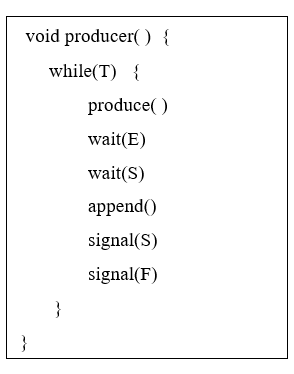
Producer-Consumer Problem

Explanation of the above code

  1. while(): - We used while() to produce the data again and again.
  2. produce(): - We called the produce() function to tell producer to produce the data.
  3. wait(E): - With the help wait() function, the value of the Semaphore variable ‘E’ can be decremented by 1. If a producer produces something, then we have to decrease the value of the Semaphore variable ‘E’ by 1.
  4. wait(S): - The wait(S) function is used to set the value of the Semaphore variable ‘S’ to ‘0’, so that other processes cannot enter into the critical section.
  5. append(): - By using append() function, new data is added in the memory buffer.
  6. signal(S): - We used the signal(S) function to set the value of the Semaphore variable ‘S’ to 1, so that another process can enter into the critical section.
  7. signal(F): - By using the signal(F) function, the value of the Semaphore variable ‘F’ is incremented by one.  In this, we increment the value by 1 because if we add the data into the memory buffer, there is one space that is filled in the memory buffer. So, we have to update the variable ‘F’.

 Below is the pseudocode for the consumer:
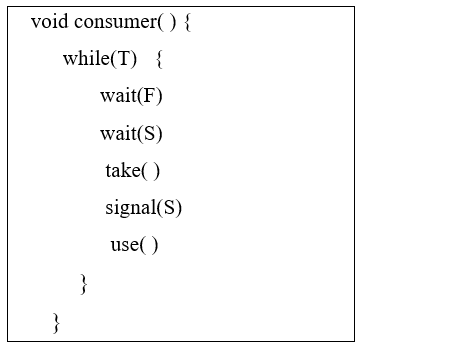
Producer-Consumer Problem

Explanation of the above code

  1. while(): - By using while(), the data can be consumed again and again.
  2.  wait(F): - We used wait(F) function to decrease the value of the Semaphore variable ‘F’ by 1. It is because if the consumer consumes some data, we have to reduce the value of the Semaphore variable ‘F’ by 1.
  3. wait(S): - The wait(S) function is used to set the value of the Semaphore variable ‘S’ to ‘0’, so that other processes cannot enter into the critical section.
  4. take():- We used take() function to take the data from the memory buffer by the consumer.
  5. signal(S): - We used the signal(S) function to set the value of the Semaphore variable ‘S’ to 1, so that other processes can enter into the critical section.
  6. signal(E): - The signal(E) function is used to increment the value of the Semaphore variable ‘E’ by 1. It is because after taking data from the memory buffer, space is freed from the buffer, and it is must to increase the value of the Semaphore variable ‘E’.
  7. use(): - By using the use() function, we can use the data taken from the memory buffer, so that we can perform some operations.

Related Topics

FCFS Scheduling in OS

FCFS: First Come First Serve Scheduling in OS FCFS is a non-preemptive and preemptive scheduling algorithm that is easy to understand and use. In this, the process which reaches first is...

3 minutes read.

Advantages of Operating System

What is an Operating System?   An operating system is an interface that helps to communicate with the user and the computer hardware. Operating systems are used for file management, memory...

3 minutes read.

Difference between Process and Program in the Operating System

What is a process in the Operating System? A process is a program that is going through the execution. It also helps us to execute all the lines of code in...

4 minutes read.

Paging and Segmentation in OS

What is Paging in OS? Paging is a storage technique used for memory management. In paging, the (OS) Operating System retrieves the processes from the secondary memory into the main memory,...

6 minutes read.

Multiprogramming Operating System

You will discover more about the multiprogramming operating system in this post, including how it functions and its benefits and drawbacks. Each process needs several types of system time, including CPU...

4 minutes read.

Strategies for Handling Deadlock

Strategies for Handling Deadlock The Strategies for handling Deadlock are: Deadlock IgnoranceDeadlock PreventionDeadlock AvoidanceDeadlock Detection and Recovery Deadlock Ignorance Deadlock Ignorance is the most popular deadlock handling strategy. We can use this in the various operating systems for...

2 minutes read.

How to implement Monitors using Semaphores

Monitors Monitor is a type of synchronization device designed to solve difficulties caused by semaphores, such as timing errors. Monitors are the type of data types that are abstract by nature...

2 minutes read.

Feedback Queue in Operating System

In a computer or a laptop, there is a processor which do all the tasks. The processor cannot do all the tasks at a time. So, the tasks will be...

3 minutes read.

Booting Process in Operating System

What is Booting? Booting is defined as the term which says that the process of loading the operating system into the memory. The process of booting begins when we switch on...

4 minutes read.

Process Schedulers and Process Queue in OS

Process Schedulers There are various types of Process Schedulers: Long Term SchedulerShort Term SchedulerMedium Term Scheduler                                            Long Term Scheduler: - Long term scheduler is also referred to as Job Scheduler. The task of the Long-term...

3 minutes read.

Deadlock Detection and Recovery

Deadlock Detection and Recovery In deadlock detection and recovery, to avoid or prevent a deadlock, the operating system uses various methods. For checking deadlock, an operating system continuously monitors the system. Then also,...

2 minutes read.

Monitors in Operating System

Monitors in Operating System Monitors are used for process synchronization. With the help of programming languages, we can use a monitor to achieve mutual exclusion among the processes. Example of monitors:...

3 minutes read.

Difference between Protection and Security in Operating System

Some operating system mechanisms facilitate us to stop tampering with logical and physical resources. Some of these methods are security and protection. Protection and security are distinct concepts, despite the...

3 minutes read.

Linux Operating System

What is Linux? The Linux operating system is used on various devices, including cellphones, automobiles, supercomputers, household gadgets, personal computers, and business servers. You can find Linux on your phones, thermostats, vehicles,...

8 minutes read.

Virtual Memory in Operating System

What is Virtual Memory Virtual Memory is a storage scheme in which the users have an illusion that users have a significant amount of Main Memory. We can perform this by taking a...

3 minutes read.

Scheduling Algorithms in OS

There are various types of scheduling algorithm which are used by the operating system to schedule the process on the processor. Objective of Scheduling Algorithms There are the following objectives of Scheduling Algorithms: Fare allocation...

2 minutes read.

Test Set Lock Mechanism | Operating System

Modification in the Assembly Code The problem in the lock variable is that, in some cases, the process reads the previous or old value of the lock variable and enters into the critical...

4 minutes read.

Interested Variable Mechanism

Interested Variable Mechanism It is a must to provide progress to the process synchronization mechanism. In variable mechanism, if there is a process that doesn’t need to enter into the critical section, then due...

5 minutes read.

SJF Scheduling in OS

Shortest Job First (SJF) Scheduling in OS Shortest Job First is a Preemptive or Non-Preemptive algorithm. In the shortest job first algorithm, the job having shortest or less burst time will...

4 minutes read.

Round-Robin Scheduling Algorithm in OS

Round-Robin is a Preemptive Scheduling Algorithm and is the most commonly used algorithm in CPU Scheduling.In this, each Process is assigned with a fix time interval to execute, which is...

5 minutes read.