
×

Cardinality in DBMS

Cardinality in DBMS

Cardinality is the relationship between two or more entities (table). It shows how all the entities are connected. In DBMS, all the entities and tables are interconnected with each other. Here we will see the relation among one entity to another entity, many entities to a single entity, and many relations.

We can categories therelationship among tablesinto four types:

  • One to one
  • One to many
  • Many to one
  • Many to many

Let’s discuss all one by one:

One to one:

Relation between two entities with each other is known as one to one relation. In this relationship, one entity is related with only one another entity.

For example:Suppose we have tables named STUDENT having column “name” and STUDENT_DETAILS having column “aadhar no." Here in these two tables, each student has their aadhar no. The aadhar number of all students will be different, so each student has only one aadhar no. The relation between these two tables will be one to one.
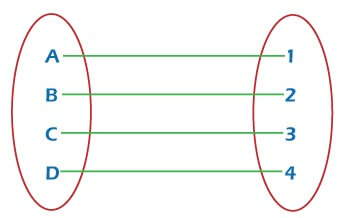
Cardinality in DBMS

One to many:

 In this relationship, data of one row of one table compares many rows of another table.

For example, we have two tables, STUDENT and LIBRARY. In these tables, one student of table STUDENT can apply for many books in table LIBRARY. Here the relation of one student with too many books has seen.
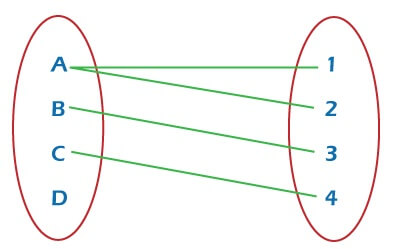
Cardinality in DBMS

Many to one:

 In this relation, many rows of one table make relation with one row of the other table.

For example, we have two tables, STUDENT and SCHOOL. Many students relate to one school; in Figures (A, B, C, and D are the students, and 1, 2, 3, and 4 are the school name). We know that many students study in a school and thus here we will see many to one relation.
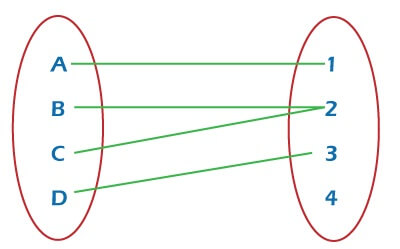
Cardinality in DBMS

Many to many:

 In this relation, many rows of one table make a relationship with many rows of another table.

For example, we have two tables, STUDENT having column ‘student name’ and SUBJECT having column 'subject name.' Here many students take many subjects, and one student can assign many subjects.
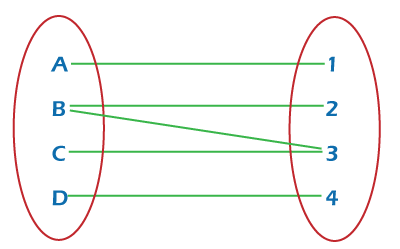
Cardinality in DBMS

Related Topics

Relational Integrity Constraints

Relational Integrity Constraints are the set of rules that can be used to maintain the data integrity during an insert, delete and update operations into a table. These constraints are checked in the...

2 minutes read.

DBMS Data Independence: Logical and Physical

Data Independence in DBMS: Data independence is a concept of DBMS which alters the schema of the database at one level of the database system without altering the schema definition...

2 minutes read.

B Tree in DBMS

How to perform Insertion operation in B Tree A new value is inserted at the leaf node. Same like in a binary search tree we traverse from starting root node to...

10 minutes read.

Concurrency Control Protocols

Concurrency Control Protocols Concurrency control protocols ensure the atomicity, serializability and isolation of the concurrent transactions. The Concurrency control protocols can be broadly classified into the following categories: Lock Based ProtocolTimestamp protocol Lock Based Protocol In this protocol,...

5 minutes read.

Structure of DBMS

DBMS means Database Management System, which is a tool or software used to create the database or delete, or manipulate the database. Query Processor, Storage Manager, and Disk Storage are the...

3 minutes read.

File Organization in DBMS

File Organization in DBMS: A database contains a huge amount of data, which is stored is in the physical memory in the form of files. A file is a set...

9 minutes read.

Difference between DBMS and RDBMS

Database Management System A DBMS is system software which is used to store and manage the data in the database. It was introduced in 1960 for storing the data or information. This system allows...

3 minutes read.

What is RDBMS?

To discuss the Relational Database Management System, there are some terms and concepts you need to know. Database Any collection of related information is called a database. The phone book is...

5 minutes read.

Serializability in DBMS

Serializability in DBMS Serializability is the concept in a transaction that helps to identify which non-serial schedule is correct and will maintain the database consistency. It relates to the isolation property of transaction in...

3 minutes read.

BCNF in DBMS

BCNF stands for Boyce–Codd Normal Form. What is the Normal form? The normal form is mainly used to reduce the redundancy of the database tables. Or we can say that the normal form...

4 minutes read.

Redundancy in DBMS

Data redundancy is a situation that is created in the database in which the same amount of data is stored in two different places. The different places are found in a...

3 minutes read.

Three Schema Architecture of DBMS

The three schema architecture describes how the data is represented or viewed by the user in the database. This architecture is also known as three-level architecture and is sometimes called...

3 minutes read.

Functional Dependencies

Functional Dependencies (FD) in the relational database management system occurs when one attribute in a relation uniquely determines other attribute in that relation. It describes the relation between the attributes. The term functional...

2 minutes read.

DBMS Architecture

Architecture of Database Management System DBMS architecture helps in development, implementation, design, and maintenance of a database that store and organize information for agencies, businesses, and institutions. It is the base of any database...

2 minutes read.

View Serializability in DBMS

View Serializability It is a type of serializability that can be used to check whether the given schedule is view serializable or not. A schedule called as a view serializable if it is view...

4 minutes read.

Domain Constraints in DBMS

Introduction about DBMS:- DBMS stands for DataBase Management System. DBMS(DataBase Management System) is a type of software by which we can save and retrieve the user's data with the security process....

3 minutes read.

Why we need Distributed Database Management System

Assuming there is a very strong single machine having properties like: Heaps of memory.Gigantic measure of dependable stockpiling with very quick I/O.Incredible handling rate and processing power (10s, 100s and might...

4 minutes read.

Types of DBMS

Database Management System A software that is programmed to enable the user to create and maintain a database. Using DBMS, we can implement create, read, update and delete operations on the...

4 minutes read.

Conversion of ER Diagram into Relational Model

After designing the Entity-Relationship diagram, you need to convert it into tables in the relational model. Because the relational model can be easily implemented by the Relational DBMS like Oracle, MySQL, etc....

2 minutes read.

Components of an ER Diagram

An ER Diagram consists of the following components: Entity AttributesRelationships 1. Entity An entity may be an object, place, person, or an event which stores data in the database. In an entity-relationship diagram, an entity...

4 minutes read.