×

Three Schema Architecture of DBMS

The three schema architecture describes how the data is represented or viewed by the user in the database. This architecture is also known as three-level architecture and is sometimes called ANSI/ SPARC architecture.

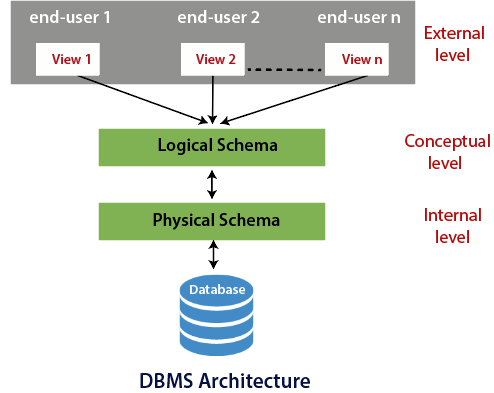
The three schema architecture divides the database into three-level to create a separation between the physical database and the user application. In simple words, this architecture hides the details of physical storage from the user. The database administrator (DBA) should be able to change the structure of database storage without affecting the user’s view.
This architecture contains three layers or levels of the database management system:

  1. External level
  2. Conceptual level
  3. Internal level
Three Schema Architecture of DBMS

Three Schema Architecture of DBMS

1. External or View level: This is the highest level of database abstraction. External or view level describes the actual view of data that is relevant to the particular user. This level also provides different views of the same database for a specific user or a group of users. An external view provides a powerful and flexible security mechanism by hiding the parts of the database from a particular user.

2. Conceptual or Logical level: The conceptual level describes the structure of the whole database. This level acts as a middle layer between the physical storage and user view. It explains what data to be stored in the database, what relationship exists among those data, and what the datatypes are. There is only one conceptual schema per database.

Database administrator and the programmers work at this level. This level does not provide any access or storage details but concentrates on the relational model of the database. The conceptual schema also includes features that specify the checks to retain integrity and consistency.

3. Internal or Physical level: This is the lowest level of database abstraction. It describes how the data is actually stored in the database and provides methods to access data from the database. It allows viewing the physical representation of the database on the computer system. The interface between the conceptual schema and the internal schema identifies how an element in the conceptual schema is stored and how it may be accessed.

If there is any change in the internal or physical schema, it needs to be addressed to the interface between the conceptual and internal schema. But there is no need to change in the interface of a conceptual and external schema. It means that the changes in physical storage devices such as hard disks, and the files organized on storage devices, are transparent to application programs and users.

Advantages of Three-schema Architecture

Following are the advantages of three schema architecture:

  • This architecture makes the database abstract. It is used to hide the details of how data is physically stored in a computer system, which makes it easier to use for a user.
  • This architecture allows each user to access the same database with a different customized view of data.
  • This architecture enables a database admin to change the storage structure of the database without affecting the user currently on the system.

Related Posts:


Related Topics

DBMS Data Independence: Logical and Physical

Data Independence in DBMS: Data independence is a concept of DBMS which alters the schema of the database at one level of the database system without altering the schema definition...

2 minutes read.

Super Key in DBMS

Super Key in DBMS: The super key is a column or a set of columns in the database table, which uniquely identifies the tuple or row of the same table....

2 minutes read.

Advantages of RDBMS

The relational database management system collects related data stored in tabular format. The data is stored in rows and columns, where rows usually represent the individual entity of the collected...

6 minutes read.

What is a Database

A database is a structured collection of data that is often kept electronically on a computer system. Typically, a database is managed by a database management system (DBMS). Together, the...

9 minutes read.

View Serializability in DBMS

View Serializability It is a type of serializability that can be used to check whether the given schedule is view serializable or not. A schedule called as a view serializable if it is view...

4 minutes read.

Data Abstraction in DBMS

Introduction Data abstraction is a fundamental concept in database management systems (DBMS). It refers to the process of hiding the details of how data is stored and retrieved from the user,...

3 minutes read.

DBMS Schema

Schema It is a physical representation of data that appears in the database management system. In simple words, a schema is the structure of any database.It defines how the data is stored...

2 minutes read.

ER Diagram for University Database in DBMS

What is an ER diagram? ER diagram, short for Entity Relationship Diagram, also known as ERD, is a diagram that shows the relationships of a set of entities stored in a...

9 minutes read.

Disadvantages of DBMS

Disadvantages of DBMS With the vast list of advantages, there are some following disadvantages or limitations of the database management system. 1. High Cost The high cost of software and hardware is the...

2 minutes read.

Query optimization in DBMS

Choosing an effective execution strategy to execute a query is a process known as query optimization. After the decision-making process of query parsing, which determines how many distinct ways a given...

5 minutes read.

Disavantages of RDBMS

RDBMS offers many features when handling the data, but it also has certain limitations that can be overcome by choosing an alternative data model. The limitations of the Relational Data...

3 minutes read.

Enforcing Integrity Constraints in DBMS

Introduction Integrity constraints are rules that specify the conditions that must be met for the data in a database to be considered valid. These constraints help to ensure the accuracy and...

2 minutes read.

Components of an ER Diagram

An ER Diagram consists of the following components: Entity AttributesRelationships 1. Entity An entity may be an object, place, person, or an event which stores data in the database. In an entity-relationship diagram, an entity...

4 minutes read.

Normalization in DBMS: 1NF, 2NF, 3NF, BCNF & 4NF with Examples

Normalization is a technique of organizing the data in the database. It is a systematic approach which is used to remove or reduce data redundancy in the tables and remove the...

7 minutes read.

Levels of Abstraction in DBMS

Data abstraction is a way to hide unwanted or irrelevant information from the end user in DBMS. It helps in enhancing the security of data, and simplifies database design using...

4 minutes read.

Relational Integrity Constraints

Relational Integrity Constraints are the set of rules that can be used to maintain the data integrity during an insert, delete and update operations into a table. These constraints are checked in the...

2 minutes read.

Applications of DBMS

There are various fields where a database management system is used. Following are some applications which make use of the database management system: 1. Railway Reservation System: In the railway reservation...

7 minutes read.

Concurrent Execution of Transaction

In the transaction process, a system usually allows executing more than one transaction simultaneously. This process is called a concurrent execution. Advantages of concurrent execution of a transaction Decrease waiting time or...

4 minutes read.

What is a Cloud Database

Cloud computing is the process of commoditizing data storage and processing time using standardized technologies. Cloud databases are databases that are hosted on cloud computing platforms such as Salesforce, GoGrid,...

4 minutes read.

Domain in DBMS

Constraints: Constraints in DBMS are a set of guidelines that guarantee that authorized users who modify the database do not alter the consistency of the data. Constraints are expressed in DDL...

3 minutes read.