
×

JavaScript dropdown onchange

What is onchange event?

It is an event in JavaScript used to make the web pages dynamic. The onchange event gets triggered whenever the value of an event changes. It usually occurs whenever the element loses focus.

This event is supported by mostly all the browsers like Google chrome, safari, Microsoft Edge/Internet Explorer, Oracle, Firefox etc.

NOTE: In case of radio buttons and checkboxes, the onchange event gets triggered whenever the checked state is changed.

What is the difference between oninput and onchange?

  • The main difference is that the oninput event gets triggered immediately after the value of an element has changed, whereas the onchange event gets triggered whenever the element or the object loses focus, after the content has been modified.
  • The other major difference can be, that the onchange event also functions on the <select> elements, whereas oninput does not.

What is a drop-down list?

It is a graphical control element. It resembles similarity to a list box. A drop-down list lets the user choose one value from a list. Whenever a drop-down list is in inactive state, it shows only a single value. Whenever the drop-down lists are activated, they display a list of values, from which the user can select one value.

How are values selected using onchange from a Drop-down list?

A JavaScript onchange event handler is usually assigned to the HTML Select DropDownList.

The GetSelectedTextValue JavaScript function gets executed whenever an item is selected in the HTML Select DropDownList.

The reference of the HTML Select DropDownList is passed as parameter to the onchange event.

This reference helps to determine the selected Text and Value, which is then displayed using JavaScript alert message box.

The onchange event can be used commonly in three ways for making dropdowns:

  • In HTML,

Syntax:

<element onchange= functionname>


<script>
function functionname(){
	//definition of the function
}
</script>

Example:

<!DOCTYPE html>
<html>
<body>


<p>Select a programming language from the list.</p>


<select id="myList" onchange="myFunctiondemo()">
  <option value="C++">C++</option>
  <option value="Python">Python</option>
  <option value="Java">Java</option>
  <option value="JavaScript">JavaScript</option>
</select>


<p>When you select a programming language, a function is triggered which outputs the value of the selected language.</p>


<p id="funcdemo"></p>


<script>
function myFunctiondemo() {
  var x = document.getElementById("myList").value;
  document.getElementById("funcdemo").innerHTML = "The new selection is: " + x;
}
</script>


</body>
</html>

Output:
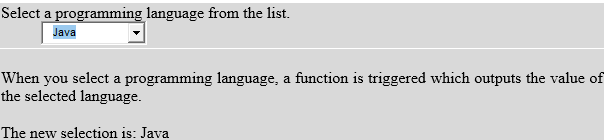
JavaScript Dropdown Onchange

The language keeps changing on selecting different languages, for example if we choose C++,
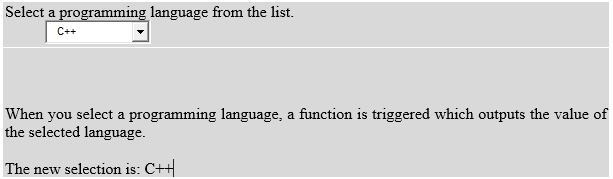
JavaScript Dropdown Onchange
  • In JavaScript,

Syntax:

<script>
object.onchange = function(){definition};


function functionname(){
	//definition of the function
}
</script>

Example:

<!DOCTYPE html>
<html>
<body>


<p>Select a programming language from the list.</p>


<select id="myList">
  <option value="C++">C++</option>
  <option value="Python">Python</option>
  <option value="Java">Java</option>
  <option value="JavaScript">JavaScript</option>
</select>


<p>When you select a programming language, a function is triggered which outputs the value of the selected language.</p>
<p id="funcdemo"></p>


<script>
document.getElementById("myList").onchange = function() {myFunctiondemo()};


function myFunctiondemo() {
  var x = document.getElementById("myList").value;
   document.getElementById("funcdemo").innerHTML = "The new selection is: " + x;
}
</script>


</body>
</html>

Output:
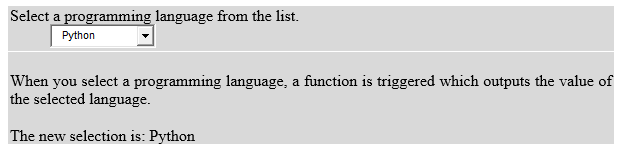
JavaScript Dropdown Onchange
  • Using addEventListener() method in JavaScript

Syntax:

<script>
object.addEventListener("change", myScript);
function functionname(){
	//definition of the function
}
</script>

Example:

<!DOCTYPE html>
<html>
<body>
<p>Select a fruit from the list.</p>


<select id="myList">
  <option value="Apple">Apple</option>
  <option value="Orange">Orange</option>
  <option value="Pear">Pear</option>
  <option value="Banana">Banana</option>
</select>


<p>When you select a fruit from the dropdown, a function is triggered which outputs the value of the selected fruit.</p>
<p id="funcdemo"></p>


<script>
document.getElementById("myList").addEventListener("change", myFunctiondemo);


function myFunctiondemo() {
  var x = document.getElementById("myList").value;
 document.getElementById("funcdemo").innerHTML = "The selected fruit is: " + x;
}
</script>


</body>
</html>

Output:
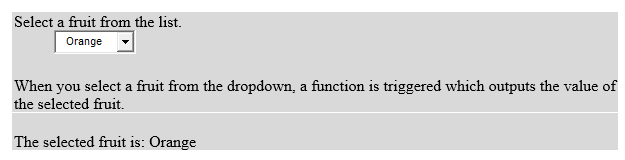
JavaScript Dropdown Onchange

NOTE: Internet Explorers and older versions do not support the method of addEventListener().


Related Topics

Javascript Window Object

The window object represents a window in browser. An object of window is created automatically by the browser. Window is the object of browser, it is not the object of JavaScript. The...

3 minutes read.

Functional Programming in JavaScript

Most developers work with object-oriented programming while developing their applications, but sometimes they need to change their approach to solve some specific tasks. Although mostly we tend to go for...

6 minutes read.

JavaScript setInterval()

On the Window and Worker interfaces, the setInterval() method calls a function or executes a snippet with a specified time delay between each call. This function provides an interval ID that...

4 minutes read.

Javascript loops

Loops in JavaScript: Loops are used to execute a specific piece or block of code repeatedly until the given condition is satisfied. What is a Loop? Almost all loops contain a certain...

7 minutes read.

Javascript Re-Password Validation

Example <!DOCTYPE html>   <html>   <head>   <script>   function pass_validation()   {   var firstpassword=document.f1.password1.value;     var secondpassword=document.f1.password2.value;     if(firstpassword==secondpassword){     return true;     }     else{   alert("Password does Not Match");     return false;     }     }    </script>   </head>   <body>   <form name="f1" action="/JavaScript/Index" onsubmit="return pass_validation()">   Password:<input type="password" name="password1" /><br/>   Re-enter :<input type="password" name="password2"/><br/>   <input type="submit">   </form>   </body>   </html> Try Now ← Prev Next → ...

1 minute read.

Javascript Example

What is JavaScript? JavaScript is a highly versatile programming language. It provides the capability to add interactivity to static web pages, which are designed with HTML and CSS. It also provides...

5 minutes read.

Javascript Find Object In Array

What is find() method? It returns the value of the first element in the given array that fulfils the given testing function. However, if no values from the array are able...

3 minutes read.

Javascript Print

JavaScript help's the functionality using the print function of window object. In JavaScript print function window.print() print the current web page when it executed. We can call function directly using onclick...

1 minute read.

JavaScript moment date difference

Often date differences are required on the web platforms for various reasons. They can be: To find the duration, of course, someone is pursuingTo find the age of a user from...

7 minutes read.

JavaScript focus on input

In JavaScript, the elements can be focused using either focus() method or onfocus() event. What is focus() method? When we want to focus on an element (if it can be focused) or...

4 minutes read.

JavaScript p5.js

Introduction to p5.js P5.js is a JavaScript library for creative programming. It is built on Processing, a coding environment for creativity. Processing's major goal is to make it as simple as...

4 minutes read.

Javascript Email Validation

We can validate the email with the help of JavaScript. Here we check the condition related to any email id, like email it must have "@" and "." sign and...

2 minutes read.

D3.js Tutorial

Introduction of D3.js D3.js is referred to as a JavaScript library that is used to manipulate the documents according to the data. The intensity of D3 is based on web standards...

5 minutes read.

Javascript String

String object works with series of characters. It is used to store and manipulate text. There are two ways to create string in JavaScript: String literal. Using new keyword. String literal By using double quotes...

4 minutes read.

Javascript Number

The Number object is a wrapper object which allows you to work with numerical values. The number object is created using the Number() constructor.It may be integer or floating-point. Syntax var n=new Number(value); Examples <!DOCTYPE html>   <html>   <body>   <script>   var x=100;//integer value   var y=100.7;//floating point value   var z=12e5;//exponent value, output: 1200000   var n=new Number(20);//integer value by number object     document.write(x+" "+y+" "+z+" "+n);   </script>   </body>   </html> Try Now Output 100 100.7 1200000 20 Description The primary...

1 minute read.

What is Ternary Operator in JavaScript?

In some cases, a ternary operator can be used instead of an if-else expression. A ternary operator examines a condition and then runs a block of code in response to...

4 minutes read.

Javascript comment

Introduction In programming languages, comments are a method to include meaningful annotations within the code that the compiler or interpreter will ignore at run time. That is to say, though comments...

7 minutes read.

Javascript getElementByID

The document.getElementById() method returns the element of specified id. In below example we receive input field by using document.getElementById() method, here document.getElementById() receive input value on the basis of input field...

1 minute read.

Javascript Redirect Button

What is a redirect button? When a button acts as a hyperlink, it is known as a redirect button. On clicking the button, it transfers the user to another page. How to...

3 minutes read.

JavaScript radio button checked value

What are radio buttons? A radio button is defined as an icon that is used to take input from the user. The user can choose only one option(value) from the group...

5 minutes read.