
WordPress Theme

Writing our WordPress Theme is relatively simple.

Requirements:

Before we begin, we need to know about the following set of requirements.

  • We need to have full knowledge of WordPress setup, which is either on the local host or live hosting. Click here to know more about WordPress.
  • A conceptual design, either HTML CSS or PSD that follow throughout the development process.
  • Basic knowledge of PHP Programming.

 Let`s Start:

The first thing we need to know that everything we do in WordPress is inside the wp-content directory. When we open the wp,-content->theme file, we will find some default WordPress themes like twentyfifteen, twentythirteen, etc.
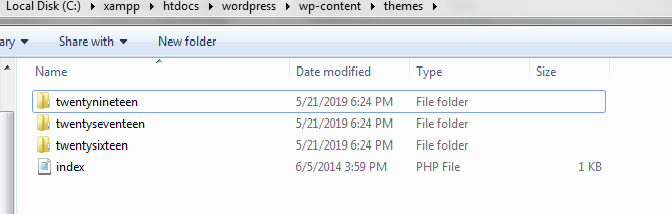
wordpress theme

We need to create a new file with any name we prefer.

We will call it a “newtheme.”

A WordPress theme contains at least two files, which are index.php and style.css.

Now go into the newtheme folder and create these two files.

In the style.css, we will insert the following comment, which is used to tell the user about the theme details and Meta information.

/* 
 Theme Name: NewTheme  
 Description: WordPress First Theme
 Version: 0.8  
 */ 

Go to the WordPress Dashboard, click on the Appearance-> Themes.  We will find NewTheme in the themes collection.
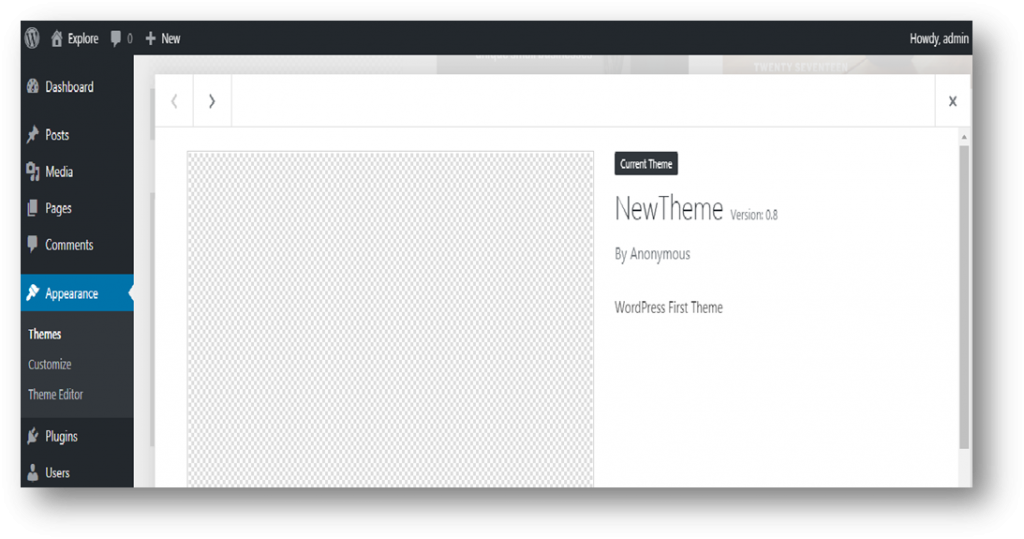
wordpress theme 1

Now, open index.php in the text editor and write the following code.:


Hello WordPress Theme.

Sections:

To develop a standard WordPress Theme, we need to divide our work into sections. It is not necessary to do everything in index.php, but a good programming practice involves standardized. We will divide our Theme into four sections, i.e., header, footer, sidebar, and body. These sections are created into four different files, namely, header.php, footer.php, sidebar.php, and content.php.

 Let`s do our Theme Header (Header.php) :


  <?php echo get_bloginfo( "name" ); ?>  


 <?php echo get_bloginfo( "name" ); ?>  

This is embedding HTML code into PHP code.

With some additional changes, it becomes:


  <?php echo get_bloginfo( "name" ); ?>  


The above code is used to get the template directory, CSS,JS etc additional resources can be located.

The above code is used to echo the homepage url.

wordpress theme 2

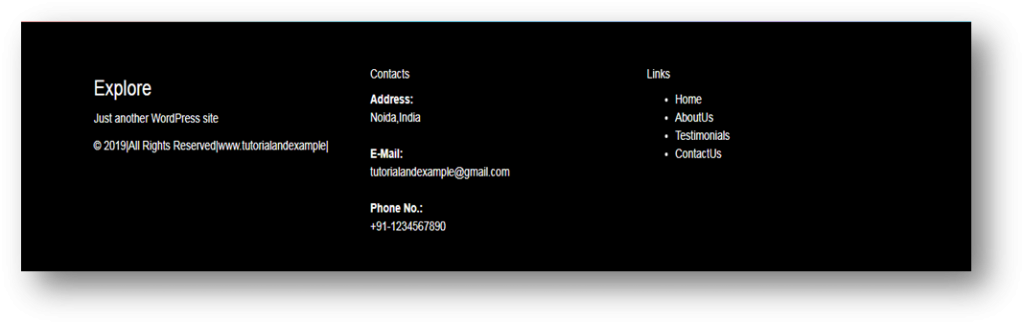
Footer.php:


The above code is used to place the site description.
sidebar.php: Often sidebars display archive links, recent posts, social media accounts, etc. In our Theme, we’ll create archive links and social media links.


Integration:

In index.php file, we will integrate all the sections. We have to clearly put these sections. Let`s see how I have done it.


  • In the above code, we have get_header(), get_sidebar() and get_footer() that all are predefined functions used for embedding sections.

And for the custom section like content.php, we have embedded with the following code:

Style.css: Let`s add some charm with CSS.

/* 
  Theme Name: NewTheme 
 Description: WordPress First Theme 
 Version: 0.8
 */
 body{
 background-image: linear-gradient
(to right, #eea2a2 0%, #bbc1bf 19%, #57c6e1 42%, #b49fda 79%, #7ac5d8 100%);
 }
 nav.navbar .navbar-brand .site-branding { 
 margin: 0; 
 } 
 footer.site-footer { 
 background-color: black; 
 color: #fff; 
 padding: 40px 0 20px 0; 
 } 
 footer.site-footer a { 
 color: #fff; 
 } 

The Loop:

The Loop is a functionality through which we can insert content into our theme.


content.php:


  • In the above code, anything which is inside the Loop will be repeated, till the page done with all of its posts.

Changed the (index.php):


The Loop inside the index.php file is calling the content.php file every time the page has a new updated post. Inside the content.php file, we have checked if the current post is_single(). This condition is used to hold true if the current page contains only a single post to Loop through. If it is not single, we wanted to link to the post via its title. So we used get_permalink() to get the URL for the particular post. If the page is single, there is no need to link it, and therefore, we have used only the_title() function.

We have displayed the_date() which is used to tell the user when the article/post is published and it’s the_author().  At last, we have used the same concept of is_single() which is used to display the_excerpt() or the_content() of the post.

So, it was easy, with the little charm of CSS, we have got the following result:
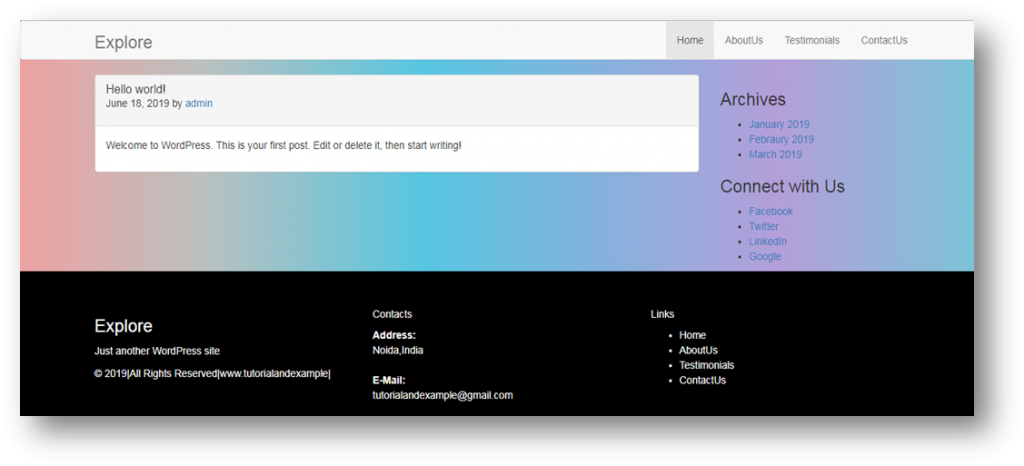
wordpress theme 4

  • We are ending this post, but we need to know there is still a lot to learn about WordPress.
  • It was a simple example, but a standard theme would be much complex.

Related Topics

PHP trim() Function

PHP trim() Function The trim() Function in PHP strips the whitespace or other characters from the beginning and the end of the given string. The trim() function strips the following characters: " " - an ordinary space."\t"- a tab."\n"- a new...

1 minute read.

PHP sscanf() Function

PHP sscanf() Function The sscanf() function in PHP parses input from a string according to a given format. Syntax sscanf ( string $str , string $format [,mixed &$arg1,$agr2,$arg++... ] ) Parameter str(required)- This parameter specifies the string to read. format(required)- This parameter specifies the format to use. The conversion specification...

3 minutes read.

PHP strrchr() Function

PHP strrchr() Function The strrchr() function in PHP finds the last occurrence of a character in the specified string and returns the portion of haystack, which starts at the last occurrence of the needle and goes until the end of haystack....

1 minute read.

PHP is_int() Function

The PHP is_int() function in PHP is used to  find whether a variable is an integer or not. It returns a Boolean value true if the parameter var is integer else it...

1 minute read.

PHP is_array() Function

The is_array() Function in PHP is used to  find whether a variable is an array or not. It returns a Boolean value true if the parameter var is an array else it returns...

1 minute read.

PHP Constant

PHP constant is an identifier(name) for a simple value. The value does not change during the script. It starts with a letter or underscore not $ sign. The define()function is...

1 minute read.

Multiple-Inheritance in PHP

Multiple-Inheritance in PHP Multiple-Inheritance is the resources of the Object Oriented Programming Languages in which child class or subclass can inherit the resources of the multiple parent classes or superclasses. PHP does...

3 minutes read.

PHP asort() function

PHP asort() function The asort() function in PHP is used to sort an array while maintaining the index association. Syntax asort ( array &$array [, int $sort_flags = SORT_REGULAR ] )  array(required)- This parameter represents the input array to sort. sort_flags (optional)- This parameter is used to...

1 minute read.

PHP natsort() Function

PHP natsort() Function The natsort() function in PHP Sort an array using a case insensitive "natural order" algorithm while maintaining the keys. Syntax natsort ( array &$array ) Parameter array(required)- This parameter represents the input array. Return This parameter returns a Boolean value TRUE on success or FALSE on...

1 minute read.

PHP usort() Function

PHP usort() Function The usort() function in PHP sorts  array by values using a user-defined comparison function. Syntax usort ( array &$array , callable $value_compare_func ) array(required)- This parameter represents the input array. value_compare_func(required)- This parameter represents a string that describe a callable comparison function. The comparison...

1 minute read.

PHP array_shift() Function

PHP array_shift() Function The array_shift() in PHP shifts the first value of the array off. This function returns the same value after shortening the array by one element and moving everything. Syntax array_shift ( array &$array )  Parameter array(required)- This parameter represents the input array Return This function returns...

1 minute read.

PHP unserialize() Function

PHP unserialize() Function The unserialize() function in PHP takes a single serialized variable and converts it back into a PHP value. Syntax unserialize ( string $str [, array $options ] ) Parameter value(required)- This parameter represents the serialized string. options(optional)- This parameter signifies any options to be...

1 minute read.

PHP krsort() Function

PHP krsort() Function The krsort() function in PHP sorts an array by key in reverse order while maintaining the keys. Syntax krsort (array & $array[,int $sort_flags= SORT_REGULAR] ) Parameter array(required)- This parameter represents the input array. sort_flags(optional)- This...

3 minutes read.

PHP array_fill_keys() Function

The array_fill_keys() function in PHP fills an array with the value of the specified value parameter, using the values of the specified keys array as keys. Syntax array_fill_keys ( array $keys , mixed $value ) Parameter keys(required)- This parameter signifies the input array of values that will be...

1 minute read.

PHP array_reduce() Function

PHP array_reduce() Function The array_reduce() function in PHP reduces the array to a single value using by applying a callback function to the elements of the array. Syntax array_reduce ( array $array , callable $callback [, mixed $initial = NULL ] ) Parameter array(required)- This parameter represents the input array. callback (required)- This...

1 minute read.

PHP doubleval() Function

PHP doubleval() Function The doubleval() function in PHP is used to give the float value of a variable. This function is an alias of floatval(). Syntax doubleval ( mixed $var ) Parameter var(required)- This parameter represents the name of the variable that...

1 minute read.

PHP strval() function

PHP strval() function The strval() function in PHP is used to get the string value for the specified variable. This function cannot be used on arrays or objects, if applied then would return only the...

1 minute read.

PHP String

PHP string is a sequence of characters. It is used to store and manipulate text. We can specify a string literal in four ways: single quoted double quoted heredoc syntax ...

2 minutes read.

PHP Magic Constants

There are various predefine PHP Magic Constants. It starts with underscore(__) and ends with double underscore.  Magic Constant Description __LINE__ To check current line number of the file. __FILE__ To check full path and filename of...

1 minute read.

PHP if..Else..Elseif

PHP conditional statements are used to test the conditions. It supports different types of conditional statement. Following are the types of conditional statement if statement ..else statement ..elseif....else statement switch statement PHP if Statement PHP...

2 minutes read.