
Intermediate-Code Generator Compiler Design

Intermediate-Code Generator

The process of translating a source language into machine code for a given target machine is done by intermediate-code. It lies between the high-level language and the machine language. See the below image that illustrates the position of the intermediate code generator:

Intermediate-Code Generator Compiler Design
  • If a compiler cannot produce intermediate code while converting the source code into machine code, then a full native compiler is required for each new machine.
  • With the use of intermediate code, we don't need a new compiler for every new machine because it keeps the analysis portion same for all the compilers.
  • The synthesis phase of the compiler is varying according to the target machine.

High-level Representation:

It is closer to the source code. It can be easily generated using source code. Code modification can easily improve the source code's performance. It is less preferred for the optimization of the target machine.

Low-level Representation:

It is closer to the target machine. It is suitable for a machine-independent task like register allocation and instruction selection.

Directed Acyclic Graph

A directed acyclic graph (called a DAG) for an expression identifies the expression's subexpressions that occur more than once. A DAG can be constructed similar to a syntax tree.

Let us see how we can construct a DAG for any expression:

The atomic operands will be the leaves of a DAG, whereas operators will be the interior node.

Example:

Given statement:

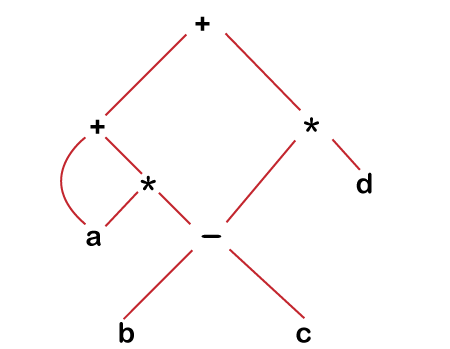
a + a * (b - c) + (b - c) * d
Intermediate-Code Generator Compiler Design

As we can see that, a appears twice in the expression, so a has two parents. The two occurrences of the common subexpression b-c are represented by one node "-." This node has two parents, representing its two uses in the subexpressions a*(b-c) and (b-c)*d. There will be only one parent for the node b and c because the common subexpression b-c use both nodes.


Related Topics

LALR 1 Parsing | Compiler Design

LALR (1) Parsing The LALR parsing refers to the "lookahead LR" that has many lesser steps than typical parsers based on LR(1) items. For constructing the LALR(1) parsing table, the canonical...

6 minutes read.

Phases of Compiler

Phases of Compiler The compilation process of a compiler goes through various phases. Each phase of the compiler takes the output from the previous as an input. Here we will see all...

2 minutes read.

Boolean Expression in Compiler Design

Boolean Expression The translation of conditional statements such as if-else statements and while-do statements is associated with Boolean expression's translation. The main use of the Boolean expression is the following: Boolean expressions...

3 minutes read.

Data Flow Analysis in Compiler Design

Data Flow Analysis All the optimization techniques we have learned earlier depend on data flow analysis. DFA is a technique used to know about how the data is flowing in any...

3 minutes read.

Parsing in Compiler Design

Parsing is the term used to describe the process of converting data between different formats. The parser can carry out this operation. The parser is a part of the translator...

4 minutes read.

Regular Expression | Compiler Design

Regular Expression A regular expression is a set of patterns that can match a character or string. It can also match alternative characters or strings. The grammar defined by the regular...

3 minutes read.

Three-Address Code

Three-Address Code If there is at most one operator on the right side of the instruction, then the instruction will be the three-address code so that no arithmetic expressions are permitted....

2 minutes read.

Symbol Table Compiler Design

Symbol Table It is an important data structure used by the compiler. It stores information about various entities such as object, class, variable names, functions name, interfaces, procedure, literals, string etc.  The...

3 minutes read.

Switch Case Statement Compiler Design

Case Statement The “case” or “switch” statement is available in various languages. The following is the syntax for the case statement: switch (E)  {             case V1: S1             case V2: S2 ...

1 minute read.

Derivation and Parse Tree in Compiler Design

Derivation and Parse Tree In this article, we will learn Derivation and Parse Tree. Derivations The parse tree can be constructed by taking a derivational view in which production is treated as rewriting...

4 minutes read.

Finite State Machine

Finite State Machine A finite state machine is a simple machine to recognize patterns. It takes a string of symbols as the input and changes its state to another state, but...

3 minutes read.

Intermediate-Code Generator Compiler Design

Intermediate-Code Generator The process of translating a source language into machine code for a given target machine is done by intermediate-code. It lies between the high-level language and the machine language....

2 minutes read.

Machine-Independent Optimizations in Compiler Design

Machine-Independent Optimizations The main aim of machine-independent optimization is to improve the generated intermediate code so that compiler can get better target code. Eliminating unwanted code from the object code or replacing...

8 minutes read.

Translation of Array References in Compiler Design

Translation of Array References We can access the elements of an array stored in consecutive blocks very easily and quickly. In a programming language like C and Java, the size of...

2 minutes read.

Ambiguity Elimination Compiler Design

Ambiguity Elimination Ambiguity elimination makes the sentence clear and readable. A sentence is grammatically ambiguous if it can produce more than one parse tree for a particular grammar. In this article,...

3 minutes read.

Lexical Analysis in Compiler Design

Lexical Analysis It is the first phase of the compiler. As we know, it is also known as a scanner. The input for lexical analysis is source code. After taking source...

2 minutes read.

Optimization of Basic Blocks in Compiler Design

Optimization of Basic Blocks We can apply the optimization process on a basic block. While optimization, there is no need to change the set of expressions computed by the block. The basic...

3 minutes read.

SLR 1 Parsing Compiler Design

SLR(1) Parsing It is a simple LR parsing. Most of the function of this parsing is the same as LR(0) parsing. The parsing table for both the parser vary. The SLR(1)...

5 minutes read.

LEX

LEX Lex is a tool/computer program that generates a Lexical analyzer. Lex is developed by Vern Paxson in C around 1987. Lex works together with the YACC parser generator. It allows...

3 minutes read.

Bottom-Up Parsing in Compiler Design

Bottom-Up Parsing A bottom-up parsing constructs the parse tree for an input string beginning from the bottom (the leaves) and moves to work towards the top (the root). Bottom-up parsing is...

6 minutes read.