
LR Parser in Compiler Design

LR Parser

The most popular type of bottom-up parsing is LR(K) parsing. The LR() parser scans the input from left – to – right, which is the actual abbreviation of L in the LR(K) parser. However, the R in the LR() parser constructs the rightmost derivation in the reverse order. The LR parser uses the lookahead input symbol, which is represented by K in LR(K) parser. The lookahead helps in making parsing decisions.

Why LR Parser

  • For any programming language construct, if we are able to write a context-free – grammar, then the LR parser will recognize such kind of programming language. There also exist some non – LR CFG, but in that case, the programming language will avoid the non – LR context-free – grammar.
  • The Non–backtracking shift-reduce parser is one of the most preferred LR Parser, which can be implemented in the same way as other primitive shift-reduce parsers.
  • LR parser can easily detect any error at the time of scanning the input when required.
  • The LR parser, which is parsed by the grammar, is itself the subset of the grammar parsed by LL or Predictive parser.

Difference Between LL and LR Parser

LL ParserLR Parser
The first L in the LL parser is for scanning the input from left to right, and the second L is for the leftmost derivation.  L in LR parser is for the left to right, and R stands for rightmost derivation in the reverse order.
LL follows the leftmost derivation.LR follows rightmost derivation in reverse order.
An LL parser amplifies non - terminals.Terminals are condensed in LR parser.
LL parser constructs a parse tree in a top-down manner.LR parser constructs a parse tree in a bottom-up manner.
It ends whenever the stack in use becomes empty.It starts with an empty stack.
It starts with the start symbol.It ends with the start symbol.
It is easier to writeIt is difficult to write
Pre-order traversal of the parse tree.Post-order traversal of the parse tree.
Reads the terminals when it pops out of the stacks.Reads the terminals while it pushes them into the stack.
Example LL(0), LL(1)Example LR(0), SLR(1), LARL(1), CLR(1)

The LR Parser Algorithm

A schematic of an LR parser is shown below fig. This parser contains an input, an output, a stack, a driver program, and a parsing table.  ACTION and GOTO are the two parts of the parsing table. The driver program is not different for all LR parsers; only the parsing table is different from one parser to another parser. The stack stores the chronology of grammar with a $ at the bottom of the stack. The string which has to be parsed stays in the input buffer, which is used to indicate the end of input, followed by a $ Symbol.
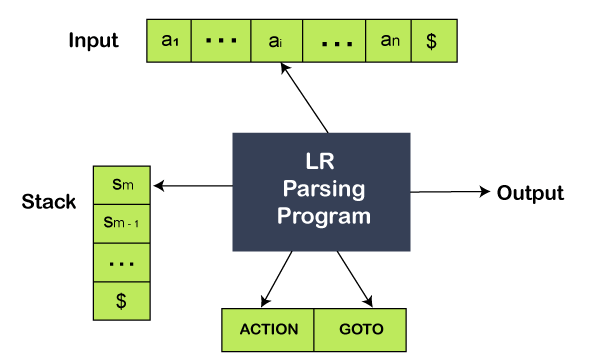
LR Parser

Related Topics

Symbol Table Compiler Design

Symbol Table It is an important data structure used by the compiler. It stores information about various entities such as object, class, variable names, functions name, interfaces, procedure, literals, string etc.  The...

3 minutes read.

Run-Time Storage Management

Run-Time Storage Management Every executing program has its own logical address space. Logical address space is partitioned into: Code: It is responsible for storing the executable target code. Static: It is used to...

3 minutes read.

Basic Blocks and Flow Graphs in Compiler Design

Basic Blocks and Flow Graphs In this section, we are going to learn how to work with basic block and flow graphs in compiler design. Basic Block The basic block is a set...

3 minutes read.

Errors in Compiler Design

Introduction Errors in compiler design refer to mistakes or issues that arise during the process of execution of the program. A compiler is a program that translates source code written in...

4 minutes read.

Storage Allocation

Storage Allocation The storage allocation represents memory management. The allocation of memory can be done in the following ways: Static AllocationStack AllocationHeap Management Static Allocation: It is a procedure used for the allocation of...

1 minute read.

Bottom-Up Parsing in Compiler Design

Bottom-Up Parsing A bottom-up parsing constructs the parse tree for an input string beginning from the bottom (the leaves) and moves to work towards the top (the root). Bottom-up parsing is...

6 minutes read.

Derivation and Parse Tree in Compiler Design

Derivation and Parse Tree In this article, we will learn Derivation and Parse Tree. Derivations The parse tree can be constructed by taking a derivational view in which production is treated as rewriting...

4 minutes read.

Syntax Analysis Compiler Design

Syntax Analysis This article will describe the parsing method used in the compiler. The grammatical rule of programming language can be constructed with the help of context-free grammars or BNF (Backus–Naur...

3 minutes read.

S-attributed and L-attributed SDTs

S-attributed and L-attributed SDTs STD stands for Syntax Directed Translation. When we associate some informal notations called semantic rules and the grammar, they are known as STD. So we can say...

2 minutes read.

LR Parser Compiler Design

LR Parser LR parsing is a type of bottom-up parsing that is used to parse the large class of grammars. Here "L" stands for left-to-right scanning of the input "R" stands...

6 minutes read.

Finite State Machine

Finite State Machine A finite state machine is a simple machine to recognize patterns. It takes a string of symbols as the input and changes its state to another state, but...

3 minutes read.

CLR Parsing Compiler Design

CLR Parsing CLR parsing refers to the canonical lookahead. We will use the canonical collection of LR(1) items for the construction of the CLR(1) parsing table. Generally, CLR(1) parsing has more...

6 minutes read.

YACC in Compiler Design

YACC  YACC is known as Yet Another Compiler Compiler. It is used to produce the source code of the syntactic analyzer of the language produced by LALR (1) grammar. The input...

5 minutes read.

Ambiguity Elimination Compiler Design

Ambiguity Elimination Ambiguity elimination makes the sentence clear and readable. A sentence is grammatically ambiguous if it can produce more than one parse tree for a particular grammar. In this article,...

3 minutes read.

Optimization of Basic Blocks in Compiler Design

Optimization of Basic Blocks We can apply the optimization process on a basic block. While optimization, there is no need to change the set of expressions computed by the block. The basic...

3 minutes read.

Three-Address Code

Three-Address Code If there is at most one operator on the right side of the instruction, then the instruction will be the three-address code so that no arithmetic expressions are permitted....

2 minutes read.

LR Parser in Compiler Design

LR Parser The most popular type of bottom-up parsing is LR(K) parsing. The LR() parser scans the input from left – to – right, which is the actual abbreviation of L...

2 minutes read.

Intermediate-Code Generator Compiler Design

Intermediate-Code Generator The process of translating a source language into machine code for a given target machine is done by intermediate-code. It lies between the high-level language and the machine language....

2 minutes read.

LEX

LEX Lex is a tool/computer program that generates a Lexical analyzer. Lex is developed by Vern Paxson in C around 1987. Lex works together with the YACC parser generator. It allows...

3 minutes read.

Syntax-Directed Translation

Syntax-Directed Translation A context-free-grammar with some additional rules is known as a syntax-directed definition. In SDT, attributes are associated with grammar symbols and rules are associated with productions. The attributes can...

3 minutes read.