
Run-Time Environments

Run-Time Environments Storage Organization

Every target program has its own logical address, and an executable program runs in it. The logical address space has the location for each program value. The target machine, compiler, and operating system share this logical address space. The operating system maps the logical addresses into physical addresses, which are usually spread throughout memory.

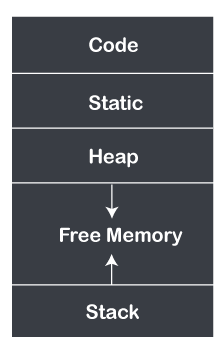
Subdivision of Run-Time Memory
Run-Time Environments

The run-time storage comes into blocks. This block has the smallest unit of addressable memory known as a byte.

Code: Astatistically determined area to hold the executable target code by the compiler.

Static: The compiler-generated data, the global constant may be determined at compile time stored in another statistically determined area static.

Stack: A dynamic area to store activation records. The size of a stack can change according to the executable program.

Heap: Another dynamically allocated data object at run-time to store C functions malloc and free.

The statistically dynamic area stack and the heap is used to utilize maximum space at a time.

Static vs. Dynamic Storage Allocation

The prime issue in run-time storage is the layout and allocation of data to memory locations. This can be risky because the same name in a program can refer to multiple locations at run time. The static is used for compile-time, and the dynamic is used for run-time storage.

If the compiler makes a decision by looking only at the text of the program, not what the program does as execution time, then storage-allocation is static.

If the decision is made at the time while the program is running is dynamic storage allocation.

The compiler used the given two technique for dynamic storage allocation:

  1. Stack storage: The procedure's local name is allocated on the stack.
  2. Heap storage: The procedure’s callee is allocated in a heap.

Related Topics

Code Generation

Code Generation The last phase of the compiler is code generation. It is the compiler's back-end that makes multiple passes over the IR before generating the target program. The code generator's...

4 minutes read.

LEX

LEX Lex is a tool/computer program that generates a Lexical analyzer. Lex is developed by Vern Paxson in C around 1987. Lex works together with the YACC parser generator. It allows...

3 minutes read.

Ambiguity Elimination Compiler Design

Ambiguity Elimination Ambiguity elimination makes the sentence clear and readable. A sentence is grammatically ambiguous if it can produce more than one parse tree for a particular grammar. In this article,...

3 minutes read.

Stack Allocation of Space

Stack Allocation of Space Almost all compilers for languages that use procedure, functions, or methods manage their run-time memory as a stack. Whenever a procedure is called, the local variable's space...

2 minutes read.

Parsing in Compiler Design

Parsing is the term used to describe the process of converting data between different formats. The parser can carry out this operation. The parser is a part of the translator...

4 minutes read.

Syntax Analysis Compiler Design

Syntax Analysis This article will describe the parsing method used in the compiler. The grammatical rule of programming language can be constructed with the help of context-free grammars or BNF (Backus–Naur...

3 minutes read.

Basic Blocks and Flow Graphs in Compiler Design

Basic Blocks and Flow Graphs In this section, we are going to learn how to work with basic block and flow graphs in compiler design. Basic Block The basic block is a set...

3 minutes read.

Data Flow Analysis in Compiler Design

Data Flow Analysis All the optimization techniques we have learned earlier depend on data flow analysis. DFA is a technique used to know about how the data is flowing in any...

3 minutes read.

Run-Time Storage Management

Run-Time Storage Management Every executing program has its own logical address space. Logical address space is partitioned into: Code: It is responsible for storing the executable target code. Static: It is used to...

3 minutes read.

Switch Case Statement Compiler Design

Case Statement The “case” or “switch” statement is available in various languages. The following is the syntax for the case statement: switch (E)  {             case V1: S1             case V2: S2 ...

1 minute read.

S-attributed and L-attributed SDTs

S-attributed and L-attributed SDTs STD stands for Syntax Directed Translation. When we associate some informal notations called semantic rules and the grammar, they are known as STD. So we can say...

2 minutes read.

Boolean Expression in Compiler Design

Boolean Expression The translation of conditional statements such as if-else statements and while-do statements is associated with Boolean expression's translation. The main use of the Boolean expression is the following: Boolean expressions...

3 minutes read.

LR Parser Compiler Design

LR Parser LR parsing is a type of bottom-up parsing that is used to parse the large class of grammars. Here "L" stands for left-to-right scanning of the input "R" stands...

6 minutes read.

Lexical Analysis in Compiler Design

Lexical Analysis It is the first phase of the compiler. As we know, it is also known as a scanner. The input for lexical analysis is source code. After taking source...

2 minutes read.

Symbol Table Compiler Design

Symbol Table It is an important data structure used by the compiler. It stores information about various entities such as object, class, variable names, functions name, interfaces, procedure, literals, string etc.  The...

3 minutes read.

Translation of Array References in Compiler Design

Translation of Array References We can access the elements of an array stored in consecutive blocks very easily and quickly. In a programming language like C and Java, the size of...

2 minutes read.

Optimization of Basic Blocks in Compiler Design

Optimization of Basic Blocks We can apply the optimization process on a basic block. While optimization, there is no need to change the set of expressions computed by the block. The basic...

3 minutes read.

Finite State Machine

Finite State Machine A finite state machine is a simple machine to recognize patterns. It takes a string of symbols as the input and changes its state to another state, but...

3 minutes read.

Shift Reduce Parsing in Compiler Design

Like the bottom-up parsing, the shift reduce parser also builds the parse tree from the leaves (bottom) to the root (up). The LR parser is a more versatile variation of...

4 minutes read.

Phases of Compiler

Phases of Compiler The compilation process of a compiler goes through various phases. Each phase of the compiler takes the output from the previous as an input. Here we will see all...

2 minutes read.