
LALR 1 Parsing | Compiler Design

LALR (1) Parsing

The LALR parsing refers to the "lookahead LR" that has many lesser steps than typical parsers based on LR(1) items. For constructing the LALR(1) parsing table, the canonical collection of LR(1) items is used. In the LALR(1) parsing, the LR(1) items with the same productions but have different lookahead are grouped together to form a single set of items. It is generally the same as CLR(1) parsing except for the one difference that is the parsing table.

Example

Suppose we have the following grammar:

E => BB
B => cB / d

Then add augment production and insert '.' symbol at the beginning of every production in the grammar G.  Next, add the lookahead also.

E’ => .E, $

E => .BB,$

B => .cB, c/d

B => .d, c/d

I0 state

Add starting production to the I0 State and Compute the Closure.

I0 = closure (E’ => .E)

Add all the production beginning with E into I0 State because "." is at the first place of production before the non-terminal. So, the I0 State becomes:

I0 = E’ => .E, $

    E => .BB, $

Add all the production beginning with "B" in modified I0 State because "." is at the first place of production before the non-terminal. So, the I0 State becomes:

E’ => .E, $

E => .BB, $

B => .cB, c/d

B => .d, c/d

I1 = Go to on (I0 E) = closure (E’ => E., $)

I1 = E’ => E., $

I2 = Go to on (I0 B) = Closure (E => B.B, $)

Add all the productions beginning with B into I2 State because "." is at the first place of production before the non-terminal. So, the I2 state becomes:

E => B.B, $

B => .cB, $

B => .d, $

I3 = Go to on (I0 c) = Closure (B => c.B, c/d)

 Add productions beginning with B in I3.

B => c.B, c/d

B => .cB, c/d

B => .d, c/d

Goto on (I3 c) = Closure (B => c. B, c/d)                       (Same as I3)

Goto on (I3 d) = Cllosure (B => d., c/d)                            (Same as I4)

I4 = Goto on (I0 d) = Closure (B => d. , c/d) = B => d. , c/d

I5 = Goto on (I2 B) = Closure (E => BB. , $) = E => BB. , c/d

I6 = Goto on (I3 c) = Closure (B =>c.B, $)

Add all productions beginning with B into I6 State because "." is at the first place of production before the non-terminal. So, the I6 state becomes:

B => c.B, $

B => .cB, $

B => .d, $

Goto on (I6, c) = Closure (B => c.B, $) = (same as I6)

Goto on (I6, d) = Closure (B => d., $) = (same as I7)

I7 = Goto on (I2 d) = Closure (B => d., $)

I8 = Goto on (I3 B) = Closure (B => cD., c/d)

I9 = Goto on (I6 B) = Closure (cB., $)

We can see that the LR(0) items of I3 and I6 are the same, but the only difference is their lookahead.

I3 = {B => c.B, c/d

         B => .cB, c/d

         B => .d, c/d

       }

I6 = {B => c.B, $

            B => .cB, $

            B => .d, $

         }

We can combine I3 and I6 as I36.

I36 = {B => c.B, c/d/$

            B => .cB, c/d/$

            B => .d, c/d/$

          }

The I4 and I7 states are same, but the lookahead symbol is distinct in both case, so we have combined both states and named as I47.

I47 = {B => d., c/d/$}

The I8 and I9 states are same, but the lookahead symbol is distinct in both case, so we have combined both states and named as I89.

I89 = {B => Cb., c/d/$ }

Drawing DFA
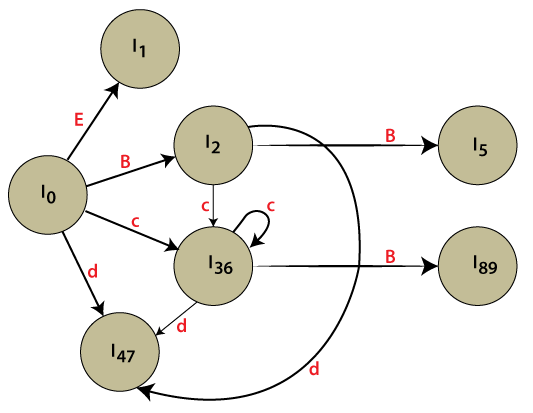
LALR 1 Parsing  Compiler Design

LALR(1) Parsing Table

StatesActionGo To
 c                                d                                $E                                B
I0S36                             S47                                  2
I1  
I2S36                               S47                                   5
I36S36                               S47                                   89
I47r3                                  r3                              r3 
I5                                                                    r1 
I89r2                                 r2                             r2 

Related Topics

Boolean Expression in Compiler Design

Boolean Expression The translation of conditional statements such as if-else statements and while-do statements is associated with Boolean expression's translation. The main use of the Boolean expression is the following: Boolean expressions...

3 minutes read.

Optimization of Basic Blocks in Compiler Design

Optimization of Basic Blocks We can apply the optimization process on a basic block. While optimization, there is no need to change the set of expressions computed by the block. The basic...

3 minutes read.

Syntax Analysis Compiler Design

Syntax Analysis This article will describe the parsing method used in the compiler. The grammatical rule of programming language can be constructed with the help of context-free grammars or BNF (Backus–Naur...

3 minutes read.

Syntax-Directed Translation

Syntax-Directed Translation A context-free-grammar with some additional rules is known as a syntax-directed definition. In SDT, attributes are associated with grammar symbols and rules are associated with productions. The attributes can...

3 minutes read.

Run-Time Storage Management

Run-Time Storage Management Every executing program has its own logical address space. Logical address space is partitioned into: Code: It is responsible for storing the executable target code. Static: It is used to...

3 minutes read.

Switch Case Statement Compiler Design

Case Statement The “case” or “switch” statement is available in various languages. The following is the syntax for the case statement: switch (E)  {             case V1: S1             case V2: S2 ...

1 minute read.

Machine-Independent Optimizations in Compiler Design

Machine-Independent Optimizations The main aim of machine-independent optimization is to improve the generated intermediate code so that compiler can get better target code. Eliminating unwanted code from the object code or replacing...

8 minutes read.

Shift Reduce Parsing in Compiler Design

Like the bottom-up parsing, the shift reduce parser also builds the parse tree from the leaves (bottom) to the root (up). The LR parser is a more versatile variation of...

4 minutes read.

Symbol Table Compiler Design

Symbol Table It is an important data structure used by the compiler. It stores information about various entities such as object, class, variable names, functions name, interfaces, procedure, literals, string etc.  The...

3 minutes read.

Run-Time Environments

Run-Time Environments Storage Organization Every target program has its own logical address, and an executable program runs in it. The logical address space has the location for each program value. The...

2 minutes read.

Ambiguity Elimination Compiler Design

Ambiguity Elimination Ambiguity elimination makes the sentence clear and readable. A sentence is grammatically ambiguous if it can produce more than one parse tree for a particular grammar. In this article,...

3 minutes read.

Three-Address Code

Three-Address Code If there is at most one operator on the right side of the instruction, then the instruction will be the three-address code so that no arithmetic expressions are permitted....

2 minutes read.

SLR 1 Parsing Compiler Design

SLR(1) Parsing It is a simple LR parsing. Most of the function of this parsing is the same as LR(0) parsing. The parsing table for both the parser vary. The SLR(1)...

5 minutes read.

LR Parser Compiler Design

LR Parser LR parsing is a type of bottom-up parsing that is used to parse the large class of grammars. Here "L" stands for left-to-right scanning of the input "R" stands...

6 minutes read.

CLR Parsing Compiler Design

CLR Parsing CLR parsing refers to the canonical lookahead. We will use the canonical collection of LR(1) items for the construction of the CLR(1) parsing table. Generally, CLR(1) parsing has more...

6 minutes read.

Errors in Compiler Design

Introduction Errors in compiler design refer to mistakes or issues that arise during the process of execution of the program. A compiler is a program that translates source code written in...

4 minutes read.

S-attributed and L-attributed SDTs

S-attributed and L-attributed SDTs STD stands for Syntax Directed Translation. When we associate some informal notations called semantic rules and the grammar, they are known as STD. So we can say...

2 minutes read.

Finite State Machine

Finite State Machine A finite state machine is a simple machine to recognize patterns. It takes a string of symbols as the input and changes its state to another state, but...

3 minutes read.

Evolution of Programming Languages in Compiler Design

The Evolution of Programming Languages The first computer came in the 1940s and was programmed in a binary language that told the computer what operations are to be performed and in...

4 minutes read.

Storage Allocation

Storage Allocation The storage allocation represents memory management. The allocation of memory can be done in the following ways: Static AllocationStack AllocationHeap Management Static Allocation: It is a procedure used for the allocation of...

1 minute read.