
Laravel Resource Controllers

Laravel resource routing assigns the “CRUD” routes to a controller with the help of single line code.

For E.g.,

If we wish to create a controller that handles all HTTP requests “photos” stored by our application using the make:controller Artisan command. We can quickly create a controller.

php artisan make:controller PhotoController --resource

This above command will generate a controller at

app/Http/Controllers/PhotoController.php.

For each of the available resource operations, the controller will contain a method.

In the next step, we are going to register an original route to the controller:

Route::resource(‘photos’,‘PhotoController’);

The single route declaration creates many routes to handle different types of action on the resource. The generated controller will already have methods for these actions, including notes informing us to the HTTP verbs and URIs they handle.

We register many resource controllers at once by passing an array to the resource method:

Route::resource([
‘photos’ => ‘PhotoController’, 
‘posts’ => ‘PostController’
 ]); 

Actions Handled By Resource Controller

Verb URI Action Route Name
GET /photos index photos.index
GET /photos/create create photos.create
POST /photos store photos.store
GET /photos/{photo} show  photos.show
GET /photos/{photo}/edit edit photos.edit
PUT/PATCH /photos/{photo} update photos.update
DELETE /photo/{photo} destroy photos.destory

Specifying the Resource Model:

If we are using route model binding and would like the resource controller`s methods to type-hint a model instance, we use the --model option when generating the controller:

php artisan make:controller PhotoController   --resource --model=Photo 

Spoofing Form Methods:

Since the HTML forms can`t make PUT, PATCH, or DELETE requests, we will need to add a hidden _method field to spoof these HTTP verbs. The @method Blade directive can create this field for us:

<form action=”/foo/bar” method=”POST”>
 @method(‘PUT’) 
 </form> 
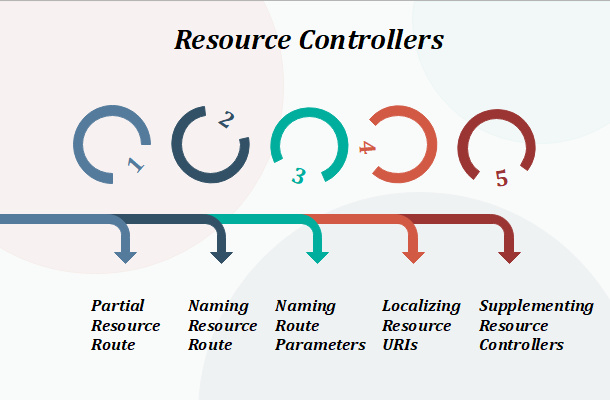
laravel resource controllers

The Resource Controllers are divided into 5 different types:

Partial Resource Route

When declaring a resource route, we specify a subset of actions.

The controller should handle instead of the face set of default actions:

Route::resource( ‘photos’,‘PhotoController’) ->only
([ 
‘index’, ‘show’ 
]); 
Route::resource( ‘photos’, ‘PhotoController’)-> except  
([
‘create’, ‘store’, ‘update’, ‘destroy’  
]); 

API Resource Routes:

When declaring resource routes that will be consumed by APIs, we will commonly want to exclude routes which present HTML templates like create and edit.

We use the apiResource method to exclude these two routes automatically:

Route::apiResource('photos','PhotoController');

We register many API resource controllers at once by passing an array to the apiResources method:

Route::apiResources([
'photos' => 'PhotoController', 
'posts' => 'PostController'
 ]); 

For quickly generate an API resource controller which does not include the create or edit methods, we use the --api switch for executing the make:controller command:

phpartisan make:controller API/PhotoController --api

Naming Resource Routes

By default, all type of resource controller actions have a route name. We can override these names by passing a names array with our options:

Route::resource(‘photos’,‘PhotoController’)->names
([
‘create’ => ‘photos.build’
]); 

Naming Resource Route Parameters

The Route::resource will create the route parameters for our resource routes based on the “singularized” version of the resource name.

We can easily override this on resource basis by using the parameters method.

The array passed into the parameters method should be an associative array of resource names and parameters routes:

Route::resource(‘users’,‘AdminUserController’)->parameters
([ 
‘users’ => ‘admin_user’ 
 ]); 

The above example generates the following URIs for the resource`s show route:

/users/{admin_user}

Localizing Resource URIs

The Route::resource is used by default; it will create a resource URIs using the English verbs.

If we need to localize the create and edit action verbs, we can use the Route::resourceVerbs method.

It may be done in the boot method of our AppServiceProvider.

use Illuminate\Support\Facades\Route;

 /**
  * Bootstrap any application services.
  *
  * @return void
  */
 public function boot()
 {
     Route::resourceVerbs([
         'create' => 'crear',
         'edit' => 'editar',
     ]);
 } 

Once the verbs have been customized, the resource route registration like Route::resource(‘fotos’, ‘PhotoController’) will produce the following URIs:

/fotos/crear
/fotos/{foto}/editar 

Supplementing Resource Controllers

If we need to add additional routes to a resource controller over the default set of resource routes, we should define these routes before our call to the Route::resource.

Otherwise, the routes defined by the resource method will take the lead over our supplement routes:  

Route::get(‘photos/popular’,‘PhotoController@method’);
Route::resource(‘photos’; ‘PhotoController’); 

Related Topics

Laravel Templating Inheritance

Introduction: The Blade is a PHP Templating Engine. It grabs the PHP code and makes it easy for us to implement in HTML. The Blade is a simple, and powerful Templating Engine provided by...

4 minutes read.

Laravel Basic Controllers

Controllers group relate request handling logic into a single class. They are stored in the app/Http/Controllers directory. Basic Controllers Defining Controllers: The controllers extend the base controller class included with Laravel. The base class...

2 minutes read.

Laravel First Packages

First Packages  Laravel provides the following ready to use packages: Cashier: It was introduced in Laravel 4.2 version, it provides an interface for managing subscription billing service, like handling coupons and generating invoices. SSH: It was...

2 minutes read.

Laravel Data Views

Passing the Data Views The data should be an array with the key/value pairs while passing the information in the following (return view(‘greeting’, [‘name’ => ‘John’]);) manner. Inside the view, we...

4 minutes read.

How to Install Git on Windows

Git Installation Git is a distributed version control system. It is used for tracking changes in source code during development. The goals include speed, data integrity, non-linear workflows, etc. Git was developed in 2005. It is free...

3 minutes read.

Laravel Authentication

Authentication is a process of identifying user credentials. Laravel makes implementing authentication very simple. The authentication configuration file is located at config/auth.php that contains various documented options for adjusting the behavior of the authentication...

4 minutes read.

Database Migrations

Database Migrations in Laravel Introduction Migrations are version control for our database. It allows our team to modify and share the application`s database. Migrations are paired with schema builder to build an application`s database...

2 minutes read.

Creating First Laravel Project

Creating the Laravel Project For creating the Laravel project, we are going to use a “Git”. If you don`t have a “Git” software and also don`t have the knowledge to install it, then click here. Let`s...

1 minute read.

Laravel Displaying Data

Display data that is passed to our Blade views by enclosing the variable in curly braces. The following route is given below: Route::get('greeting', function () { return view('welcome', ['name' => 'rafia']); }); We display...

2 minutes read.

Laravel Named Routes

Named Routes Named routes allow the suitable generation of URLs or redirects to specific routes. We specify a name for a route by changing the name method onto the route definition: Syntax:  Route::get(‘user/profile’, function () {...

2 minutes read.

Laravel Eloquent Database Relationships

Eloquent Relationships Laravel: Database tables are related to one another. Eloquent manages and work with easy relationships. It supports some different types of relationship, which are as follows: One to oneOne to manyMany...

8 minutes read.

XAMPP Installation

install xampp on windows XAMPP is a free & open-source stack package which is developed by Apache, mainly it consists of Apache HTTP server, Maria DB database for scripts written in the...

2 minutes read.

Laravel Basic Routing

Basic Routing The basic Laravel routes accept a URI and a Closure, providing a straightforward method for defining routes: Route::get('/', function () { return view('welcome') }); E.g.: Route::get('/', function () { return "Hello Laravel"; }); Output: We...

3 minutes read.

Laravel Advantages

Top 8 Advantages of Laravel The following advantages that Laravel offers, it is based upon designing a web application:- 1. Powerful Authentication: The Laravel PHP framework was developed with a purpose that can help...

2 minutes read.

Laravel Route Parameters

Required Parameters: We need to capture segments of the URI within our route. We are going to see how to pass parameters through two or many views inside the closure function. Route::get('/home',...

2 minutes read.

Laravel Tutorial

Laravel Tutorial is a PHP based web-framework; it is used for developing high-end web applications by using significant syntax's. It has a substantial collection of tools and provides application architecture....

5 minutes read.

CSS Icons

CSS Icons       CSS icons are specified like a symbol or image used inside a computer interface assign to any element. CSS icons are the graphical depiction of any program or...

4 minutes read.

Laravel Resource Controllers

Laravel resource routing assigns the “CRUD” routes to a controller with the help of single line code. For E.g., If we wish to create a controller that handles all HTTP requests “photos” stored by...

4 minutes read.

Raw SQL Queries

Raw SQL Queries: Laravel interact with databases by the variety of database back-ends with raw SQL, the fluent query builder, and the Eloquent ORM. Laravel supports four types of databases: MySQLPostgreSQLSQLiteSQL Server Configuration The database...

3 minutes read.

Laravel Validation

Laravel provides a different way to validate the application`s incoming data. Laravel base controller class uses a ValidatesRequests that provides an easy method to validate incoming HTTP request with many powerful validation rules. Defining the...

5 minutes read.