
×

How to Add Comments in SQL?

How to Add Comments in SQL

Comments are text notes that are incorporated into the program to make the code easier to understand. In SQL, commenting is used to explain various sections and to provide appropriate documentation to a program. In addition, it also prevents the code from being executed.

Comments can be added in SQL in the following ways:

  1. Single Line Comment
  2. Multi Line Comment
  3. Inline Comment

1. Single Line Comments: Comments which are added to a single line are called as single line comments.

Syntax:

--Add a single line which is to be commented

Example:

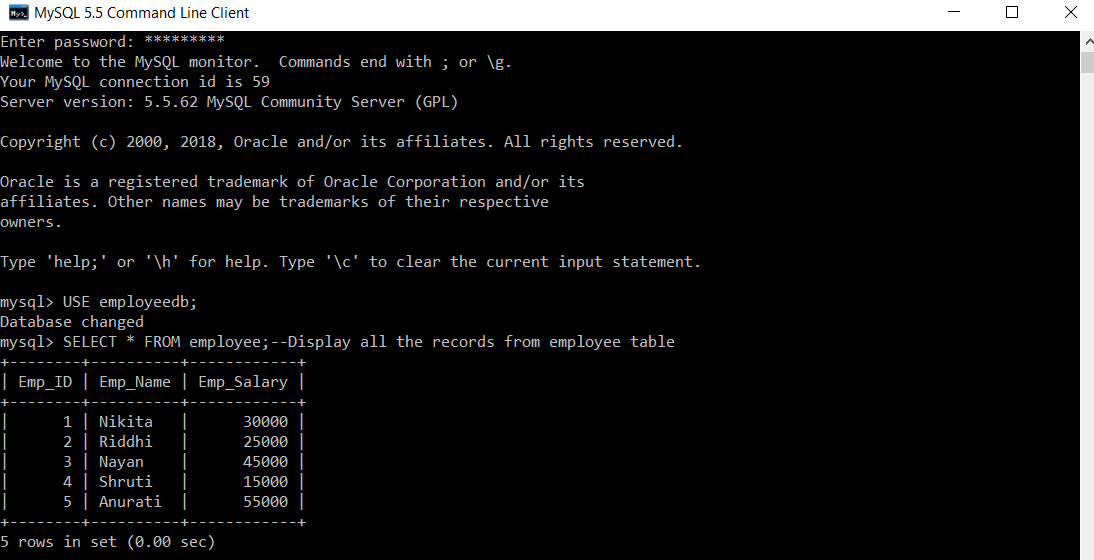
SELECT * FROM employee;--Display all the records from employee table

Output:

 +--------+----------+------------+
 | Emp_ID | Emp_Name | Emp_Salary |
 +--------+----------+------------+
 |      1 | Nikita   |      30000 |
 |      2 | Riddhi   |      25000 |
 |      3 | Nayan    |      45000 |
 |      4 | Shruti   |      15000 |
 |      5 | Anurati  |      55000 |
 +--------+----------+------------+
 5 rows in set (0.00 sec) 
Add Comments in SQL

“Display all the records from employee table” is displayed as a single line comment in above example, and also not get executed.

2. Multi Line Comment: Comments which are added to multiple lines together are called as multi line comments.

Syntax:

 /*
 Add multiple lines
 which are to be commented
 */ 

Example:

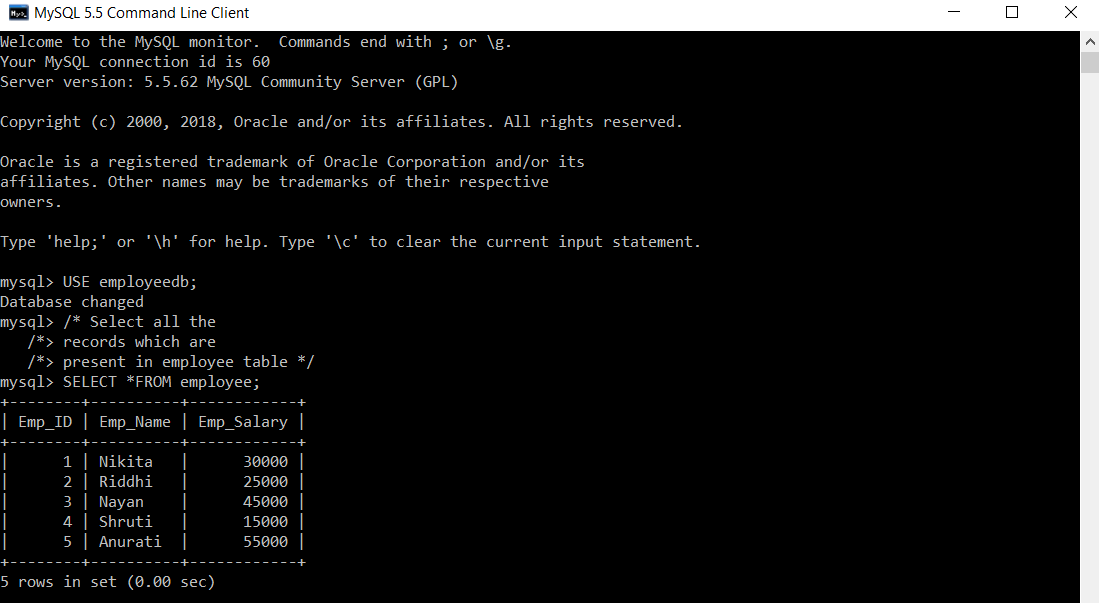
 /* Select all the
 records which are
 present in employee table */
 SELECT *FROM employee; 

Output:

 +--------+----------+------------+
 | Emp_ID | Emp_Name | Emp_Salary |
 +--------+----------+------------+
 |      1 | Nikita   |      30000 |
 |      2 | Riddhi   |      25000 |
 |      3 | Nayan    |      45000 |
 |      4 | Shruti   |      15000 |
 |      5 | Anurati  |      55000 |
 +--------+----------+------------+
 5 rows in set (0.00 sec) 
Add Comments in SQL

“Select all the records which are present in employee table” is displayed as a multiline comment in above example.

3. Inline Comment: Comments which are added in between the SQL statements are called as inline comments.

Syntax:

SQL Statements /*single or multiple lines which are to be commented*/ continuation of SQL Statements

Example:

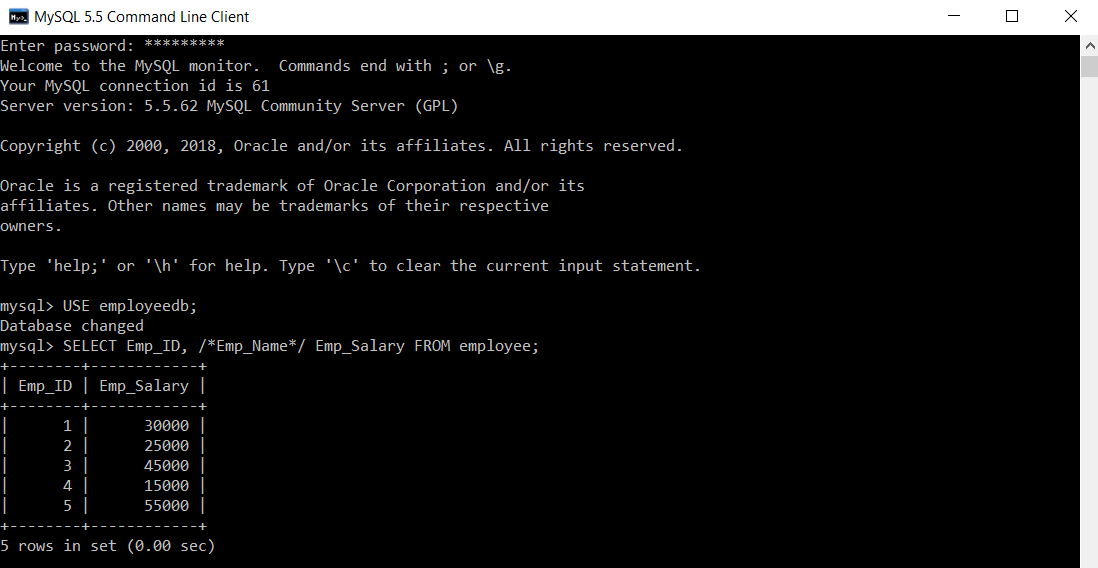
SELECT Emp_ID, /*Emp_Name*/ Emp_Salary FROM employee;
  • Output:
 +--------+------------+
 | Emp_ID | Emp_Salary |
 +--------+------------+
 |      1 |      30000 |
 |      2 |      25000 |
 |      3 |      45000 |
 |      4 |      15000 |
 |      5 |      55000 |
 +--------+------------+
 5 rows in set (0.00 sec) 
Add Comments in SQL

“single or multiple lines which are to be commented” is displayed as an inline comment in above example.


Related Topics

How to Add Foreign Key in SQL?

How to Add Foreign Key in SQL Foreign key is an attribute or a set of attributes that references to primary key of same table or another table (relation). Foreign key creation along...

4 minutes read.

SQL WHERE Multiple Conditions

In this topic, we will learn how to add multiple conditions using the WHERE clause. First, let's understand the concept of WHERE clause. WHERE clause is used to specify a condition while...

5 minutes read.

Types of SQL Commands

The Structured Query Language is used to deal with structured data. The data which are stored in the form of tables are structured data. These SQL commands store records or...

10 minutes read.

SQL Truncate

This command deletes all records from table. Truncate is a DDL command. Syntax: TRUNCATE table table_name; Example: Truncate table teacher; ORDER BY The ORDER BY clause arranges the table or column in ascending...

5 minutes read.

SQL INSERT Statement

In this tutorial, we will help you to understand and learn how to insert records to the table in SQL with the help of examples. SQL INSERT query is used to...

5 minutes read.

SQL SET Keyword

This article will provide you a good understanding of the Set keyword in Structured Query Language. What is the SET keyword? The SET keyword is used to specify values for the variables....

3 minutes read.

How to compare date in SQL

In this section, we will learn about how dates can be compared in SQL. We can compare any random date with another date stored in a column of a table.This comparison...

4 minutes read.

Codd’s Rules in SQL

Codd’s Rules Dr. Edgar F. Codd, in 1985, laid down 13 fundamental rules after doing large-scale research on the Relational Model of databases. According to him, every database must follow these...

3 minutes read.

SQL FULL JOIN

In this section, we will help you understand the concept of the SQL FULL Join clause with a few examples. The SQL FULL Join query is executed to display the integrated...

3 minutes read.

SQL SubQuery

The Sub-query in the SQL is the inner query placed or positioned inside another query, which is also known is the outer query. The inner query is embedded in the...

6 minutes read.

SQL CONSTRAINTS

SQL Constraints specifies the rules/limitations/restrictions for data present in table. SQL Constraints are specified at the time of table creation or after table creation using ALTER command. There are two...

5 minutes read.

SQL Left Join

The SQL Left Join query displays all the records from the table and displays similar records from the right table. The query displays zero records if it doesn’t find any...

4 minutes read.

SQL CROSS Join

In this tutorial, we will help you understand the concept of the SQL CROSS Join clause with the few examples. The SQL CROSS Join query is used to join one or...

5 minutes read.

SQL Operators

Arithmetic Operators Arithmetic operators are +, -, *, /, % performs addition, subtraction, multiplication, division, modulo respectively. Example:   Select 100+222; Select salary+100 From teacher Where teacher_id=1; Following output screen shows different arithmetic operations. We...

2 minutes read.

SQL SELECT SUM

The SQL Sum() function is an aggregate function in SQL that returns the total values of an expression. The expression may be numerical, or it may be an expression. Syntax: SELECT SUM(columnname)...

3 minutes read.

SQL Primary Key

A field, which contains unique data in a table, is called a PRIMARY KEY (PK). It means, a PRIMARY KEY field must contain unique data in the table. A PRIMARY KEY...

4 minutes read.

SQL Data Control Language

Data Control Language decides to whom should (which user) permit access privileges. GRANT and REVOKE are the commands of DCL. GRANT: It gives privileges to user. REVOKE: It takes back privileges from granted...

1 minute read.

SQL FOREIGN KEY

In this article, we will learn about the FOREIGN KEY constraints and how to define a FOREIGN KEY constraint to build the relationship between two tables. In a Relational Databases Management...

4 minutes read.

How to use the BETWEEN operator in SQL

In this entire SQL article, we will understand and learn about the BETWEEN operator concept and how to use it in SQL. What is the BETWEEN operator in SQL? The Between operator...

4 minutes read.

Grant Command in SQL

What is DCL (Data Control Language)? Data Control Language (DCL) is a computer programming language with syntax intended to manage access to data kept in databases. It is a part of...

3 minutes read.