
×

SQL Data Control Language

Data Control Language decides to whom should (which user) permit access privileges.

GRANT and REVOKE are the commands of DCL.

GRANT: It gives privileges to user.

REVOKE: It takes back privileges from granted user.

Data Query Language

Data Query Language does not make any changes in database. Neither schema level nor data level.
SELECT is a command of DQL.

SELECT: Retrieves data /records from table.

Syntax:

SELECT Column_1, Column 2, …..
FROM  Table_name
[WHERE condition];

Example:

  1. Select Student_id , Student_name
From Student Where Student_id=’10’;
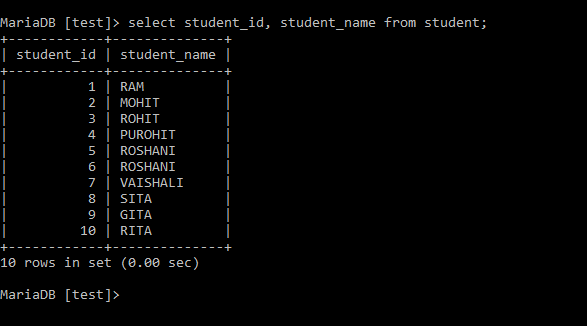
  1. Select Student_id , Student_name From Student;
Syntax:

SELECT * FROM  Table_name [WHERE condition];

Example:

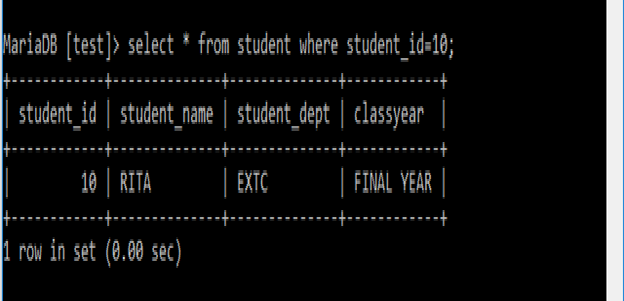
Select  * From  Student where Student_id=’10’;

  • This query retrieves single record with all its attributes/columns.
  • ‘* ‘Indicates all the fields/attributes/columns in the table.
  • Where condition is specified for a particular record.
Syntax:

SELECT * FROM  Table_name;

Example:

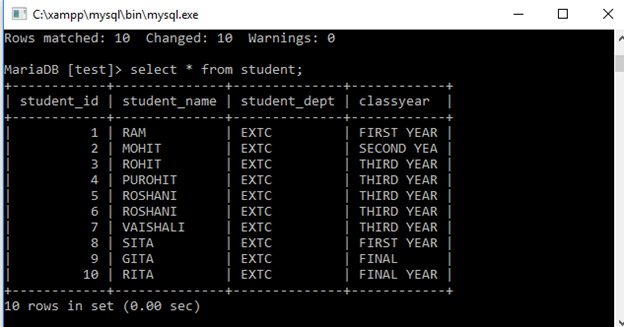
SELECT * FROM STUDENT;

It will retrieve all records and all the columns from the table.

Where condition is not specified to fetch a particular record. 

Related Topics

SQL SET Keyword

This article will provide you a good understanding of the Set keyword in Structured Query Language. What is the SET keyword? The SET keyword is used to specify values for the variables....

3 minutes read.

SQL SELECT AVG

In this tutorial, we will learn about the aggregate function name avg() function concept in SQL with the help of examples. The AVG() function is one of the aggregate functions in...

3 minutes read.

SQL INTERSECT

SQL intersect operator is used to combine two or more SELECT statements, but it only displays the data similar to the SELECT statement. The syntax for the INTERSECT operation: SELECT COLUMN_NAME1, COLUMN_NAME2,...

3 minutes read.

SQL SELECT AND Operator

This SQL tutorial explains and helps us understand how to use the AND Operator in the SELECT query with examples. The AND Operator is used to fetch the table’s records if...

2 minutes read.

SQL Topological Sorting

It is for Directed Acyclic Graph, which linearly describes the ordering of graphs. It is not possible for all graphs, it is possible for only Directed acyclic graphs. Applications of Topological...

3 minutes read.

SQL Data Types

In SQL DATA TYPES, each column holds value. Data types can be an integer type, character type, etc., and such data is stored in the database table. The data type is...

4 minutes read.

SQL IN vs SQL EXISTS

SQL IN vs SQL EXISTS This article discusses in detail about the IN and the EXISTS operators in SQL. It is a common question between developers that what is the difference...

3 minutes read.

Types of SQL JOIN

The SQL JOIN combines one or more than one tables based on their relationship. The SQL JOIN involves a parent table and a child table relationship. There are different types of...

10 minutes read.

How to compare date in SQL

In this section, we will learn about how dates can be compared in SQL. We can compare any random date with another date stored in a column of a table.This comparison...

4 minutes read.

Commit and Rollback in SQL

In Structured Query Language, we have Data Definition Language (DDL) and Data Manipulation Language (DML) commands the same way we have Transaction Control Language (TCL) commands in the Structured Query...

4 minutes read.

SQL FULL JOIN

In this section, we will help you understand the concept of the SQL FULL Join clause with a few examples. The SQL FULL Join query is executed to display the integrated...

3 minutes read.

SQL Handling Duplicate

Removing Duplicates using DISTINCT Keyword: By using the DISTINCT keyword in SQL we can remove duplicate characters from tables or databases. A table contains more duplicate values and duplicate values can cause...

4 minutes read.

SQL WHERE Clause

The WHERE clause is a search filter that returns only true records. The WHERE clause chooses the selected records based on the given conditions. The WHERE clause is used with...

4 minutes read.

Truncate function in SQL

The TRUNCATE is a numeric function in SQL which truncates the number according to the particular decimal points. Syntax of TRUNCATE Function SELECT TRUNCATE(X, D) AS Alias_Name; In the TRUNCATE syntax, X...

4 minutes read.

SQL Wildcards

SQL WILDCARD CHARACTERS: SQL wild card character is used to substitute zero or more characters of a string. These characters are used with the “LIKE” operator. Wild Card Characters in SQL: %_[]^- “%” : It is...

3 minutes read.

SQL Comparision Operator

The Comparison Operator compares different data of the Structured Query Language table and checks whether the data are the same, less than, greater than, less than, or greater than equal....

14 minutes read.

SQL COPY Table

In this tutorial, we will learn how to copy tables in SQL with the help of examples. Using the SELECT INTO statement in the SQL we can copy one table into...

4 minutes read.

SQL Cloning Tables

Cloning a Table: To create a copy of the table. To perform the operations, without affecting the actual table. Steps for creating a Cloning Table: Step 1: Empty Table Creation The syntax for Creating...

3 minutes read.

SQL Count

Structured Query Language Count() Function is used with Structured Query Language SELECT Statement. SQL Count() function returns the number of items that match the specified criteria in the SELECT statement. Count()...

2 minutes read.

How to use HAVING clause in SQL

In this article, we will learn about the HAVING clause concept and how to use it in SQL. What is the HAVING clause? In Structured Query Language, HAVING Clause used with GROUP...

7 minutes read.