SQL SELECT LIKE Operator
The SQL SELECT LIKE Operator tutorial helps us understand how to use the LIKE operator in the SELECT query with examples.
The SQL SELECT LIKE Operator retrieves the records from the table, which finds the data using wildcard options. The SQL LIKE operator is used with the WHERE clause in the query.
Following are the two wildcard characters are used to find the pattern matching string from the table.
1 Percent Wildcard Character (%)
2 Underscore Wildcard Character (_)
The syntax of the LIKE Operator with the SELECT statement is as follows:
SELECT Column_1, Column_2, Column_3. Column_4, Column_5 FROM Table_Name WHERE Column_Name LIKE expression;
1 Percent Wildcard Character (%): The Percent Wildcard Character symbol is used to search the zero, one, or more than one string character.
The syntax of the SQL SELECT LIKE operator using Percent wildcard Character is as follows:
SELECT Column_1, Column_2, Column_3. Column_4, Column_5 FROM Table_Name WHERE Column_Name LIKE %expression%;
2 Underscore Wildcard Character (%): The Underscore Wildcard Character symbol searches for the zero or one string character.
The syntax of the SQL SELECT LIKE operator using Underscore wildcard Character is as follows:
SELECT Column_1, Column_2, Column_3. Column_4, Column_5 FROM Table_Name WHERE Column_Name LIKE ___%;
We can use the AND operator and the OR operator for multiple combinations in the query.
Let’s understand the SQL SELECT LIKE operator with the help of an examples
Consider the already existing table with the certain records
Table Number 1: Student
| Student_Id | Student_Name | City | Age |
| 1 | Pratik Srivastav | Pune | 23 |
| 2 | Utkarsh Rokade | Mumbai | 22 |
| 3 | Sourabh Chougale | Nashik | 23 |
| 4 | Prateek Zimbre | Pune | 24 |
| 5 | Sakshi Patil | Aurangabad | 22 |
| 6 | Shruti Sharma | Mumbai | 21 |
| 7 | Pranoti Shende | Aurangabad | 23 |
| 8 | Harshada Dhanwat | Nashik | 24 |
| 9 | Tejas Bairagi | Nashik | 21 |
| 10 | Nikhil Patil | Pune | 24 |
| 11 | Samaira Sharma | Mumbai | 22 |
| 12 | Anushka Sen | Aurangabad | 23 |
| 13 | Bhushan Pachpande | Bangalore | 25 |
| 14 | John Chaudhary | Bangalore | 24 |
| 15 | Sonakashi Sen | Bangalore | 25 |
| 16 | Mayuri Wagh | Hyderabad | 22 |
| 17 | Ritika Patil | Hyderabad | 21 |
| 18 | Tushar Mahale | Hyderabad | 23 |
Table Number 2: Course
| Course_Id | Course_Name | Student_Id | Duration |
| 11 | Cloud Computing | 2 | 3 |
| 12 | SQL Database | 1 | 1 |
| 13 | Advance Java | 4 | 3 |
| 14 | Data Structures | 7 | 6 |
| 15 | AWS | 8 | 2 |
| 16 | Angular Js | 10 | 3 |
| 17 | Oracle Integration Cloud | 11 | 6 |
| 18 | Python | 6 | 1 |
| 19 | ReactJs | 1 | 3 |
| 20 | Computing | 6 | 4 |
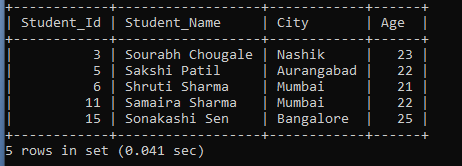
Example 1: Execute a query to display the student information from the student table where the student name starts with the 'S' letter.
SELECT * FROM Student WHERE Student_Name LIKE 'S%';
The above SELECT LIKE operator query example retrieved all the student information from the student table where the student name starts with the letter 'A'.
The output of the above query is as follows:
| Student_Id | Student_Name | City | Age |
| 3 | Sourabh Chougale | Nashik | 23 |
| 5 | Sakshi Patil | Aurangabad | 22 |
| 6 | Shruti Sharma | Mumbai | 21 |
| 11 | Samaira Sharma | Mumbai | 22 |
| 15 | Sonakashi Sen | Bangalore | 25 |
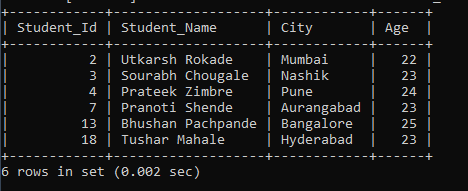
Example 2: Execute a query to display the student information from the student table where the student name ends with the 'E’ letter.
SELECT * FROM Student WHERE Student_Name LIKE '%E';
The above SELECT LIKE operator query example retrieved all the student information from the student table where the student name ends with the letter 'E'.
The output of the above query is as follows:
| Student_Id | Student_Name | City | Age |
| 2 | Utkarsh Rokade | Mumbai | 22 |
| 3 | Sourabh Chougale | Nashik | 23 |
| 4 | Prateek Zimbre | Pune | 24 |
| 7 | Pranoti Shende | Aurangabad | 23 |
| 13 | Bhushan Pachpande | Bangalore | 25 |
| 18 | Tushar Mahale | Hyderabad | 23 |
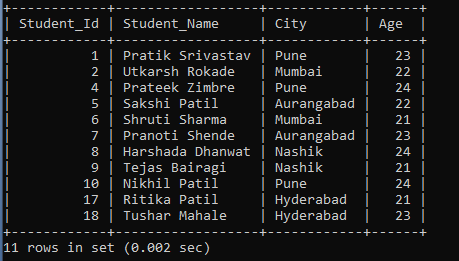
Example 3: Execute a query to display the student information from the student table where the student name contains the letter 'T' at any position.
SELECT * FROM Student WHERE Student_Name LIKE '%T%';
The above SELECT LIKE operator query example retrieved all the student information from the student table where the student name contains the letter 'T' anywhere.
The output of the above query is as follows:
| Student_Id | Student_Name | City | Age |
| 1 | Pratik Srivastav | Pune | 23 |
| 2 | Utkarsh Rokade | Mumbai | 22 |
| 4 | Prateek Zimbre | Pune | 24 |
| 5 | Sakshi Patil | Aurangabad | 22 |
| 6 | Shruti Sharma | Mumbai | 21 |
| 7 | Pranoti Shende | Aurangabad | 23 |
| 8 | Harshada Dhanwat | Nashik | 24 |
| 9 | Tejas Bairagi | Nashik | 21 |
| 10 | Nikhil Patil | Pune | 24 |
| 17 | Ritika Patil | Hyderabad | 21 |
| 18 | Tushar Mahale | Hyderabad | 23 |
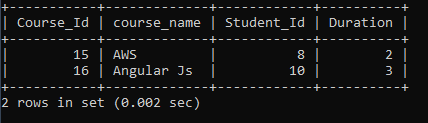
Example 4: Execute a query to display the course information from the course table where the course name starts with 'A' and ends with 'S'.
SELECT * FROM Course WHERE Course_Name LIKE 'A%S';
The above SELECT LIKE operator query example retrieved all the student course information from the course table where the course name starts with the letter 'A' and ends with the letter 'S'.
The output of the above query is as follows:
| Course_Id | Course_Name | Student_Id | Duration |
| 15 | AWS | 8 | 2 |
| 16 | Angular Js | 10 | 3 |
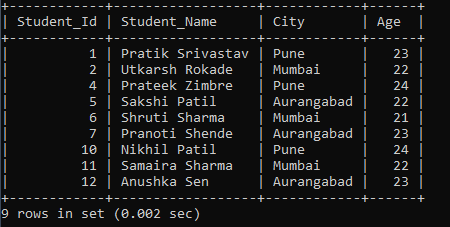
Example 5: Write a query to display the student information from the student table whose student city contains U at the second position.
SELECT * FROM Student WHERE City LIKE '_U%';
The above SELECT LIKE operator query example retrieved all the student course information from the course table where the city name contains the letter 'U' at the second index.
The output of the above query is as follows:
| Student_Id | Student_Name | City |
| 1 | Pratik Srivastav | Pune |
| 2 | Utkarsh Rokade | Mumbai |
| 4 | Prateek Zimbre | Pune |
| 5 | Sakshi Patil | Aurangabad |
| 6 | Shruti Sharma | Mumbai |
| 7 | Pranoti Shende | Aurangabad |
| 10 | Nikhil Patil | Pune |
| 11 | Samaira Sharma | Mumbai |
| 12 | Anushka Sen | Aurangabad |
Example 6: Write a query to display the student information from the student table whose student city name is 6 letters.
SELECT * FROM Student WHERE City LIKE '______';
The above SELECT LIKE operator query example retrieved all the student course information from the student table. The city name contains only 6 letters, starts with any letter, and ends with any letter.
The output of the above query is as follows:
| Student_Id | Student_Name | City | Age |
| 2 | Utkarsh Rokade | Mumbai | 22 |
| 3 | Sourabh Chougale | Nashik | 23 |
| 6 | Shruti Sharma | Mumbai | 21 |
| 8 | Harshada Dhanwat | Nashik | 24 |
| 9 | Tejas Bairagi | Nashik | 21 |
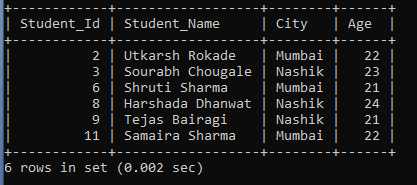
| 11 | Samaira Sharma | Mumbai | 22 |