
×

Configure IP Routing

  • IP Routing stands for “Internet Protocol Routing.”
  • It is the process of sending packets (data) from a source network to a destination network.
  • In IP Routing, routers select the best route for a data packet from the routing table.
  • A routing table contains a list of a different path for destination networks.
  • It stores destination network, subnet mask, next-hop address, routing metrics, and Administrative distance.

Example:

Configure IP routing in the topology is given below:
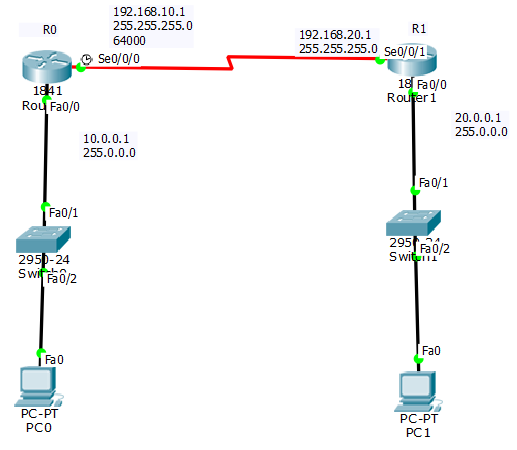
Configure IP Routing

The process to configure the ip routing is given below:

Correctly configure the IP address on each router’s interface. To configure ip address on router’s interface, first, add ip address followed by the subnet mask. Then provide clock rate if required, and give no shutdown command.

R0 Configuration

For R0 configuration, we need to configure two router interfaces.

1) interface s0/0/0

In interface s0/0/0, we provide the following commands:

ip address – 192.168.10.1    // you can give any series of ip address and subnet mask.
subnet mask- 255.255.255.0
clock rate – 64000
no shutdown 
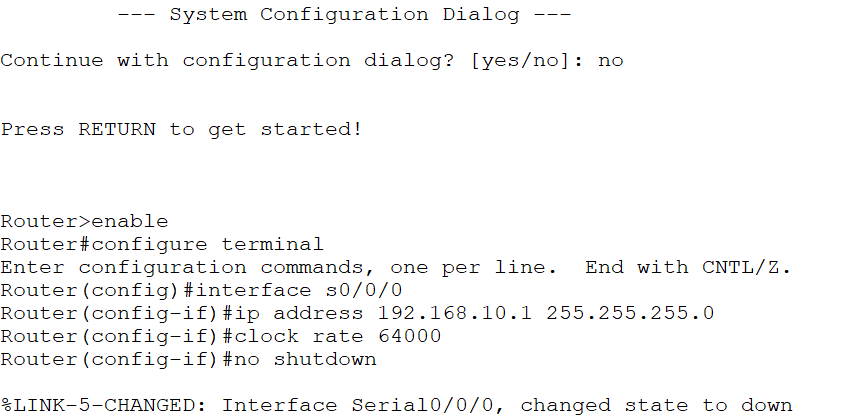
Configure IP Routing 1

2) interface f0/0

In interface f0/0, we provide the following commands:

 ip address 10.0.0.1  255.0.0.0  //you can give any series of ip address and subnet mask
 no shutdown
 exit //to move global configuration mode
 exit   // to move privileged exec mode 
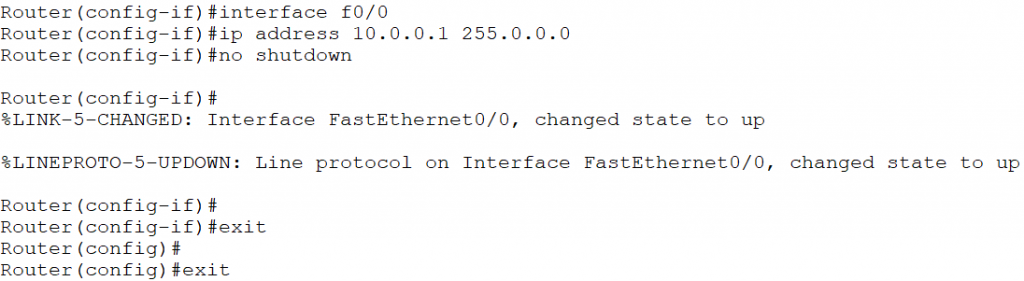
Configure IP Routing 2

To view the IP routing table created on a router R0, use “show ip route” command.
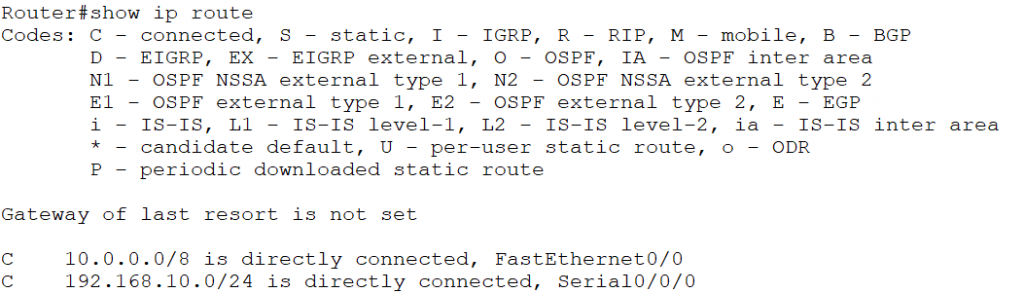
Configure IP Routing 3

In the above screenshot, you can check that only configured ip addresses, and directly connected networks are shown in the routing table.

R1 Configuration

For R1 configuration, we need to configure two router interfaces.

1) Interface s0/0/1

In interface s0/0/1, we provide the following commands:

 ip address 192.168.20.1  255.255.255.0  // you can use any series of ip address and subnet   mask
 no shutdown 

Configure IP Routing 4

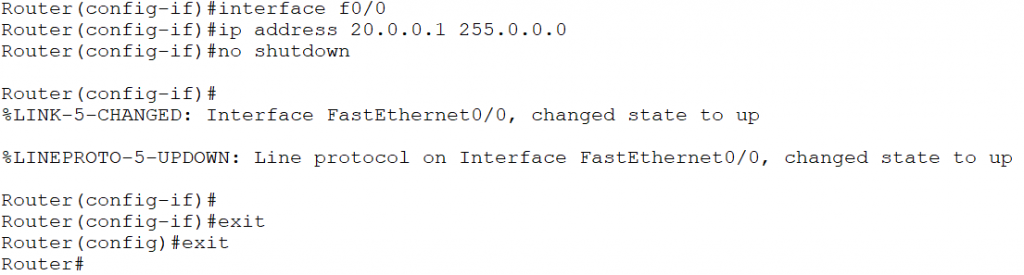
2) Interface f0/0

In interface f0/0, we provide the following commands:

 ip address 20.0.0.1  255.0.0.0  //you can give any series of ip address and subnet mask
 no shutdown
 exit    //to move global configuration mode
 exit   // to move privileged exec mode 
Configure IP Routing 5
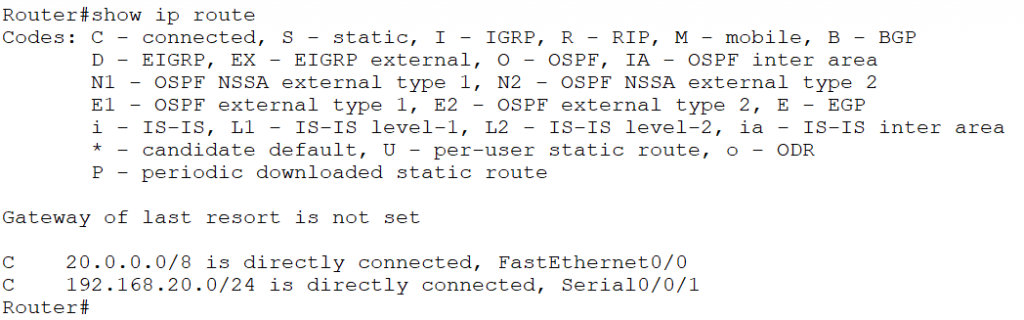
  • To view the IP routing tables created on a router R1, use the command “show ip route”.
Configure IP Routing 6

In the above screenshot, you can check that only configured ip addresses, and directly connected networks are shown in the routing table.


Related Topics

Components of a Cisco Router

The Internal Components of a Cisco Router Before troubleshoot and configure Cisco devices, it is necessary to know the major components of the Cisco routers. The given table shows all the internal components of...

2 minutes read.

Configuring OSPF

Consider the topology given below – The initial IP configuration table is given below: Devices Interface IP address Router1 ...

2 minutes read.

Getting familiar with the IOS modes

  There are following primary modes of operation in IOS. Setup ModeUser Exec ModePrivileged Exec ModeGlobal Configuration ModeInterface Configuration ModeRommon Mode Setup Mode In router or switches, all configurations are saved in NVRAM.If there is no...

3 minutes read.

Subnetting

Subnetting is the process of dividing a big network into many small networks. Suppose there is a company which has four departments like Development, HR, Marketing, and Testing. We don't want that all...

5 minutes read.

Spanning Tree Protocol (STP)

Spanning Tree Protocol (STP) is a Data link layer (layer 2) protocol that is used to discover and maintain a valid loop-free path for the switched network. It is also used to analyze...

4 minutes read.

EIGRP Basics

EIGRP stands for Enhanced Interior Gateway Routing Protocol. It is also called as the Hybrid routing protocol. It contains the features of both distance vector and link-state routing protocols. Characteristics of EIGRP There are the...

5 minutes read.

Banner config

Banner config The banner is a little pool which is used in Cisco systems and also in other systems like Unix, Linux and so no.It permits a text that is displayed when you log in a...

1 minute read.

Classes of IP Addresses

Classes of IP Addresses There are following five classes of IP Addresses: Class A – It is used for allocating an IP address.Class B - It is used for allocating an IP address.Class C – It...

6 minutes read.

Configure IP address to Router and PC in Packet Tracer

Configure IP address to Router and PC in Packet Tracer As a Network Engineer, it is compulsory to know how to configure an IP Address on networking devices like Router, Switch, PC, and Server.Assigning...

3 minutes read.

Cisco IOS Overview

Cisco IOS Overview Cisco Internetwork Operating System (IOS) is a multitasking operating system which controls all functions of Cisco routers and switches. Willaim Yeager wrote the first IOS in 1986.It is used to allocate resources and manages...

2 minutes read.

Configuring EIGRP

Consider the topology given below – The initial IP configuration table is given below: Devices Interface IP address Router1 ...

2 minutes read.

Data Encapsulation and De-Encapsulation

Data Encapsulation It is the process of adding headers and trailers to data. When a host transmits data to another device over a network, the data is encapsulated, with protocol information...

5 minutes read.

Configure Hostname

Configure a hostname on a router A hostname is a unique name given to a device (router or switch) on a network and is used to identify one device from another on a specific...

1 minute read.

Download and Install the Cisco Packet Tracer

Download and Install the Cisco Packet Tracer Step1: -Download Cisco Packet Tracer from the link given below: https://arief-jr.blogspot.com/2016/01/download-cisco-packet-tracer-62-for.html Here we will download Cisco packet tracer for Windows OS, so for Windows, go for...

1 minute read.

Verifying OSPF Configuration

There are several ways to verify OSPF configuration and operations, which are: show ip route commandshow ip ospf commandshow ip ospf database commandshow ip ospf interface commandshow ip protocol commandshow ip ospf neighbor commanddebugging ospf Consider the following topology –We...

2 minutes read.

Saving, Erasing, and Verifying Configuration

Saving Configuration Cisco device store commands information into two configuration files: running configurationstartup configuration running configuration In the running configuration, you can manually save the data from RAM to NVRAM by typing the copy running-config startup-config command. When you...

3 minutes read.

Routing Basics

Routing is the process of delivering a message across one or more networks by choosing the most appropriate path.It is performed by many kinds of networks like telephone network (Circuit Switching), electronic data networks...

2 minutes read.

Types of Spanning Tree Protocol

There are the following types of Spanning Tree Protocol – 1. Common Spanning Tree (802.1D) A Common Spanning Tree (802.1D) standard is developed by IEEE which elects only one Root Bridge for the...

2 minutes read.

Configure DHCP

 DHCP DHCP stands for Dynamic Host Configuration Protocol.It is a client server-based architecture which involves DHCP client and DHCP server.It is a messaging system for the communication between the DHCP server and DHCP client.It...

3 minutes read.

Configuring Catalyst Switches

When you power on a new purchased Switch for the first time, it runs a series of Power-On Self Tests (POSTs) operations. A  POST is designed to verify the basic operations of the...

3 minutes read.