
×

IP Addressing

IP Addressing

IP Addressing is designed to allow hosts on a network to communicate with another host on a different network.

There are two types of IP address:

  1. IPv4

IPv4 addresses are 32-bits long. It allows maximum 4,294,967,296 (232) unique addresses.

  • IPv6

IPv6 addresses are 128-bits long. It allows maximum 3.4 x 1038  (2128) unique addresses.

IP Terminology

Before starting of IP address, there are several important terms that you should understand about the Internet Protocol, which are:

Bit

It contains only one digit, either 1 or 0.

Byte

It contains 8 bits, depending on whether parity is set or not.

Octet

It is made up of 8 bits, or we can say an ordinary 8-bit binary number.

Network Address

It is used in routing to send packets to a remote network.

Example – A network address can be of type:

10.0.0.0, 172.16.0.0, and 192.168.10.0

Broadcast Address

It is the address used by applications and hosts to send information to all nodes on a network.

Example: A broadcast address can be of type:

255.255.255.255

The Hierarchical IP Addressing Scheme

An IP address is a 32-bit binary number. For readability, this binary number can be divided into four 8-bit octets, and then each octet (or byte) can be converted to decimal number.

There are three methods to write IP addresses.

  • Dotted-decimal (172.16.30.56)
  • Binary (10101100.00010000.00011110.00111000)
  • Hexadecimal (AC.10.1E.38)

Private IP Addresses

The user who creates the IP addressing scheme also needs to create private IP addresses. These addresses can be used on a private network, and not routable through the Internet.

There are three classes in the Private IP Address:

     Class A   10.0.0.0-10.255.255.255

     Class B    172.16.0.0-172.31.255.255

     Class C   192.168.0.0-192.168.255.255

Unicast Address

  • One-to-One Communication:

 A process where data is delivered from a sender to a receiver is called unicast.

Example: Browsing a website.
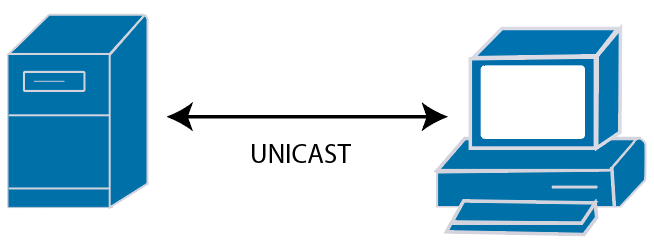
ip addressing

Multicast Address

  • One-to-Many Communication

A process where data is delivered from a sender to multiple receivers is called multipoint communication or multicast.

Example: ARP request message.
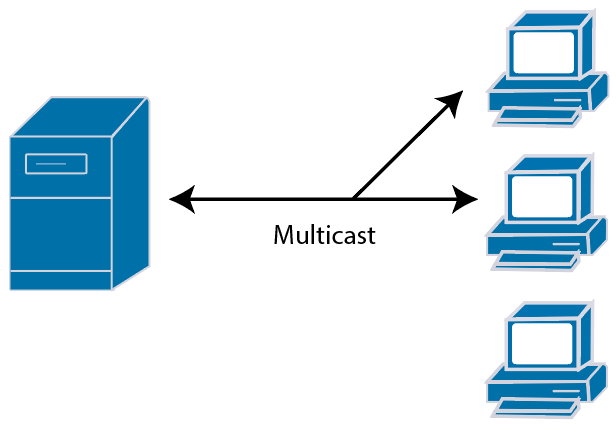
One-to-Many Communication

Broadcast Address

  • One-to-all Communication

In the Broadcast address, data travels from a single source to all destinations.

Example: Broadcasting an audio or video message.
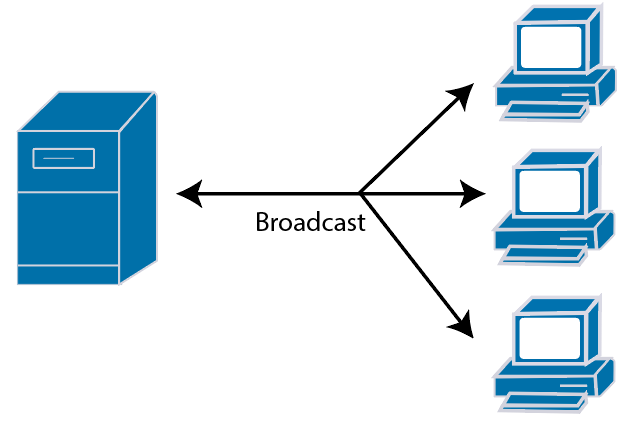
ip addressing 3

Related Topics

Variable Length Subnet Masks (VLSMs)

Variable Length Subnet Masks (VLSMs) A VLSM is a process of allocating IP addresses to the subnets according to the user’s need.VLSM is introduced to avoid the wastage of IP addresses.It allows you to...

3 minutes read.

Download and Install the Cisco Packet Tracer

Download and Install the Cisco Packet Tracer Step1: -Download Cisco Packet Tracer from the link given below: https://arief-jr.blogspot.com/2016/01/download-cisco-packet-tracer-62-for.html Here we will download Cisco packet tracer for Windows OS, so for Windows, go for...

1 minute read.

Saving, Erasing, and Verifying Configuration

Saving Configuration Cisco device store commands information into two configuration files: running configurationstartup configuration running configuration In the running configuration, you can manually save the data from RAM to NVRAM by typing the copy running-config startup-config command. When you...

3 minutes read.

Ethernet Networks in Review

Ethernet Networks in Review Today, Ethernet is the most used technology for the LANs. It is described as IEEE 802.3 standard. Ethernet is a connection-based media access method i.e., Carrier Sense...

2 minutes read.

Routing Information Protocol

Routing Information Protocol (RIP) Routing Information Protocol is a distance-vector routing protocol. It uses hop count to determine the best way for the remote network. By default, it has a maximum hop count 15. In...

5 minutes read.

The OSI Reference Model

OSI Reference Model OSI stands for Open System Interconnection. OSI provides a framework for creating and implementing networking standards, devices, and internetworking schemes. The following devices operate at the OSI model: Network...

6 minutes read.

Switching

A switch is a network device which is used to connect multiple devices (routers, computers) inside the LAN (Local Area Network). It operates at Data Link Layer (Layer 2) of the OSI reference...

3 minutes read.

IP Addressing

IP Addressing IP Addressing is designed to allow hosts on a network to communicate with another host on a different network. There are two types of IP address: IPv4 IPv4 addresses are 32-bits long. It allows...

2 minutes read.

CCNA Tutorial

What is CCNA? CCNA stands for Cisco Certified Network Associate. It is a certification course offered by Cisco. CCNA improves your understanding of the internet working and how different network topologies work...

3 minutes read.

Configure Hostname

Configure a hostname on a router A hostname is a unique name given to a device (router or switch) on a network and is used to identify one device from another on a specific...

1 minute read.

Power on a Cisco device

Power on a Cisco device When you power on a new purchased Cisco device for the first time, it performs a power-on-self-test (POST) operation to identify the hardware components and to verify that all...

1 minute read.

Configuring Catalyst Switches

When you power on a new purchased Switch for the first time, it runs a series of Power-On Self Tests (POSTs) operations. A  POST is designed to verify the basic operations of the...

3 minutes read.

Configuring EIGRP

Consider the topology given below – The initial IP configuration table is given below: Devices Interface IP address Router1 ...

2 minutes read.

Components of a Cisco Router

The Internal Components of a Cisco Router Before troubleshoot and configure Cisco devices, it is necessary to know the major components of the Cisco routers. The given table shows all the internal components of...

2 minutes read.

Spanning Tree Protocol (STP)

Spanning Tree Protocol (STP) is a Data link layer (layer 2) protocol that is used to discover and maintain a valid loop-free path for the switched network. It is also used to analyze...

4 minutes read.

Internetworking Basics

What is a Network? A network is a group of two or more devices connected by some transmission media, i.e., cables. The purpose of designing a network is to enable the sharing...

4 minutes read.

Configuring OSPF

Consider the topology given below – The initial IP configuration table is given below: Devices Interface IP address Router1 ...

2 minutes read.

Types of Spanning Tree Protocol

There are the following types of Spanning Tree Protocol – 1. Common Spanning Tree (802.1D) A Common Spanning Tree (802.1D) standard is developed by IEEE which elects only one Root Bridge for the...

2 minutes read.

EIGRP Basics

EIGRP stands for Enhanced Interior Gateway Routing Protocol. It is also called as the Hybrid routing protocol. It contains the features of both distance vector and link-state routing protocols. Characteristics of EIGRP There are the...

5 minutes read.

Classes of IP Addresses

Classes of IP Addresses There are following five classes of IP Addresses: Class A – It is used for allocating an IP address.Class B - It is used for allocating an IP address.Class C – It...

6 minutes read.