
Difference between AI/ ML/ Deep Learning
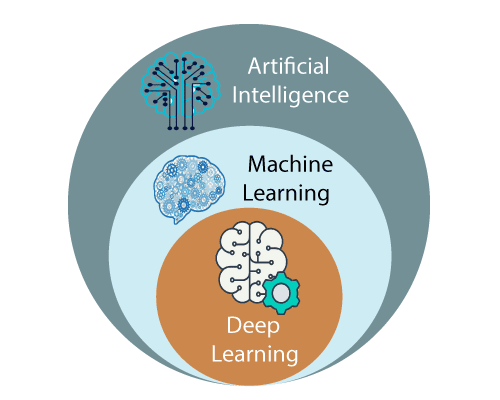
Nowadays, people are very much confused with the terms artificial intelligence, machine learning, and deep learning. For them, it seems to be that all these three concepts are the same, but in reality, they are interrelated to each other but are not the same. So, let’s see how they differ from each other;
What is Machine Learning?
Before directly digging into the concept of machine learning, let’s first look at the term data mining. Basically, data mining is a practice that keeps on reviewing extensive data sets and extracts some important information from that set only. So, it can be seen that machine learning works similarly to that of data mining or even we can say that it is one of a kind of data mining.
“A subset of AI that contains some techniques permitting the computers to learn from past experiences without being programmed explicitly is what Machine Learning is.”
Machine learning is widely used by many big brands such as online shopping apps like Amazon and Myntra etc, in which they provide their customers with some suggestions based on their previous shopping or products reviewed. Also, Netflix gives recommendations to users about the latest web series and shows that they would love to watch based on their previous watch and search history.
What is Deep Learning?
Deep learning is a subpart of machine learning. It works in the same manner as that of machine learning, just the fact that it differs in terms of its ability.
In the case of Machine learning, the model becomes better while growing. If an error occurs, the programmers have to solve the issue by themselves as the machine learning models require some supervision, but deep learning differs in this case as the model fixes itself. It did not need any help from the outside. A good example would be an automatic car driving system.
“Deep learning is a subset of machine learning used to decode complicated issues by learning from its methods of computation.”
What is Artificial Intelligence?
Machine learning and deep learning are further the subsets of artificial intelligence. AI is entirely different from ML and Deep learning. AI is rising so fast these days due to its concept that the machine has to imitate exactly like a human brain while solving problems and learning. It has good potential to outperform the company’s growth, reinventing some new ideas by changing its way of work.
“An ability of a computer or machine to work the same as the human brain is called Artificial Intelligence.”
AI means to copy the human brain in such a way that it performs exactly how a human brain would in any particular situation by thinking and functioning just like a human. AI is still under growth but has achieved a lot so far, and the best example to take into account would be Sophia, an advancement of AI, Siri, etc. It does not need to be preprogrammed, and rather, it uses algorithms that work for its intelligence. It incorporates Reinforcement learning, deep learning neural networks.
Examples of DL, AI, and ML
Examples and programs of ML vs. DL and AI will be listed in this phase:
Examples of Machine Learning
1. Recognition of speech
Sometimes, using your voice to control a smart device is more convenient than stopping to enter commands with your hands, whether you're running a long distance, kneading bread, or operating a car. Many smart gadgets can now identify voice thanks to machine learning, allowing users to accomplish activities like phoning a buddy, setting a timer, or looking for a certain program on a streaming service without ever touching the device.
These days, a lot of readily accessible smart gadgets, such as Amazon's Blink home security system and Google's Nest speakers, have voice recognition built in.
2. Autonomous vehicles
The creation of self-driving automobiles is perhaps one of the more "futuristic" technical developments of the last few years. Although this idea was formerly thought of as science fiction, a number of automobiles with semi-autonomous driving capabilities are already on the market, including the BMW X5 and Tesla Model S. Over the next ten years, manufacturers are working hard to make completely autonomous vehicles a reality for commuters.
Self-driving car development is a complicated process that is still in its early stages, but its main components are computer vision and machine learning. The vehicle employs machine learning algorithms to make judgments while it is moving and computer vision to scan its surroundings.
3. Artificial intelligence personal assistants
Everyone needs a little more assistance. For this reason, a lot of smart gadgets have AI personal assistants to help users with everyday duties like making phone calls, taking notes, and setting up meetings. Whether consumers are aware of it or not, they are utilizing machine learning-powered software anytime they utilize Google Assistant, Alexa, or Siri to accomplish these types of activities.
4. Recommendations
Companies and marketers invest a lot of money in attempting to match customers with the appropriate items at the appropriate moment. Customers are more likely to make a purchase or just remain on their platform if they can display the sorts of goods or information that suit their demands at the exact moment they need them.
Salespeople at physical establishments used to match customers with the types of things they might be interested in. However, as digital and online buying grow more commonplace, businesses must provide Internet customers with the same degree of support.
Modern streaming services and online stores do this by using recommendation engines, which provide tailored results for users based on data such as their location and past purchases. Amazon, Netflix, and Instagram are a few popular sites that employ recommendation engines based on machine learning.
5. Identify health issues
Big data is everywhere in the healthcare sector. Health institutions hold significant medical data, such as diagnostic pictures and electronic health records, which may be utilized to train machine learning algorithms to identify medical disorders. Some researchers are really using machine learning to detect malignant growths in medical scans, while others are using it to develop software that may assist medical personnel in making more precise diagnoses.
Examples of DL
1. Fraud detection
Deep learning algorithms can identify security issues to help protect against fraud. For example, deep learning algorithms can detect suspicious attempts to log into your accounts and notify you, as well as inform you if your chosen password isn’t strong enough.
2. Customer service
You may have seen or used customer service help online and interacted with a chatbot to help answer your questions or utilized a virtual assistant on your smartphone. Deep learning allows these systems to learn over time to respond.
3. Financial services
Several financial services can rely on assistance from deep learning. Predictive analytics helps support investment portfolios and trading assets in the stock market, as well as allowing banks to mitigate risk relating to loan approvals.
4. Natural language processing
Natural language processing is an important part of deep learning applications that rely on interpreting text and speech. Customer service chatbots, language translators, and sentiment analysis are all examples of applications benefitting from natural language processing.
5. Facial recognition
An area of deep learning known as computer vision allows deep learning algorithms to recognize specific features in pictures and videos. With this technique, you can use deep learning for facial recognition, identifying you by your unique features.
6. Self-driving vehicles
Autonomous vehicles use deep learning to learn how to operate and handle different situations while driving, and it allows vehicles to detect traffic lights, recognize signs, and avoid pedestrians.
7. Predictive analytics
Deep learning models can analyze large amounts of historical information to make accurate predictions. Predictive analytics helps businesses in several aspects, including forecasting revenue, product development, decision-making, and manufacturing.
8. Recommender Systems
Online services often use recommender systems with enhanced capabilities provided by deep learning models. With enough data, these deep learning models can predict the probabilities of certain interactions based on the history of previous interactions. Industries such as streaming services, e-commerce, and social media implement recommender systems.
9. Health care
Deep learning applications in the healthcare industry serve multiple purposes. Not only can they assist in developing treatment solutions, but deep learning algorithms are also capable of understanding medical images and helping doctors diagnose patients by detecting cancer cells.
Artificial Intelligence Examples
1. Risk Management and Evaluation
Artificial intelligence is a potent instrument in the financial industry that aids lenders in their decision-making process. Banks and other institutions may employ AI algorithms to evaluate applicants' data and determine if they are at high risk of loan default. In this case, one advantage of AI is that, in theory, the algorithms are impartial in their judgments. Depending on user inputs like risk preferences and result objectives, these AI systems may provide insights that bankers use to decide which loans and investments to make.
By identifying patterns and offering insights that might assist firms in lowering their risk threshold, AI also identifies overall risk.
2. Chatbots for Customer Service
Chatbots are being used by businesses to enhance customer service. These chatbots use artificial intelligence to comprehend user input and provide replies that are understandable to consumers. They are able to assist clients in getting the information they want and reply to direct inquiries. One benefit of chatbots is their ability to help consumers around-the-clock without the need for human intervention, which might save employment expenses for companies.
3. Algorithms for Streaming Services
AI is used by streaming services like Netflix to enhance user recommendations for movies and search results. This technology may improve adaptive services and provide consumers with more individualized information by continuously improving itself. To suggest stuff that you are more likely to love, the algorithms use your past searches, ratings, and content. AI is also used by streaming services to decide what kind of material to create, who to recruit, and what needs improvement.
4. Suggestions for internet buying
AI algorithms may customize online shopping content and recommendations according to user behaviour, much as streaming services do. In order to provide recommendations that are more likely to pique your interest, this kind of algorithm tracks your activities on retail websites and gains knowledge of your tastes and routines.
5. Intelligent Robots
Because they may make many people's lives at home simpler, smart gadgets are becoming more and more popular. The Roomba, for instance, is a vacuum robot that can navigate the home by itself and clean floors without assistance. These robots can now follow human instructions and respond to precise requests, like spot-cleaning certain areas, thanks to advancements in smart technology. Smart lightbulbs, doorbells, thermostats, and home assistants like Alexa are a few more examples of smart items.
6. Accurate Medical Care
Artificial intelligence algorithms in the medical field are able to forecast a patient's reaction to a particular therapy or series of treatments. The most probable therapy can be identified using this kind of algorithm. In order to do this, a collection of data, such as past illness and patient characteristics and the results, is used to "train" the model. Healthcare professionals may give their patients more tailored treatment by spotting patterns in outcomes.
7. Evaluation of National Security
Government agencies use AI to examine vast volumes of data and identify trends linked to questionable activity. AI is a potent tool to boost the speed and agility of these security measures, as its algorithms can handle vast volumes of data much more quickly than humans can.
8. Evaluations and Comments on Education
Artificial intelligence (AI) systems can grade tests and reveal patterns of wrong responses in the classroom. For instance, AI algorithms may inform the teacher about the kind of material that students are missing if a significant percentage of students fail to answer a certain question. This may enhance learning results and guide instructional direction. AI algorithms may also adjust to various learning styles and deliver individualized education based on the requirements of each student.
9. Development of Autonomous Vehicles
Due to the possible risks associated with algorithm faults, autonomous cars have been a subject of discussion for a long time. They are an excellent illustration, nonetheless, of how artificial intelligence algorithms may be used to enable robots to "sense" the environment and make defensible choices without the need for direct human input.
10. Predicting the Weather
Based on current data and worldwide patterns, artificial intelligence algorithms can assist several weather forecasting apps in making quick predictions about the weather. Compared to conventional techniques, these models save money and energy and may provide continuous updates and information changes. In a number of studies, they have outperformed humans in accuracy, and their use is growing. GraphCast, a machine learning and artificial intelligence model financed by Alphabet and Google DeepMind, is a recent example of this. On 90% of studied variables, our model beats existing industry standards and can forecast hundreds of weather variables globally.
ML, DL, and AI: Difficulties
Complexity of computation
ML and DL algorithms need a lot of data to process, which means they need a lot of computing power to do fast calculations. Nevertheless, it was discovered that there aren't enough resources to apply these methods to big data.
Solution: While cloud computing platforms like Google Colab, Kaggle, and Microsoft Azure provide some promise, the complexity of algorithms increases with data amount, making these tools useless.
Insufficient awareness and assistance
Many firms find it challenging to invest in AI-based initiatives since, in contrast to web and software development, AI is a relatively young discipline with few application cases. Put differently, there are relatively fewer data scientists who can convince people of AI's potential.
Solution: Raising awareness of AI's potential is the solution. Additionally, firms may use pre-made solutions and simply plug and play with data-driven AI services rather than creating everything from scratch.
Black-box Nature
Since natural AI-based models are black boxes, data scientists only need to locate and import the appropriate machine learning algorithm or artificial network. However, because they are unable to comprehend the model's decision-making process, data scientists lose confidence and comfort.
Making people think that the model is effective is one potential remedy. "Explainable AI" is another option that is popular right now; it allows people to understand the rationale behind the choice.
Identity theft and data breaches
For ML and DL algorithms to learn and make wise judgments, they need a lot of data. However, models are vulnerable to identity theft and data breaches since data frequently contains private and sensitive information.
Solution: To safeguard sensitive data, a range of privacy and security solutions are now offered. In order to guarantee the safety of personal data, the European Union is also implementing the General Data safety Regulation (GDPR).
Sparsity of Data
It is a reality that the amount of data created nowadays is far higher than it has ever been. However, high-density datasets that may be utilized to test AI systems are still lacking. For example, the AI-based recommendation system is tested on a 97% sparse standard dataset.
Solution: Researchers from academia and business have begun to create AI models that can process sparse data without sacrificing accuracy.