CodeIgniter Calendaring Library
The calendar library contains various functions that are used to create a dynamic calendar. It also enables you to pass the data to calendar cells and 100% control over the calendar design.
Load a Calendar library
Before using the calendar class, you must load in the controller file by following the syntax:
$this -> load-> library ( ‘calendar’ );
Functions of the Calendaring class
- Display a calendar:
generate(): As the statement defines, this function is used to create a calendar of the current month and year based on the local server time.
Syntax
$this>load->library (‘calendar’);
 echo $this>calendar->generate();
If you want to show a calendar of a specific month and year, you have to pass the month and year as an argument in the generate() function of the calendar.
Syntax:
$this>load->library (‘calendar’);
 echo $this>calendar->generate(2015, 7);
Example: Create a Learn.php file in application/controller folder and write the following program:
Learn.php
<?php
 class Learn extends CI_Controller {
 public function generate_function()
 {
 echo "<title> Tutorial and example </title>";
     $this->load->library('calendar');
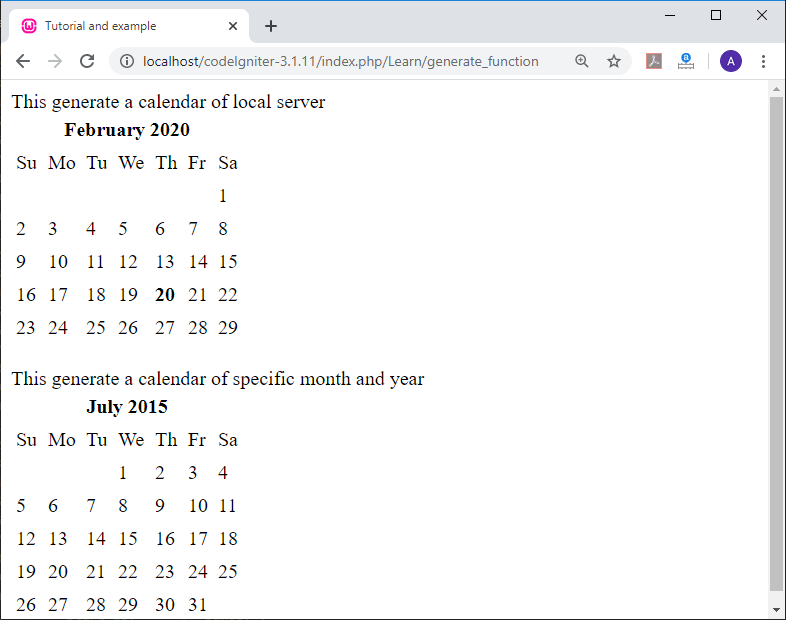
     echo "This generate a calendar of local server";
 echo $this->calendar->generate();
 echo "<br>";
 echo "This generate a calendar of specific month and year ";
 echo $this->calendar->generate(2015, 7);
 }
 }
 ?>
When you execute the above program in the localhost by invoking the URL localhost/CodeIgniter-3.1.11/index.php/Learn/generate_function, it returns the output, as shown below.
2.Passing data to the calendar cells:
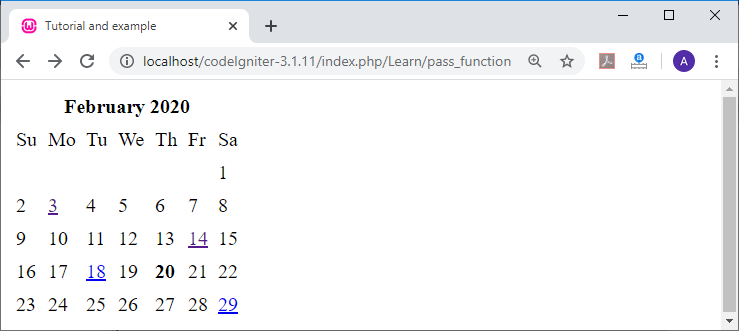
Using this function, you can add data to calendar cells. This function uses an associative array that includes days of links and the array data populated on calendar cells.
Example: Create a Learn.php file in application/controller folder and write the following program:
Learn.php
<?php
 class Learn extends CI_Controller {
 public function pass_function()
 {
  echo "<title> Tutorial and example </title>";
     $this->load->library('calendar');
     $data = array(
     29  => 'http://tutorialandeaxmple.com',
     18  => 'http://tutorialandeaxmple.com',
     3 => 'https://www.google.com',
     14 => 'http://localhost/codeIgniter-3.1.11/index.php/Learn/pass_function'
 );
 echo $this->calendar->generate(2020, 2, $data);
 }
 }
 ?>
When you execute the above program in the localhost by invoking the URL localhost/CodeIgniter-3.1.11/index.php/Learn/pass_function. It returns the output, as shown below.
3.Setting Calendar preferences:
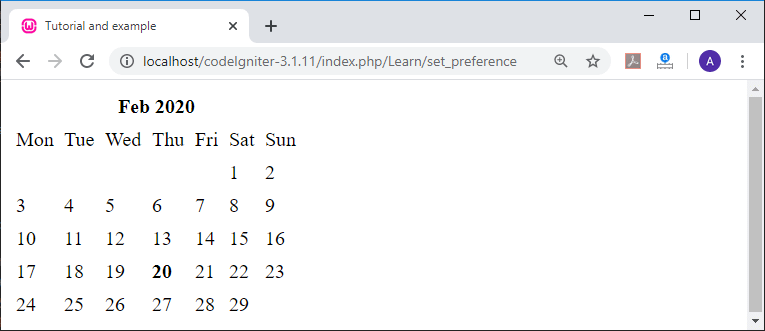
It enables you to set preferences in the calendar class, such as start date, day_type, month_type, etc.
There are seven preferences setting available in the calendar class.
| Preferences | Default | Options |
| local_time | time() | None |
| start_day | sunday | You can provide any week day (Sunday, Monday, Tuesday, etc.) |
| month_type | long | Short, long |
| day_type | abr | Short, long, abr |
| show_next_prev | FALSE | It takes Boolean value TRUE or FALSE |
| next_prev_url | Controller/method | It takes a URL |
| show_other_days | FALSE | It takes Boolean value TRUE or FALSE |
Example: Create a Learn.php file in application/controller folder and write the following program:
Learn.php
<?php
 class Learn extends CI_Controller {
 public function set_preference()
 {
     echo "<title> Tutorial and example </title>";
 $data = array(
     'start_day'    => 'monday',
     'month_type'   => 'short',
     'day_type'     => 'short'
 );
 $this->load->library('calendar', $data);
 echo $this->calendar->generate();
 }
 }
 ?>
When you execute the above program in the localhost by invoking the URL localhost/CodeIgniter-3.1.11/index.php/Learn/set_preference, it returns the output, as shown below.
4.Showing Next/Previous Month links:
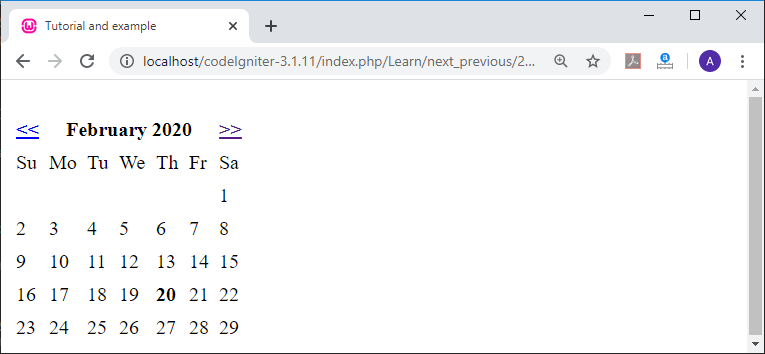
These methods allow you to dynamically create a forward or backward calendar through the use of Next and Previous links in the calendar class.
Example: Create a Learn.php file in application/controller folder and write the following program:
Learn.php
<?php
 class Learn extends CI_Controller {
 public function next_previous()
 {
     echo "<title> Tutorial and example </title>";
 $prefs = array(
     'show_next_prev'  => TRUE,
     'next_prev_url'   => 'http://localhost/codeIgniter-3.1.11/index.php/Learn/next_previous'
 );
 $this->load->library('calendar', $prefs);
 echo $this->calendar->generate($this->uri->segment(3), $this->uri->segment(4));
 }
 }
 ?>
When you execute the above program in the localhost by invoking the URL localhost/CodeIgniter-3.1.11/index.php/Learn/next_previous, it returns the output, as shown below.
5.Creating a calendar Template:
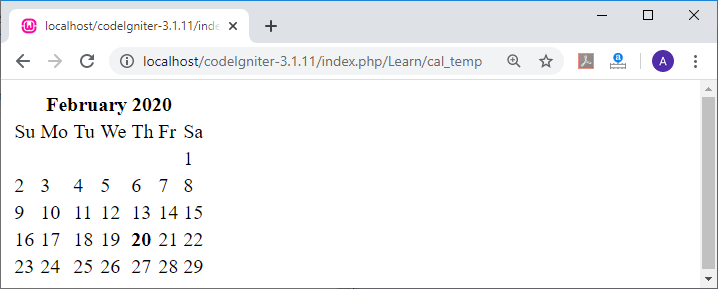
Using this method, you can get 100% control over the design of the calendar. It uses key-value pairs in array methods to design the calendar.
Example: Create a Learn.php file in application/controller folder and write the following program:
Learn.php
<?php
 class Learn extends CI_Controller {
 public function cal_temp()
             {
         $datas['template'] = array(
             'heading_row_start' => '<tr class = "heading_row_start">',
             'table_open'           => '<table class = "calendar">',
             'cal_cell_start'       => '<td class = "day">',
             'cal_cell_start_today' => '<td class = "today">'
     );
     $this->load->library('calendar', $datas);
     echo $this->calendar->generate();
     }
 }
 ?>
When you execute the above program in the localhost by invoking the URL localhost/CodeIgniter-3.1.11/index.php/Learn/cal_temp, it returns the output, as shown below.
Class References
- generate(): It is used to create a calendar in a CodeIgniter application.
Syntax
generate ([ $year = ‘’ [, $month = ‘’ [, $data = array() ] ] ]);
Parameters:
$year: It defines the year.
$month: It takes month name in numeric.
$data: It defines the data that shown in the calendar cells.
2.get_month_name() : As the function defines, it is used to display the month name on a string format by taking a numeric value.
Syntax
get_month_name ($month);
$month: It takes a numeric number to pass in get_month_name ().
3.get_day_names(): It is used to generate the days' name based on the type provided in the function. It contains three options to display the days' names, such as ‘long’, ‘short’, and ‘abr’. By default, it uses the ‘abr’ option to display the name of the day in the calendar.
Syntax
get_day_names ($day_type = ‘’ );
$day_type: It defines the type of days name as short, long or abr.
4.adjust_date(): As the name suggests, this function is used to adjust the date and year provided by the user. And if the year provided is not valid, it automatically increases or decreases the month and year.
Syntax
adjust_date ($month, $year);
It has two parameters:
$month: It takes month name in numeric.
$year: It takes year as a numeric.
5.get_total_days(): It is used to calculate the total number of days in a specified month.
Syntax
get_total_days ($month, $year);
It has two parameters:
$month: It takes month name in numeric.
$year: It takes Year as a numeric.
6.default_template(): As the name defines, it is used to set a default template in the calendar.
Syntax
default_template();
7.parse_template(): It is used to harvest data that is used in a template to display the calendar.
Syntax
parse_template();
Example: Create a Learn.php file in application/controller folder and write the following program:
Learn.php
<?php
 class Learn extends CI_Controller {
     public function calendar_function()
     {
  echo "<title> Tutorial and example </title>";
         $this->load->library('calendar');
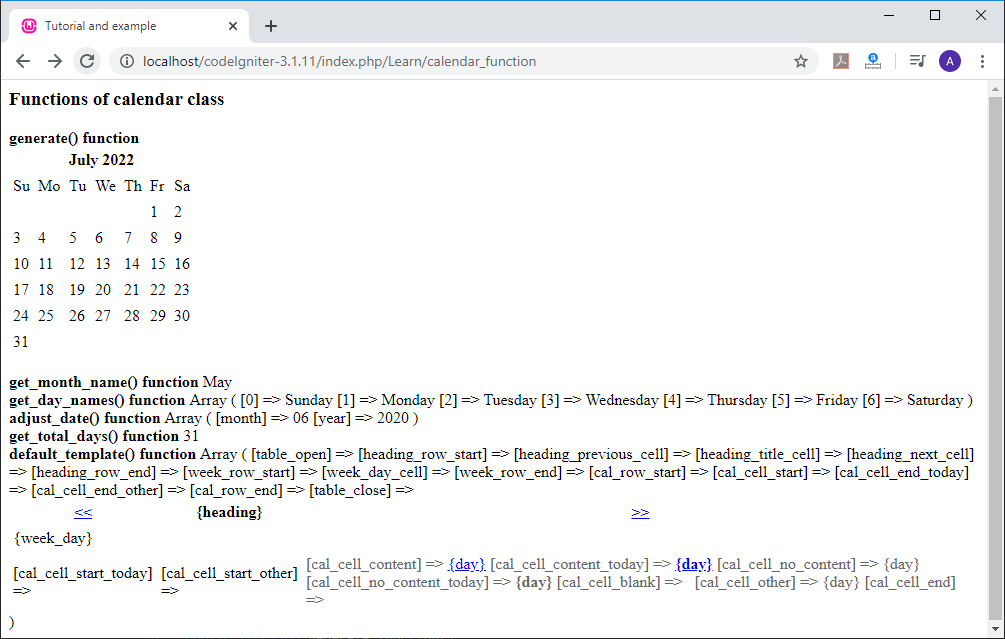
 echo "<h3>Functions of calendar class</h3>";
         $y = '2022';
         $m = '07';
         echo "<strong> generate() function </strong>".$this->calendar->generate($y,$m);
         echo "<br>";
         $month = '05';
         $data= $this->calendar->get_month_name($month);
         echo "<strong> get_month_name() function </strong>".$data;
         echo "<br>";
         echo "<strong> get_day_names() function </strong>";
         print_r($this->calendar->get_day_names('long'));
         echo "<br>";
         echo "<strong> adjust_date() function </strong>";
         print_r($this->calendar->adjust_date(18, 2019));
         echo "<br>";
         echo "<strong> get_total_days() function </strong>".$this->calendar->get_total_days(5, 2020);
         echo "<br>";
         echo "<strong> default_template() function </strong>";
        print_r($this->calendar->default_template());
     }
 }
 ?>
When you execute the above program in the localhost by invoking the URL localhost/CodeIgniter-3.1.11/index.php/Learn/calendar_function, it returns the output, as shown below.