×

Tableau Box Plot

How to Create Tableau Box Plot?

The box plot is the type of chart that shows the distribution of values along an axis. It is also known as a box-and-whisker plot. In the box plot, the Boxes represent the middle two quartiles or 50 percent of the data's distribution. The rest 50 percent of data on either side are denoted by lines that are also known as whiskers, to indicate all points within 1.5 times the interquartile range, which is all aspects within 1.5 times the width of the adjoining box, or all positions at the maximum extent of the data.

Creating a Box Plot

To create a box plot, the following are the steps.
  • Connect to the excel data source.
  • Drag and drop the dimension (here we have taken direction), to the Columns shelf.
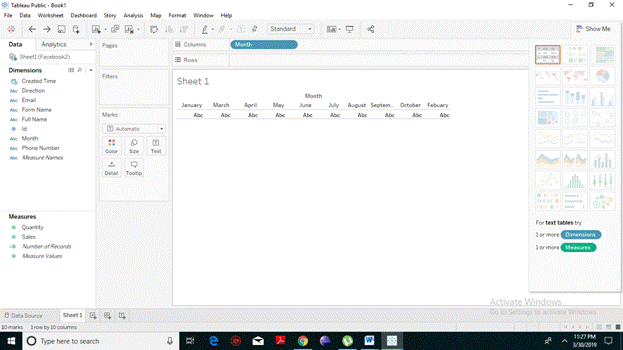
How to Create Tableau Box Plot?  
  • Similarly, drag and drop the Discount measure to Rows Shelf. You will notice that Tableau has automatically created a vertical axis and displays a bar chart which is the default chart type.
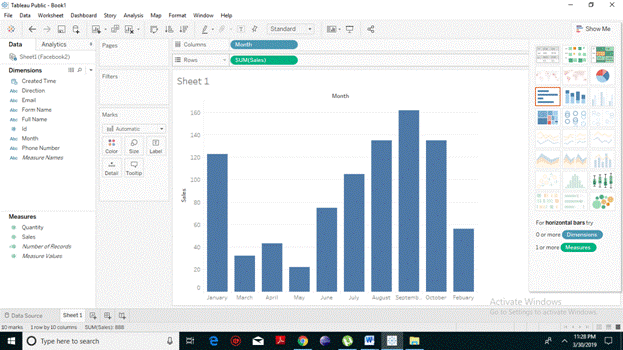
How to Create Tableau Box Plot?  
  • For creating a box plot, click on Show Me toolbar present on the right-hand side of the pane, then select the box-and-whisker plot chart type.
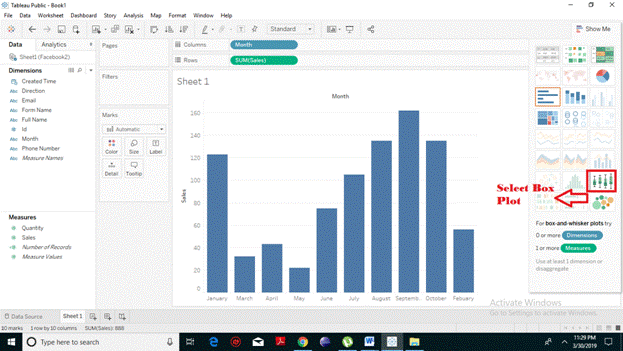
How to Create Tableau Box Plot?  
  • From the following screenshot, you will notice that Tableau has automatically reassigned the Direction dimension from the Columns shelf to the Marks card. When you changed the chart type to a box plot, Tableau itself determines what the individual marks in the plot should represent.But you can easily drag the dimension to the column shelf.
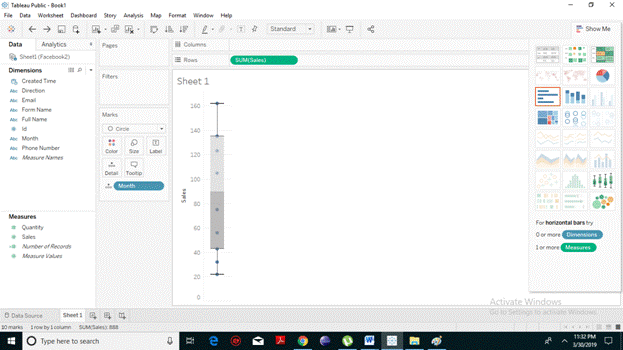
How to Create Tableau Box Plot?  
  • Now, Drag the dimension Direction from the Marks card back to Columns shelf. You will notice the chart has changed to flattened horizontal lines box plots. This happens when the box plots are based only on a single mark.
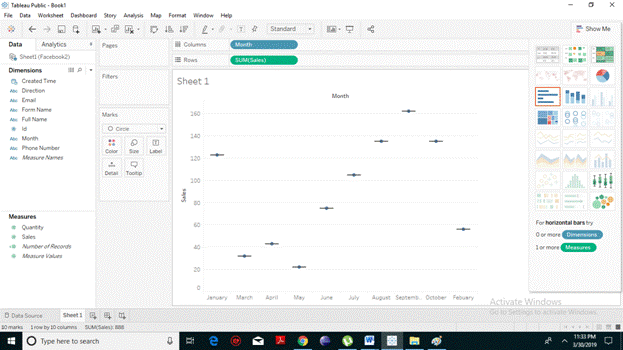
How to Create Tableau Box Plot?

Disaggregate the Data

To disaggregate the data, you need to turn off the aggregation command because data is aggregated by default in Tableau. When you disaggregate the data, then instead of a single mark for each column in the view, you can see a range of marks, one for each row in your data source.  The following are the steps to disaggregate the data:
  • Select the Analysis toolbar present at the top.
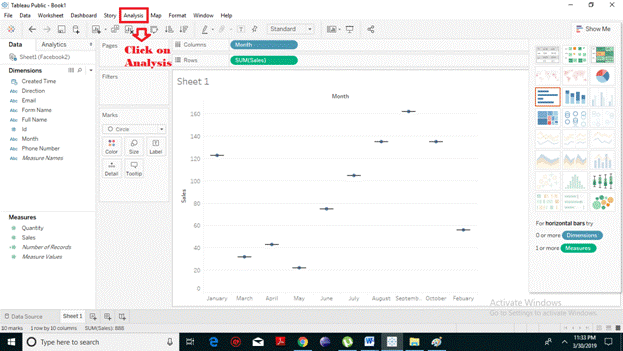
How to Create Tableau Box Plot?
  • A drop-down menu will appear. Click on Aggregate Measures. The first time you select this command, it disaggregates the data.
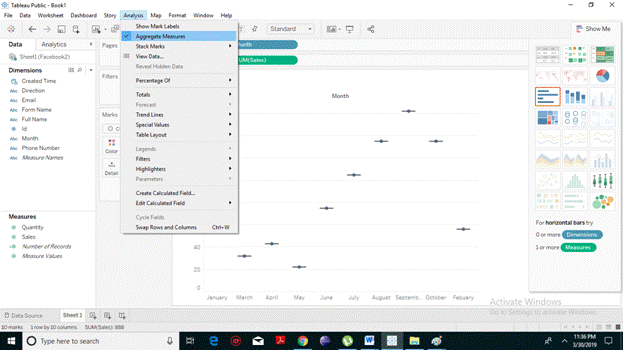
How to Create Tableau Box Plot?
  • From the resulting screenshot, you can notice that instead of representing a single mark for each there is range of marks.
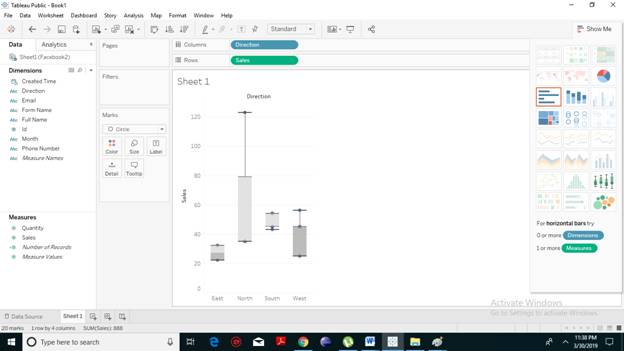
How to Create Tableau Box Plot?

Box Plot with Two Dimensions

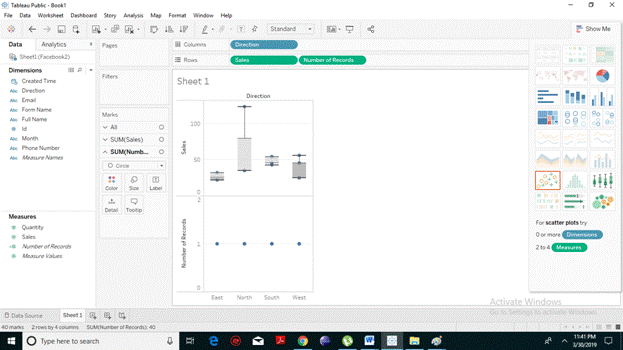
To create two dimensional Box Plot you need to drag, take one measure with two dimensions. By pulling and adding another dimension to the Column shelf, you will find the following result representing a chart which shows the box plots for each region. How to Create Tableau Box Plot?  
Related Topics

Advantages and Disadvantages of Tableau

Advantages of Tableau Speed In the early stages, the Tableau software becomes popular because of its momentum with which it can analyze hundreds or even millions of rows and also gives...

3 minutes read.

Tableau Pie Chart

A pie chart is a type of graph in which a circle is divided into sectors to represent the data with different sizes and colors. In Tableau, the slices of...

1 minute read.

Tableau Connectivity with Excel

Connect Excel to Tableau server Step by Step Let’s get started by connecting tableau to a data source:   Step: 1 Click on Microsoft Excel   Step: 2 Choose your excel file and open it...

1 minute read.

Introduction to Tableau

 What is Business Intelligence? Companies use business intelligence technologies to collect, analyze and present data to create actionable information. Today’s businesses are always seeking insights about their customers, products, and services. So...

3 minutes read.

Tableau Dimensions and Measures

How to Use Tableau Dimensions and Measures? Tableau is very built on the premises of drag and drops so let’s developed a simple visualization and talk about what each of these...

3 minutes read.

Tableau Date Functions

Tableau Date Functions with Examples Dates are crucial fields which are widely used in data analysis. Hence, Tableau provides a large number of inbuilt date functions that allows you to manipulate...

2 minutes read.

Tableau LOD Expressions

LOD Expressions LOD or Level of Detail expressions computes values at the data source and the visualization level instead of bringing all the data to the Tableau interface. However, LOD expressions...

3 minutes read.

Tableau Server Architecture Components

Tableau Architecture Explanation Tableau provides a scalable solution for the delivery and creation of web, mobile and desktop analytics. Tableau Server is an analytics platform that is used to level up thousands...

2 minutes read.

Tableau Opening Page

Let’s have a look at the content of the tableau opening page: Step: 1 On your left you have the different things and you can connect to it. This is more...

1 minute read.

Tableau Bump Chart Tutorial

How to Create Tableau Bump Chart? A Bump Chart shows a comparison between two dimensions using a measure of your choice. It is a line chart which is used when we...

2 minutes read.

Tableau Filter card

Tableau add Filter Card to Dashboard Tableau provides a very significant feature of filtering of data for the ease of data analysis. Tableau allows the filtering of data of the fields,...

3 minutes read.

Tableau Waterfall Chart

How to Create Tableau Waterfall Chart? The waterfall chart is a type of chart that effectively displays how an initial value is incremented and decremented by a series of intermediate values,...

2 minutes read.

Tableau Bar Chart

How to Create Tableau Bar Chart? In Tableau, different kinds of bar charts can be produced by using dimensions and measures. A bar chart represents your data in rectangular bars with the...

2 minutes read.

Tableau Calculated Field

An Introduction to Calculated Fields in Tableau Calculated fields create new data field from the data that already exists in your data source. When you create a calculated field, you are...

2 minutes read.

Tableau Marks

Tableau Marks Tableau is an excellent tool to depict your data in the most attractive way. There is a particular part of the tableau workspace that’s specific to Mark’s called the...

3 minutes read.

Tableau Operator

Operator in Tableau An operator is referred to as a symbol that often tells the compiler to execute certain mathematical or logical operations. Tableau accepts the same operators which are used...

4 minutes read.

Tableau Bullet Chart

How to Create Tableau Bullet Chart? A bullet chart is a type of chart that is used to compare the value of one measure with another measure. It is a variation...

2 minutes read.

Difference between Tableau and Excel

Why is Tableau used instead of Excel? Tableau is a fastest growing and powerful data visualization tool which is primarily used in the Business Intelligence Industry whereas Microsoft Excel is a...

2 minutes read.

Tableau TreeMap

The treemap is a kind of chart that displays the data in nested rectangles and provides simple data visualization. In a treemap, the values of the dimension describe the structure...

2 minutes read.

Tableau file Extensions

Tableau data file Extensions The output of Tableau’s data analysis can be saved in different formats, which further can be distributed on different platforms. The various forms are reflected as different...

2 minutes read.
