
Types of Cloud

  • Public
  • Private
  • Hybird
  • Community
  1. Pubic cloud:-The-Public cloud permits the accessibility of systems and services efficiently to the general public. A public cloud is the one in which the services and infrastructure provides offsite over the internet. Examples: Amazon, IBM, Microsoft, Google, Rackspace, etc.
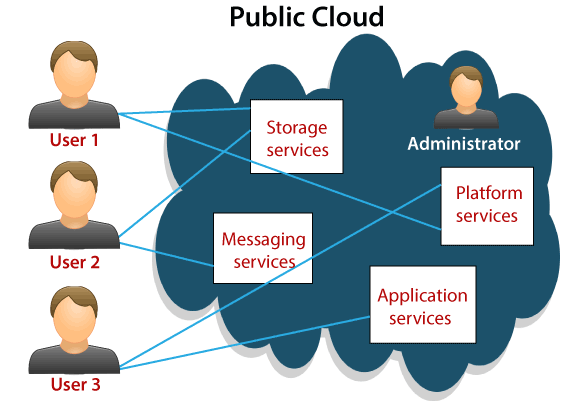
Types of Cloud

Advantage of Public Cloud

  • Low cost: - As compared to a private cloud, a public cloud is having low cost, because the public cloud shares the same resources with a large number of consumers.
  • Reliable:-The biggest advantage of the public cloud is that, it provides a large number of resources from different locations.  If any of the resources stop working, the public cloud can employee another one.
  • Flexible: -The Public cloud can be easily integrated or combined with private cloud; that’s why it is so flexible.
  • Location independent: - Public cloud assures the independency of location because the public cloud services are delivered through the internet.
  • High scalability:-Resources on the cloud are provided as per the demand from the pool of resources which, means resources can be scaled up or down according to the need of the user.

Disadvantages of Public Cloud

  • Low security: - Security is the major drawback of the public cloud. In the public cloud, data is present offsite and resources are shared publicly. So, in this way, the public cloud does not assure the high level of security.
  • Less customization: - Customization of services is not possible in public cloud.
  • Performance: - The performance of the network mainly depends on the speed of the internet.
  • Lacks proper control:- In the public cloud, there is no control over the data and infrastructure.

2) Private cloud: -“A private cloud is a cloud in which the services and infrastructure are maintained on a private network.” It allows accessibility of systems and services within the organization. Private cloud is specially operated only within a particular organization. It is managed by third party.
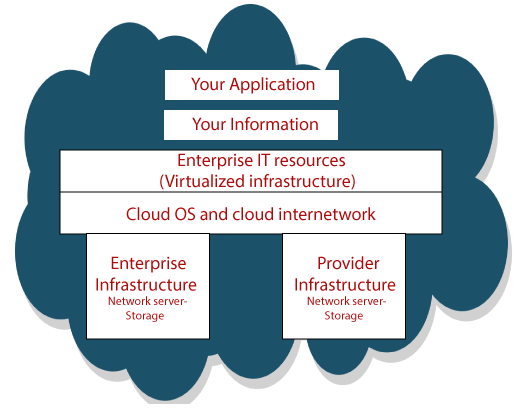
Advantages of Private Cloud

  • High security and privacy:- The major advantage of private cloud is security. Data on private cloud is secured because in private cloud resources are shared from distinct pool of resources.
  • More control:- Private cloud have more control on its resources more than the public cloud because it can be accessed only within the boundary of an organization.
  • Customization: - Customization is another advantage of private cloud. An important characteristic of private cloud is the level of customization they offer.

Disadvantages of Private Cloud

  • Restriction:- Private cloud can be accessed locally. It is very difficult to expand globally.
  • More cost:-The cost of private cloud is more than the public code.
  • Less scalability:-Private cloud is less scalable. It is scaled only within limited capacity of internal hosted resources.

3) Hybrid cloud:- Hybrid cloud is defined as “the mixture of public and private cloud.” Hybrid cloud is a combined cloud service utilizing both private and public clouds to perform different types of functions within the same organization.
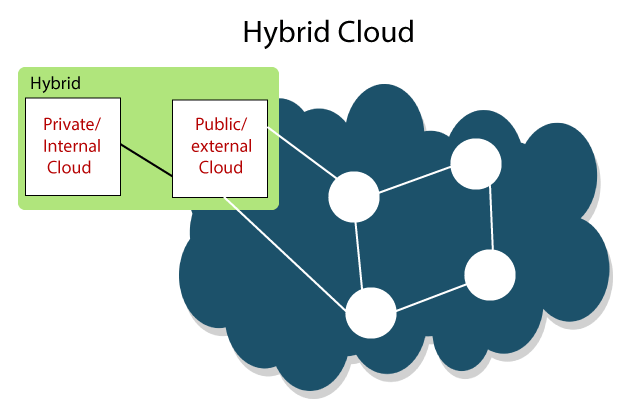
Advantages of Hybrid Cloud

  • Scalable:- Hybrid cloud is scalable because it provides the feature of both public as well as private cloud scalability
  • Flexible and secure:- Hybrid cloud provides secure resources due to private cloud and scalable resources due to public cloud.
  • Cost-effective:-The cost of a hybrid cloud is less as compared to private cloud.

Disadvantages of Hybrid Cloud

  • Networking issues:- Networking becomes complex in hybrid cloud because of the private and public cloud.
  • Infrastructure dependency
  • Possibility of security breach through a public cloud.

4) Community cloud: - In community cloud, system and services are allowed to be accessible by group of organizations. Cloud computing shares the infrastructure between various organizations from a specific community. Cloud computing is managed internally by organization or by a third party.
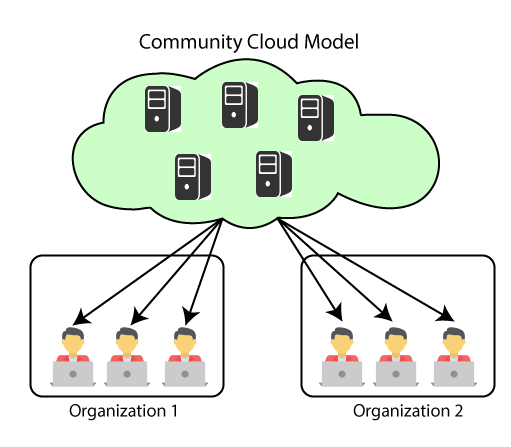
Advantages of Community Cloud

  • Cost effective:-Community cloud provides same advantage as that of private cloud at low cost.
  • Sharing among organization:-Community cloud offers an infrastructure to share cloud resources and competences among several organization.
  • Security:-Community cloud is more secure than the public cloud.

Disadvantages of Community Cloud

  • Not the right choice for every organization.
  • Slow adoption date.


Related Topics

Cloud Cube Model

What is Cloud Cube Model? The Cloud computing model is developed by the Jericho forum. It helps to classify the network of cloud-based on the four-dimensional factor: Internal/External, proprietary/open, de-perimeterized/...

4 minutes read.

What is Virtualization?

Virtualization in Cloud Computing Virtualization is a technique, which permits to share single physical instance of an application or resources among various organizations. Virtualization is the designing of a virtual variant of something,...

2 minutes read.

Cloud Computing Application

The applications of cloud computing are in almost every field like in business, entertainment, data storage, management, education, and art, etc. Let’s discuss the most widely used cloud computing applications in detail: Business applications:...

2 minutes read.

Infrastructure as a Service

Infrastructure as a Service (IaaS) Infrastructure as a Service (IaaS) provides the facility of essential resources like physical machines, virtual machines, virtual storage, etc. Infrastructure as a service (IaaS) is a form of cloud computing...

1 minute read.

Cloud Computing Strategy

Strategic Planning Before investing the money for cloud computing and developing cloud applications, the user must necessarily consider the needs, strategically plan them for business needs. Users must consider the following issues. Budget requirementPrivacy and data securityNeed...

3 minutes read.

Federated Cloud

What is Federated Cloud? In this modern era, we are using cloud storage widely for the storage of data. There are many different types of clouds. Many organizations provide the cloud...

3 minutes read.

Cloud Computing Management

Cloud providers are responsible for managing resources and their quality. Management of resources consists of several aspects of cloud computing such as load balancing performance, backups, deployment, capacity, etc. the management is vital to...

3 minutes read.

Azure Consumption Pricing Model

This part of Azure we will learn, needs some pre-requisite of CapEx vs OpEx. Consumption based pricing model: You're just charged for what you use, no more, no less.  Microsoft has provided various...

3 minutes read.

Cloud Computing for Business

Cloud Computing for Business Cloud computing plays a vital role in business. It offers a way for a business to organize and manage computer resources online. In recent years, the term cloud computing has...

3 minutes read.

Microsoft Azure Vocabulary

Cloud is a symbol, metaphor, and abstraction between your business and local computing infrastructure. While, there is globally distributed data centers, which will be owned by the firm and provided...

3 minutes read.

Cloud Computing Tutorial

Our tutorial provides you the basic and advanced concepts of cloud computing in detail. Our cloud computing tutorial is mainly designed for beginners and profession What is Cloud Computing? Cloud computing is a general...

3 minutes read.

Software as a Service SaaS Model

What is Software as a Service (SaaS) Model? Software as a Service (SaaS) is defined as a software delivery model where the application is hosted by the third-party provider and makes...

7 minutes read.

Future of Cloud Computing

Future of Cloud Computing Cloud computing and cloud storage platforms have been discussed a lot in recent years, such as Amazon Web Service and google cloud. Various newcomers are also added in this space,...

3 minutes read.

What is Cloud Cube Model ?

The Cloud computing model is developed by the Jericho forum. It helps to classify the network of cloud-based on the four-dimensional factor: Internal/External, proprietary/open, de-perimeterized/ perimeterized, and insourced/ outsourced.    Now discuss the cloud cube...

4 minutes read.

Grid Computing vs Cloud Computing

What is Grid Computing? Grid computing is a distributed structure of a large number of computers connected to solve a complicated problem. In grid computing, servers and computers run independently and are loosely...

4 minutes read.

Cloud Computing Storage

Cloud Storage is a service that permits to store data on the offsite storage system, and it is managed by third-party and is made accessible by a web service API. Storage Devices Storage devices are of...

2 minutes read.

Server Virtualization

Server virtualization means partitioning of a physical server into various virtual servers. It is used to expand the server resources. In the server virtualization, the resources of the server are hidden from the...

2 minutes read.

Cloud Computing Technologies

Cloud Computing Technologies  Technologies used in cloud computing are: Grid ComputingService-Oriented Architecture (SOA)VirtualizationUtility Computing Grid Computing: - Grid computing is a distributed structure of large number of computers connected to solve a complicated problem. In grid computing, servers...

6 minutes read.

Cloud Deployment Models

Cloud Deployment Model Because it's a virtual computing environment, there are various ways to deploy it, depending on the amount of data you want to store and who has access. Various Types...

7 minutes read.

Cloud Service Models

There are various types of cloud service model Software as a service (SaaS)Infrastructure as a service (IaaS)Platform as a service (PaaS)Identity as a service (IDaaS)Network as a service (NaaS) Let’s discuss each service model in detail. Software-as-a-service (SaaS):- SaaS is...

2 minutes read.