
×

Configure Password

  • Password configuration is an in-built feature of Cisco devices.
  • Each Cisco device uses a password to authenticate users for accessing the device and also provides security to the Cisco devices.

There are five types of the password which are used to secure Cisco routers:

  • Enable Password
  • Enable Secret
  • Auxiliary Password
  • Console Password
  • Telnet Password

Enable Password

Enable password allows security on a Cisco router when a user moves from User Exec Mode to Privileged Exec Mode.

You can set enable password in global configuration mode by using the command“enable password”:

configure-password

The above command creates the enable password.

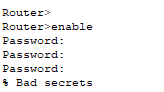
  • In case, if you entered an incorrect password three times, it will show the error "% Bad secrets."
configure-password 1
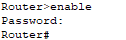
  • If you entered the correct password, it directly enters in the Privileged Exec Mode.
configure-password 2
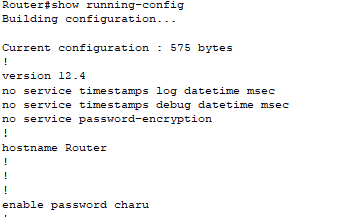
  • If you forget the password, use “show running-config” command to view the password.
configure-password 3

Enable Secret Password

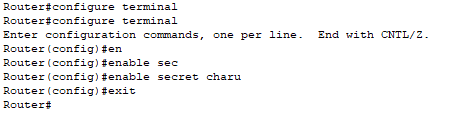
Enable secret password is quite similar to the Enable password. The main difference between Enable and Enable secret is the encryption. Enable password stored in a plain text format and is not encrypted. While in Enable secret password, a password is in encrypted form. Means Enable Secret Password is more secure as compare to Enable password.
configure-password 4

To see your encrypted password, use “show running-config” command.
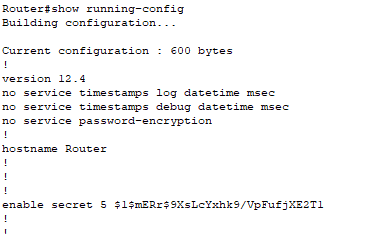
configure-password 5

Auxiliary Password

Auxiliary Password is configured into the “Global Configuration Mode” by typing the command “line aux ?”

configure-password 6

You can see <0-0> because there is only one port.
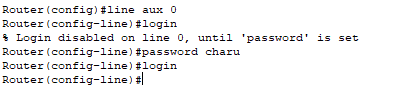
configure-password 7

Console Password

Console password is used on a network when multiple users have to access the router. It prevents an unauthorized user from accessing the router.

To set the console password, use “line console 0” command. We choose 0 because there is only one console port.
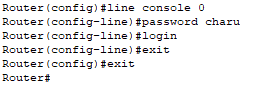
configure-password 8

Telnet Password

To configure Telnet password into the router or switch, first, move into the line configuration mode and use line vty0 4 command. Here ‘0 4’ means we are configuring the router for 0 to 4, i.e., total of 5 users can take router's telnet at the same time.
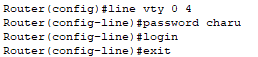
configure-password 9

There are three sub-portions of telnet which should be configured on to the router before you can access it through-

  1. An interface IP
  2. Enable or Enable secret
  3. Vtyconfig

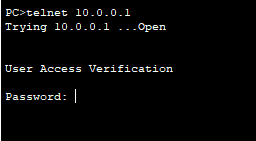
Let’s verify to take telnet of a router

Our topology is:
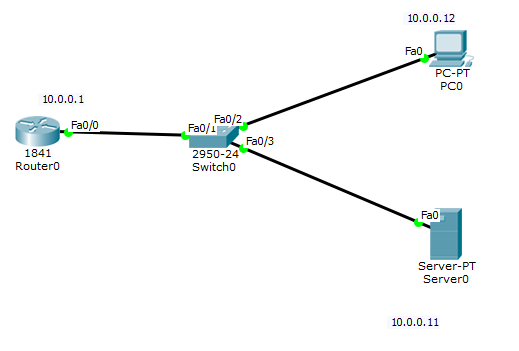
configure-password 10

First assign the IP address to router, PC, and server so that they can communicate with each other.
configure-password 11

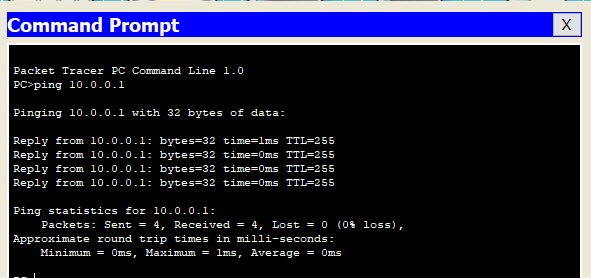
To verify the reachability to the router, we use ping command as below example:

Since we are able to ping, now try to take telnet to router from ping.
configure-password 12

Important Note:

Note 1: To provide the IP address to the device (PC or Server), first click on the device then click on IP configuration and provide IP address manually to the device.

Note 2: For ping, click on the device then go to command prompt and first type ping and then the IP address of the device that you want to access.


Related Topics

Internetworking Basics

What is a Network? A network is a group of two or more devices connected by some transmission media, i.e., cables. The purpose of designing a network is to enable the sharing...

4 minutes read.

Configuring Catalyst Switches

When you power on a new purchased Switch for the first time, it runs a series of Power-On Self Tests (POSTs) operations. A  POST is designed to verify the basic operations of the...

3 minutes read.

Verifying OSPF Configuration

There are several ways to verify OSPF configuration and operations, which are: show ip route commandshow ip ospf commandshow ip ospf database commandshow ip ospf interface commandshow ip protocol commandshow ip ospf neighbor commanddebugging ospf Consider the following topology –We...

2 minutes read.

EIGRP Basics

EIGRP stands for Enhanced Interior Gateway Routing Protocol. It is also called as the Hybrid routing protocol. It contains the features of both distance vector and link-state routing protocols. Characteristics of EIGRP There are the...

5 minutes read.

Banner config

Banner config The banner is a little pool which is used in Cisco systems and also in other systems like Unix, Linux and so no.It permits a text that is displayed when you log in a...

1 minute read.

CCNA Tutorial

What is CCNA? CCNA stands for Cisco Certified Network Associate. It is a certification course offered by Cisco. CCNA improves your understanding of the internet working and how different network topologies work...

3 minutes read.

Subnetting

Subnetting is the process of dividing a big network into many small networks. Suppose there is a company which has four departments like Development, HR, Marketing, and Testing. We don't want that all...

5 minutes read.

Configuring OSPF

Consider the topology given below – The initial IP configuration table is given below: Devices Interface IP address Router1 ...

2 minutes read.

Saving, Erasing, and Verifying Configuration

Saving Configuration Cisco device store commands information into two configuration files: running configurationstartup configuration running configuration In the running configuration, you can manually save the data from RAM to NVRAM by typing the copy running-config startup-config command. When you...

3 minutes read.

Components of a Cisco Router

The Internal Components of a Cisco Router Before troubleshoot and configure Cisco devices, it is necessary to know the major components of the Cisco routers. The given table shows all the internal components of...

2 minutes read.

Configure DHCP

 DHCP DHCP stands for Dynamic Host Configuration Protocol.It is a client server-based architecture which involves DHCP client and DHCP server.It is a messaging system for the communication between the DHCP server and DHCP client.It...

3 minutes read.

IP Addressing

IP Addressing IP Addressing is designed to allow hosts on a network to communicate with another host on a different network. There are two types of IP address: IPv4 IPv4 addresses are 32-bits long. It allows...

2 minutes read.

Switching

A switch is a network device which is used to connect multiple devices (routers, computers) inside the LAN (Local Area Network). It operates at Data Link Layer (Layer 2) of the OSI reference...

3 minutes read.

TCP/IP and DoD Model

Introduction to TCP/IP Model TCP/IP model was introduced in 1974. TCP/IP stands for Transmission Control Protocol/Internet Protocol. TCP/IP is an underlying communication protocol used by internet and commercial networks. The Transmission Control Protocol (TCP)...

10 minutes read.

Cisco IOS Overview

Cisco IOS Overview Cisco Internetwork Operating System (IOS) is a multitasking operating system which controls all functions of Cisco routers and switches. Willaim Yeager wrote the first IOS in 1986.It is used to allocate resources and manages...

2 minutes read.

Configure Password

Password configuration is an in-built feature of Cisco devices.Each Cisco device uses a password to authenticate users for accessing the device and also provides security to the Cisco devices. There are five types of the...

2 minutes read.

Types of Spanning Tree Protocol

There are the following types of Spanning Tree Protocol – 1. Common Spanning Tree (802.1D) A Common Spanning Tree (802.1D) standard is developed by IEEE which elects only one Root Bridge for the...

2 minutes read.

VLAN Basics

VLAN stands for Virtual Local Area Network. It is a logical group of networking devices that allows a single extended LAN to be partitioned into several separate LANs. The important feature of...

4 minutes read.

Data Encapsulation and De-Encapsulation

Data Encapsulation It is the process of adding headers and trailers to data. When a host transmits data to another device over a network, the data is encapsulated, with protocol information...

5 minutes read.

Spanning Tree Protocol (STP)

Spanning Tree Protocol (STP) is a Data link layer (layer 2) protocol that is used to discover and maintain a valid loop-free path for the switched network. It is also used to analyze...

4 minutes read.