
C++ int into String
Data type conversion is a standard editing process. You may need to convert variable from one type of data to another in a variety of situations. There are two ways to modify data types: ambiguous type conversion (producer-made) and transparent-type conversion (user-generated) (manual). Explicit type conversion is available in many editing languages with built-in methods.
If you convert data from a complete format to a character unit, you may use it to run multiple character unit functions. Compared to the function of a character unit, the performance of arithmetic can be difficult. Consider the following scenario for printing a current date.
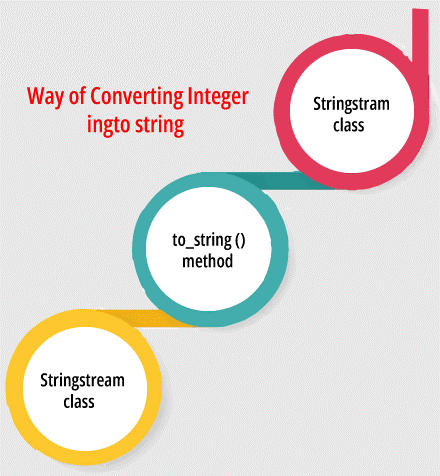
An integer can be converted to a string in three ways:
- The stringstream class is used.
- The to_string() function is used.
- By utilising boost.lexical cast.
Using stringstream class to convert an integer to a string.
A stream class defined in the header file is stringstream. It's a stream class that lets you execute input-output actions on strings.
The operations used to insert or extract data are as follows:
- It pulls data from the stream using the operator >>.
- The operator<< enters data into the stream.
Let's look at an example to better comprehend the notion of operators.
- The insertion operator puts 100 into the stream in the sentence below.
stream1 << 100;
- The >> extraction operator extracts data from the stream and saves it in the x variable in the sentence below.
stream1 >> x.
Example :
#include <iostream>
#include <bits/stdc++.h>
#include <stdlib>
#include<sstream>
using namespace std;
int main() {
  int x;
  cout<<"enter an integer value";
  cin>>x;
  stringstream sst;
  sst<<x;
  string a;
  sst>>a;
  cout<<"\n"<<"An integer value is : "<<x<<"\n";
  cout<<"String representation of an integer value is : "<<a;
}
OUTPUT:
Enter an integer value 14
An integer value is: 14
String representation of an integer value is : 14
........................................................
Process executed in 4553.34 seconds
Press any key continue.
Explanation:
We generated the k variable in the previous example and wish to convert its value to a string value. The stringstream class has been used to transform the x integer value into a string value. We can also do it the other way around, converting a string to an integer value using simply the stringstream class.
Let's look at an example to better grasp the notion of string to number conversion.
#include <iostream>
#include <bits/stdc++.h>
#include <stdlib>
#include<sstream>
using namespace std;
int main()
{
  string number ="99";
  stringstream sst;
  ss<<number;
  int x;
  sst>>x;
  cout<<"The value of the string is : "<<number<<"\n";
  cout<<"Integer value of the string is : "<<x;
}
OUTPUT:
The value of the string is : 99
Integer value of the string is : 99
.......................................................
Process executed in 0.33 seconds
Pres any key to continue.
Explanation
In the above program in C++, string number is 99 and string stream we are using to generate x variable.
Using to_string() method to convert an integer to a string.
The to_string () method takes a single integer and turns it to a string using the to_string () method.
Example:
#include <iostream>
#include <stdlib>
#include <bits/sdtc++.h>
#include<string>
using namespace std;
int main()
{
 int x=14;
 float y=16.2;
string str= to_string(x);
string str1= to_string(y);
cout<<"string value of integer x is :"<<str<<"\n";
cout<<"string value of y is : "<< str1;
return 0;
}
OUTPUT:
string value of integer x is : 14
string value of y is : 16.200000
.................................................
Process executed in 2834.44 seconds
Press any key to continue.
Explanation
In the above example in C++, we are using to_string method to convert integer number to string number which is a predefined number in C++.
Using boost.lexical method to convert an integer to a string.
The boost.lexical cast package includes a cast operator, boost.lexical cast, that transforms a string value to an integer or other data type value and back.
Let's look at an example of how to convert an integer to a string using boot.lexical method:
#include <iostream>
#include <bits/stdc++.h>
#include <stdlib>
#include <string>
#include <boost/lexical_cast.hpp>
using namespace std;
int main()
{
int x=12;
string str = boost::lexical_cast<string>(x);
cout<<"string value of integer x is :"<<str<<"\n";
}
OUTPUT:
string of integer x is : 12
...............................................
Process executed in 323.32 seconds
Press any key to continue.
Explanation:
Using the lexical cast () method, we transformed the value of the x variable into a string value in the above example.
Another Example:
#include <iostream>
#include <bits/stdc++.h>
#include <stdlib>
#include <string>
#include <boost/lexical_cast.hpp>
using namespace std;
int main()
{
string str="5678";
 int b = boost::lexical_cast<int>(str);
cout<<"Integer value of string str is : "<<b<<"\n";
}
OUTPUT:
Integer value of string str is : 5678
..............................................................
Process Executed in 427.36 seconds
Press any key to continue.
Explanation
We used the lexical cast () method to turn the string value into an integer value in the previous example.
One more example to understand better:
#include <boost/lexical_cast.hpp> // for lexical_cast()
#include <iostream>
#include <string> // for string
using namespace std;
int main()
{
// Declaring float
float f_value = 13.4;


// Declaring int
int x_value = 19;


// lexical_cast() converts a float into string
string strf = boost::lexical_cast<string>(f_value);


// lexical_cast() converts a int into string
string strx = boost::lexical_cast<string>(x_value);


// Displaying string converted numbers
cout << "The float value in string is : ";
cout << strf << endl;
cout << "The int value in string is : ";
cout << strx << endl;
return 0;
}
OUTPUT:
The float value in string is : 13.4
The int value in string is : 19
Explanation
In the above example in C++, Her we used a lexical_cast.hpp library which is a method of using lexical() to turn the string value into an integer.