
×

C++ array of Pointers

Array of Pointers:

In high-level programming languages like C++, the array's name is its pointer. The name of an array contains an address which is the address of an element. In C++, an array name is considered as the address of the first element. For instance, if we have an array of size 20, i.e., it can hold 20 values, then the value will contain the first element's address, i.e., array[0]. Thus, it can be said that name of the array is a pointer that holds the memory address of the first element present in the array.

In other words, an array of pointers is the array consisting of a variable of pointer types. This simply means that the pointer variable is addressing some other elements.

Syntax:     

int *pointer[N];

Here,

 *pointer = pointer array
 N = number of elements or size. 

Example: 

int *ptr[2];

Note: An array of the pointer can also be initialized by assigning the address of the variables like ptr[2] = &a.

There can be various ways of implementing an array of pointers. We may see its application in the arrays and similar data structures like linked-lists, strings, etc. The array of pointers comes in handy while implementing these programming practices efficiently.

To visualize how array of pointer work, let’s look at the below example:

 #include <iostream> 
 using namespace std; 
 int main() 
 { 
     int *pointer;   
     int array[10];
 cout << "Please enter the array elements :" <<endl; 
     for(int i=0;i<10;i++) 
     { 
         cin>>array[i]; 
     } 
     pointer = array;  
                       cout << "The value of *pointer :" <<*pointer<<endl; 
                       cout << "The value of *array :" <<*array<<endl; 
 Return 0;
 }  

Output:
C++ array of Pointers

Explanation:

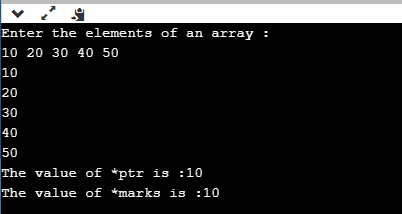
In the above code, we implemented the array of pointers concerning an array that stores elements given by the user. As already discussed above, the array of pointers has the address of the first element of the array. We get the first element printed on the console. Therefore, we declared an integer pointer and integer type array, and we assigned the array to the pointer by equating pointer = array. It means that both have the same element, and the element is at the first index. The values for *pointer and *array will be the same since we have assigned them to be equal.

Let us now look at how the arrays of pointers are used to implement strings using the example code given below.

String application of array pointers:

 #include<bits/stdc++.h>
 using namespace std;
 const int Maximum = 4;
 int main ()
 {
 const char *pandavs[Maximum] = { "Nakul", "Bhim", "Yudhishthir",
                          "Sehdev" };
    for (int i = 0; i < Maximum; i++)
 {
       cout << "Addresses of pandavs: [" << i << "] = ";
       cout << (pandavs + i) << endl;
 }
    return 0;
 } 

Output:
C++ array of Pointers

Explanation:

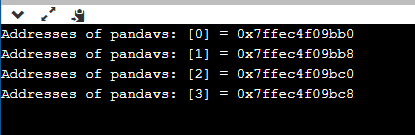
In the above code, we have initialized the value of the array pointer to the maximum. Here, the maximum value can be anything, but to keep it simple and sober, we fixed the size to 4. We have used the const keyword to preserve the value of the maximum to 4. The const keyword is used so that the maximum value or, say, the array's size doesn't increase more than 4. The next step is to loop over the array to access all the values' addresses through the pointer array associated. The addresses of each value are then printed on the console using an array of pointers.

Using array of pointers to print container values:

 #include<bits/stdc++.h>
 using namespace std;
 const int Maximum = 4;
 int main () {
    int  container[Maximum] = {10, 100, 200, 400};
    int *pointer[Maximum];
    for (int i = 0; i < Maximum; i++)
  {
       pointer[i] = &container[i];
   }
    for (int i = 0; i < Maximum; i++) {
       cout << "Value of container at position: [" << i << "] = ";
       cout << *pointer[i] << endl;
  }
    return 0;
 } 

Output:
C++ array of Pointers

Explanation:

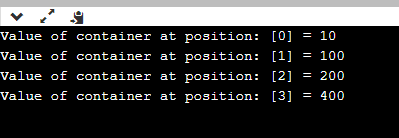
In the above code, we have used a similar approach as we used in the string example. The value of maximum is constant (cannot be changed) and is kept 4. The only difference in this example is that we have used the container address which holds the integers. The next step is to iterate over the elements and by doing that we now know that each element in ptr, now holds a pointer to an int value.

The output generated is the values at their respective indexes.

Let us now look at some of the applications of array of pointers.

Applications

  1. The array of pointers comes in handy while making embedded systems. A temperature measuring system may need to scale up different sensors so we can use an array of pointers to hold the memory address of each sensor so that it will be very easy to manipulate the sensor status.
  • An array of pointers allows us to numerically index a large set of variables.
  • We can separately make pointer variables that can point to different values or we can make one integer array of pointers to point all the values.

Related Topics

Hospital Management Project in C++

The following capabilities are required to build a hospital management project: These are as follows: hospitals' names, contact information, and lists of doctors and patients. Activities Supported Hospital Data Print Patients' data to...

4 minutes read.

How to create a library in C++

Before going on to the creation of a library, let’s understand its meaning. What is a library? In simple words, a library is a collection of numerous functions, methods, classes, header files...

7 minutes read.

C++ If

C++ Control Statement C++ control statement or decision-making statement is used to control the flow of program statement according to condition applied. C++ if Control Statement An if control statement in C++ is used to...

2 minutes read.

Free vs delete() in C++

Free vs delete() in C++ In this section, we will learn about the free() function and also create a C ++ program of the delete operator. What is free() Function in C++? In...

4 minutes read.

Binary Search in C++

The binary search in the C++ programming language will be discussed. By continually halves the array and then seeking specified items from a half array; binary search is a technique...

8 minutes read.

How to create a stack in C++

A stack is a data structure, which is of linear type. A specific order has to be followed while inserting and deleting the elements from the stack. Generally, stack follows...

5 minutes read.

Reverse function in C++

The function std::reverse() is included in the standard template library of C++. It takes in a beginning and ending iterator, reversing the order. To use the reverse statement, we need...

2 minutes read.

Pointers in C++

Pointers are a powerful feature in the C++ programming language, allowing developers to directly manipulate memory addresses and create more efficient and dynamic programs. However, pointers can also source various...

3 minutes read.

Web Development in C++

Before learning above C++ web development, we need to learn about CGI What is CGI? CGI stands for common gateway interface. CGI is a standard that tells us how the exchange of...

4 minutes read.

Destructor

Let’s discover the C++ destructor, virtual and pure virtual destructors, and when destructors are invoked and their rules in this lesson. Destructors : A member function that destroys an object is known as...

5 minutes read.

How to Reverse a String in C++ using For Loop

For Loop: We may loop through a certain section of C++ code repeatedly using the for loop. A for loop is carried out if the test expression yields a true result. The...

4 minutes read.

C++ Pointer

Pointer is a derived data type that stores the address of a variable. A pointer is used for memory management and dynamic memory allocation. Pointer works on the address of data rather than...

2 minutes read.

C++ Deque

Definition: Deque or the Doubly ended queue is a data structure or operation performed under queue where insertion and deletion are allowed at both ends. A deque is an ordered collection of...

5 minutes read.

Print Table Using Do while Loop in C++

Multiplication Table In mathematics, a table is created by multiplying a certain number by all of the counting numbers, i.e., 1, 2, 3, 4, 5, 6, and so on. It is...

4 minutes read.

Palindrome Number Program in C++

A palindrome number is one that is the same when it is reversed. Palindrome numbers include 22, 33, 44, 55, 66, 77, 88, and 99. Algorithm for Palindrome Numbers Get the user's...

4 minutes read.

How to create the Processes with Fork in C++

 In this article, we are going to explain the different methods that help us to create processes with a fork(). There are two methods to do so. These methods are...

2 minutes read.

Reverse a String using Stack C/C++

Reverse the given string using stack. To turn "tutorialandexample" into "elpmaxednalairotut," for instance. Here is a straightforward stack-based technique for reversing strings. Algorithm: 1) Make a stack that is empty. 2) Push each character...

3 minutes read.

Upcasting and Downcasting in C++

With the help of various examples in the C++ programming language, this section will cover Upcasting and Downcasting. Upcasting and downcasting, on the other hand, are two forms of object typecasting. Consider...

3 minutes read.

Armstrong Number using Do-While Loop in C++

What is Do-While Loop? An iterative loop that checks the condition at the end.The Do-While loop can be used whenever a test condition is specific, as the control enters the loop...

4 minutes read.

C++ STL (Standard Template Library)

Introduction C++ is a flexible type and general proposed programming language. So we need a standard library that supports C++. C++ STL (Standard Template Library) is a collection of templates that...

6 minutes read.