
×

Singleton Design Pattern in C++

Singleton is similar to the global variable. Singleton helps to have only one object of its kind and provides only single access. One of the key features of the singleton pattern is that it provides a global point of access to the class and ensures it has only one instance. Similar to a global variable that can be used everywhere in the program, a singleton object can be used anywhere.

Advnatges of Singleton:

Similar to global variables, singleton has similar advantages and disadvantages.

  1. Provides control over the object's allocation and destruction.
  2. This method provides thread-safe access to the global state of an object.
  3. Pollutes the global namespace by preventing it from being used.

We need a static member, private constructor, and static function in the singleton design pattern class.

Example:

#include <iostream>
using namespace std;
class Singleton {
    private:
   static Singleton *instance;
   int data;
   protected:
    Singleton() {
      data = 0;
   }
   public:
   static Singleton *getInstance() {
      if (instance==0){
      instance = new Singleton;
      }
      return instance;
   }
   int getData() {
      return this -> data;
  }
   void setData(int data) {
      this -> data = data;
   }
};


Singleton *Singleton::instance = 0;
int main(){
   Singleton *s = s->getInstance();
   Singleton *s1 = s1->getInstance();
   Singleton *s2 = s2->getInstance();
   cout << s->getData() << endl;
   s->setData(100);
    s1->setData(200);
    s2->setData(300);
   cout << s->getData() << endl;
    cout << s1->getData() << endl;
    cout << s2->getData() << endl;
   return 0;
}

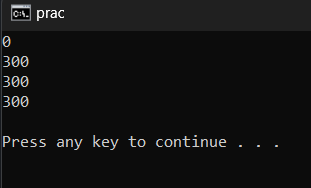
Output:
C++ singleton design pattern

Explanation:

In the above code, we have created a class called as singleton. In the code, we have created an object for the singleton class by checking that no other object is created for the class. In the code, three instances, s,s1, and s2, are created for the class singleton. We have set the data values as 100 for the s instance and 300 for the s1 instance, and 300 for s2. Here we have set different values, for instance, but the output is similar. This is due to the properties of the singleton design pattern, which is that it can create only one instance for the class


Related Topics

Pthreads or POSIX Threads in C++

The thread API for C/C++ is implemented by pthreads or POSIX threads. It enables the multithreading system, which enables parallel and distributed processing, and the creation of new concurrent process...

3 minutes read.

C++ Interfaces

The C++ programming language provides programmers with a variety of capabilities and functions. It also enables object-oriented programming, which is essential while working on a project. It will be simple...

7 minutes read.

C++ Polymorphism

Polymorphism refers to the fact that something exists in several forms. Polymorphism, in simple terms, is the ability of a message to be presented in several formats. A real-life example...

4 minutes read.

C++ program to read string using cin.getline()

C++ program to read string using cin.getline() C++ getline() is a standard library feature for reading a string or a line from an input source. A getline() function gets characters from...

3 minutes read.

C++ Prime number program

In this lesson, you'll learn how to verify whether a given number is a prime number or not in C++, and you'll obtain code to do it. What is the definition...

3 minutes read.

Single level Inheritance

Inheritance is a fundamental element of C++’s Object-Oriented Programming (OOP). It allows a class (called the derived class) to inherit characteristics and attributes from another class (called the base class)....

5 minutes read.

Inheritance Program in C++

What is Inheritance? Inheritance is the ability of a class to inherit traits and properties from another class. One of the most crucial aspects of Object-Oriented Programming is inheritance. The ability or...

9 minutes read.

Print Table Using Do while Loop in C++

Multiplication Table In mathematics, a table is created by multiplying a certain number by all of the counting numbers, i.e., 1, 2, 3, 4, 5, 6, and so on. It is...

4 minutes read.

How to create a library in C++

Before going on to the creation of a library, let’s understand its meaning. What is a library? In simple words, a library is a collection of numerous functions, methods, classes, header files...

7 minutes read.

std::distance() in C++

The primary function of std::distance is to facilitate the total number of elements if we have two iterators. It is defined inside the header files. It has both magnitude and...

2 minutes read.

Object Slicing in C++

In this article, we will learn about Object slicing. When an object from a derived class is assigned to an object from a base class in C++, these extra attributes...

3 minutes read.

Stringstream in C++ and its applications

In this tutorial, we will explore what the stringstream in C++ is. We will also learn its application. What is stringstream? With the aid of a stringstream, user can read from a...

2 minutes read.

C++ Functions

In other programming languages, a function is referred to as a process or a subroutine. We can design functions to execute any task. A function can be used repeatedly. It...

5 minutes read.

Single dimension array

C++ Array An array is a collection of data (elements) of the same data types. The elements of an array are allocated in contiguous memory allocation. Elements of the array are accessed through...

1 minute read.

C++ Program to find the product array puzzle

Write a C++ program to form a product array from arr[] where product[i] is the product of all the array elements except arr[i]. Example Input: arr[]  = {10, 3, 5, 6,...

6 minutes read.

C++ Aggregation

C++ Aggregation Definition: In C++, aggregation is a process in which one class (as an entity reference) defines another class. It provides another way to reuse the class. It represents...

4 minutes read.

Top 14 Best Free C++ IDE (Editor & Compiler) for Windows in 2024

Bjarne Stroustrup created the all-purpose object-oriented programming language C++. To develop C++ programs, there are various Integrated Development Environments (IDE) that offer prewritten code templates. These programs automatically modify the...

6 minutes read.

C++ Call by Reference

Call by Reference is a C++ method for passing arguments to a function that enables us to pass the actual memory address of the parameter rather than a copy of...

4 minutes read.

swap() function in C++

Swap() function: swap() function in C++: swap() function is a pre-define function in c++ present in STL( Standard template library ). It is used to swap two numbers. It takes two mandatory...

6 minutes read.

OOPs Concepts in C++

C++ Object-Oriented Programming Concepts C++ uses the concept of object-oriented programming. Object Oriented Programming has some prominent features: Object Class Data abstraction Encapsulation Polymorphism Inheritance Message passing Object An object is the basic unit...

2 minutes read.